

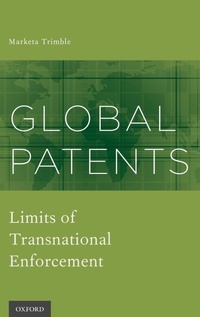
Global Patents
Limits of Transnational Enforcement
1st Edition
Published on 8. March 2012
Book
Hardback
248 pages
978-0-19-984068-7 (ISBN)
Description
In today's globalized economy, many inventors, investors and businesses want their inventions to be protected in many, if not most, countries. However, there currently exists no single patent that will protect an invention globally, and despite the attempts in international treaties to simplify patenting, the process remains complicated, lengthy, and expensive. Furthermore, the necessity of enforcing patents in multiple countries exists without any possibility of concentrating in one location any parallel proceedings that concern the same invention and the same parties, thus making the maintenance of parallel patents infeasible.
Global Patents: Limits of Transnational Enforcement, by Marketa Trimble, explains why the absence of a "global patent" persists, and discusses the events in the 140-year history of patent law internationalization that have shaped the solutions. The author analyzes the ways in which patent holders attempt to mitigate the problems that arise from the lack of global patent protection. One way is to concentrate enforcement in one court of patents granted in multiple countries, which makes the enforcement of the patents less costly and more consistent. Another way is to attempt to use the litigation of a single country patent to reach acts that occur outside the country, which can mitigate the lack of patent protection outside the country. However, both the concentration of proceedings and extraterritorial enforcement suffer from significant limitations. Global Patents explains these limitations and presents the solutions that have been proposed to address them. The book includes a thorough comparative analysis of the extraterritorial features of U.S. and German patent laws, and original statistics on U.S. patent litigation. Based on a comprehensive treatment of the various facets of transnational enforcement challenges, the author proposes the next stage of patent law internationalization.
Global Patents: Limits of Transnational Enforcement, by Marketa Trimble, explains why the absence of a "global patent" persists, and discusses the events in the 140-year history of patent law internationalization that have shaped the solutions. The author analyzes the ways in which patent holders attempt to mitigate the problems that arise from the lack of global patent protection. One way is to concentrate enforcement in one court of patents granted in multiple countries, which makes the enforcement of the patents less costly and more consistent. Another way is to attempt to use the litigation of a single country patent to reach acts that occur outside the country, which can mitigate the lack of patent protection outside the country. However, both the concentration of proceedings and extraterritorial enforcement suffer from significant limitations. Global Patents explains these limitations and presents the solutions that have been proposed to address them. The book includes a thorough comparative analysis of the extraterritorial features of U.S. and German patent laws, and original statistics on U.S. patent litigation. Based on a comprehensive treatment of the various facets of transnational enforcement challenges, the author proposes the next stage of patent law internationalization.
Reviews / Votes
"Patent infringement is global, but patent law is national. Global Patents explores the problems this causes for cross-border patent enforcement. A must-read for anyone who hopes to enforce a patent overseas, or to enforce a judgment once they win."--Mark A. Lemley, William H. Neukom Professor, Stanford Law School
"In Global Patents, Marketa Trimble tells the story of how the territorial split of inventions into national patents encumbers the exercise and enforcement of rights, spanning such diverse issues as private international law, notions of infringement (including secondary liability), and empirical research, all based on a rich and thorough comparative analysis of US and German legal history and case law. In short, it is a scholarly work that is also highly
relevant for practice."
--Prof. Annette Kur, Max-Planck-Institute for Intellectual Property and Competition Law, Munich
"Marketa Trimble's very readable contribution to ongoing debates about the protection of patents on a global basis puts the proposition that patent law is territorial in historical, theoretical, and comparative context. Global Patents offers a comprehensive treatment of the topic, canvassing developments in public and private international law, tackling both acquisition and enforcement, and paying critical attention to both theoretical and practical
questions. It is a valuable resource for scholars and practitioners alike."
--Graeme B. Dinwoodie, Professor of Intellectual Property and Information Technology Law,
University of Oxford
More details
Language
English
Place of publication
New York
United States
Target group
Professional and scholarly
-Academic audience (intellectual property law, patent law, international law, conflict of laws) -Legal practitioners who specialize in intellectual property law with an emphasis on patents -Inventors, investors, business people, and policy makers who are concerned about patent-related issues that intersect national borders
Dimensions
Height: 240 mm
Width: 161 mm
Thickness: 18 mm
Weight
534 gr
ISBN-13
978-0-19-984068-7 (9780199840687)
Copyright in bibliographic data and cover images is held by Nielsen Book Services Limited or by the publishers or by their respective licensors: all rights reserved.
Schweitzer Classification
Other editions
Additional editions
E-Book
02/2012
1st Edition
OUP eBook
€61.99
Available for download
Person
Marketa Trimble is an associate professor at the William S. Boyd School of Law at the University of Nevada Las Vegas. Previously, she studied at Stanford Law School, where she received her second doctoral degree. In her research, she focuses on intellectual property and issues at the intersection of intellectual property and private international law/conflict of laws. Professor Trimble has conducted comparative and empirical work in her areas of interest using her extensive research experience from law schools in the U.S. and Europe, her expertise from the European Union and European governments, and her foreign language abilities.
Content
Preface ; Introduction ; Chapter 1: Global Protection for Inventions ; 1.1 The Territorial Limitations of Patent Protection ; 1.2 A World Patent ; 1.3 Parallel Patents ; 1.3.1 Obtaining a Patent Abroad ; 1.3.2 Obtaining Patents in Multiple Countries ; 1.4 Obstacles to Global Protection ; Chapter 2: Enforcing Parallel Patents ; 2.1 Private International Law Solutions to the Problem of Enforcement of Parallel Patents ; 2.1.1 The Brussels Regime ; 2.1.2 Mitigating the Problems Created By the Brussels Regime ; 2.1.3 The Hague Convention ; 2.1.4 The ALI Principles ; 2.1.5 The CLIP Principles ; 2.1.6 Obstacles to Implementation of Private International Law Solutions ; 2.1.6.1 Foreign Patents in U.S. Courts ; 2.1.6.2 Foreign Patents in German Courts ; 2.2 Institutional Solutions to the Problem of Enforcement of Parallel Patents ; 2.3 Obstacles to the Enforcement of Parallel Patents ; Chapter 3: Protecting an Invention outside the Protecting Country ; 3.1 Inventions in the Means of Transportation ; 3.2 Inventions in Transit and Border Measures ; 3.3 Offers to Sell ; 3.4 Inventions Assembled Abroad from Components from a Protecting Country ; 3.5 Acts Abroad Contributing to Infringements in the Protecting Country ; 3.6 Acts in Multiple Locations ; 3.7 Limits on the Protection of an Invention outside the Protecting Country ; Chapter 4: Limits of Protection under the Law of the Protecting Country ; 4.1 Foreign Parties before U.S. Courts ? A Quantitative View of the Enforcement Problem ; 4.1.1 Patent Cases Filed in 2004 and 2009 ; 4.1.2 Cases Involving Foreign Parties ; 4.1.3 Cases Involving at Least One Foreign Defendant and Cases with Only Foreign Defendants ; 4.1.4 Some Observations about the Data on the Involvement of Foreign Defendants in Patent Litigation in 2004 and 2009 ; 4.2 Injunctions ; 4.2.1 Cross-Border Injunctions in U.S. Courts ; 4.2.2 Cross-Border Injunctions in Europe ; 4.2.3 Challenges to Enforcement of Injunctions Abroad ; 4.2.3.1 Enforcement of an Injunction ; 4.2.3.2 Enforcement of a Contempt Order ; 4.3 Monetary Relief ; 4.3.1 Punitive Damages ; 4.3.2 Ongoing Royalties ; 4.4 Additional Requirements of Recognition and Enforcement ; 4.5 Obstacles to Enforcement Abroad ; Conclusions ; Bibliography ; Table of Cases ; Index