

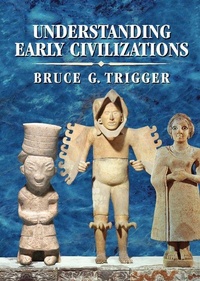
Understanding Early Civilizations
A Comparative Study
Published on 5. May 2003
Book
Hardback
774 pages
978-0-521-82245-9 (ISBN)
Description
This book offers the first detailed comparative study of the seven best-documented early civilizations: ancient Egypt and Mesopotamia, Shang China, the Aztecs and adjacent peoples in the Valley of Mexico, the Classic Maya, the Inka, and the Yoruba. Unlike previous studies, equal attention is paid to similarities and differences in their sociopolitical organization, economic systems, religion, and culture. Many of this study's findings are surprising and provocative. Agricultural systems, technologies, and economic behaviour turn out to have been far more diverse than was expected. These findings and many others challenge not only current understandings of early civilizations but also the theoretical foundations of modern archaeology and anthropology. The key to understanding early civilizations lies not in their historical connections but in what they can tell us about similarities and differences in human behaviour.
Reviews / Votes
'This work is a milestone in the scientific study of sociocultural evolution ... I know of no other comparative study of early civilizations of similar scope, depth, and originality.' Philosophy of the Social Sciences 'Its comprehensiveness of theme, readiness to pursue profound if difficult and sometimes not readily answerable questions, and impressive control of a wide range of sources, reflect distinguished thought and dedicated effort ... a major achievement.' The International History Review 'Understanding Early Civilizations is the capstone of Trigger's remarkable archaeological career. This is, quite simply, a definitive work.' Brian Fagan, University of California, Santa Barbara 'Trigger's study is monumental and magisterial. It is a work to treasure and digest for years to come.' Philip L. Kohl, Wellesley College 'The latest in Trigger's impressive string of ground-breaking works ... An astounding work of scholarship.' Boyce Richardson 'This book is an extraordinary undertaking and a great achievement ... It provides an accessible introduction to the problems and priorities of cross-cultural comparison and approaches to early civilisations.' AntiquityMore details
Language
English
Place of publication
Cambridge
United Kingdom
Target group
Professional and scholarly
Dimensions
Height: 250 mm
Width: 175 mm
Thickness: 46 mm
Weight
1490 gr
ISBN-13
978-0-521-82245-9 (9780521822459)
Copyright in bibliographic data and cover images is held by Nielsen Book Services Limited or by the publishers or by their respective licensors: all rights reserved.
Schweitzer Classification
Other editions
Additional editions
Book
04/2007
Cambridge University Press
€49.50
Shipment within 15-20 days
E-Book
05/2003
1st Edition
Cambridge University Press
€27.99
Available for download
E-Book
05/2003
Cambridge University Press
€23.49
Available for download
Person
Bruce G. Trigger is James McGill Professor in the Department of Anthropology at McGill University. He received his Ph.D. from Yale University and has carried out archaeological research in Egypt and the Sudan. His current interests include the comparative study of early civilizations, the history of archaeology, and archaeological and anthropological theory. He has received various scholarly awards, including the prestigious Prix Leon-Gerin from the Quebec government, for his sustained contributions to the social sciences. He is an honorary fellow of the Society of Antiquaries of Scotland and an honorary member of the Prehistoric Society (UK). His numerous books include The Children of Aataentsic: A History of the Huron People to 1660 (1976), A History of Archaeological Thought (Cambridge 1989), Early Civilizations: Ancient Egypt in Context (1993), and Sociocultural Evolution (1998), and The Cambridge History of the Native Peoples of the Americas, Volume 1 (Cambridge 1996), co-edited with Wilcomb E. Washburn.
Content
Part I. Introduction: 1. Rationalism and relativism; 2. Comparative studies; 3. Defining 'early civilization'; 4. Evidence and interpretation; Part II. Sociopolitical Organization: 5. Kingship; 6. States: city and territorial; 7. Urbanism; 8. Class systems and social mobility; 9. Family organization and gender roles; 10. Administration; 11. Law; 12. Military organization; 13. Sociopolitical constants and variables; Part III. Economy: 14. Food production; 15. Land ownership; 16. Trade and craft specialization; 17. Appropriation of wealth; 18. Economic constants and variables; Part IV. Cognitive and Symbolic Aspects: 19. Conceptions of the supernatural; 20. Cosmology and cosmogony; 21. Cult; 22. Priests, festivals, and the politics of the supernatural; 23. The individual and the universe; 24. Elite art and architecture; 25. Literacy and specialized knowledge; 26. Values and personal aspirations; 27. Cultural constants and variables; Discussion: 28. Culture and reason; 29. Conclusion; References; Index.