

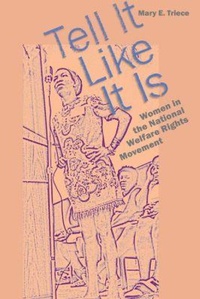
Tell It Like It Is
Women in the National Welfare Rights Movement
Published on 30. March 2013
Book
Hardback
176 pages
978-1-61117-153-2 (ISBN)
Description
In Tell It Like It Is, Mary E. Triece brings to light a lesser known yet influential social movement of the late 1960s and early 1970s-the welfare rights movement, led and run largely by poor black mothers in the National Welfare Rights Organization (NWRO). Her study combines theory and critical analysis to explore rhetorical strategies and direct actions women employed as they argued for fair welfare legislation in both formal policy debates and in the streets. Triece focuses on how welfare recipients spoke for themselves in forums often marked by widely held stereotypes.
Triece explains the influence of racism on welfare legislation throughout the early 1900s and explores how welfare recipients cultivated agency while challenging stereotypes such as the ""welfare cheat"" and the ""welfare mother."" To illuminate her study, Triece uses historical documents including pamphlets, flyers, position statements, and convention materials. She examines the official newspaper of the NWRO, the Welfare Fighter, and draws on the congressional testimonies of welfare recipients, providing the first in-depth look at the ways that these women represented themselves in this formal political forum.
Tell It Like It Is presents an interdisciplinary study touching on communication, rhetoric, politics, feminist theory, and the intersections of race, class, gender, and sexuality. It also engages in ongoing scholarly debate regarding language, knowledge, reality, and the potential for social change. Triece contributes to each of these disciplines as she explores how a marginalised and beleaguered people managed to mobilise a nationwide movement.
Triece explains the influence of racism on welfare legislation throughout the early 1900s and explores how welfare recipients cultivated agency while challenging stereotypes such as the ""welfare cheat"" and the ""welfare mother."" To illuminate her study, Triece uses historical documents including pamphlets, flyers, position statements, and convention materials. She examines the official newspaper of the NWRO, the Welfare Fighter, and draws on the congressional testimonies of welfare recipients, providing the first in-depth look at the ways that these women represented themselves in this formal political forum.
Tell It Like It Is presents an interdisciplinary study touching on communication, rhetoric, politics, feminist theory, and the intersections of race, class, gender, and sexuality. It also engages in ongoing scholarly debate regarding language, knowledge, reality, and the potential for social change. Triece contributes to each of these disciplines as she explores how a marginalised and beleaguered people managed to mobilise a nationwide movement.
More details
Language
English
Place of publication
South Carolina
United States
Product notice
sewn/stitched
Cloth over boards
Illustrations
6 illustrations
Dimensions
Height: 229 mm
Width: 152 mm
Thickness: 13 mm
Weight
413 gr
ISBN-13
978-1-61117-153-2 (9781611171532)
Copyright in bibliographic data and cover images is held by Nielsen Book Services Limited or by the publishers or by their respective licensors: all rights reserved.
Schweitzer Classification
Person
Mary E. Triece is a professor in the School of Communication at the University of Akron, USA. She is the author of Protest and Popular Culture: Women in the U.S. Labor Movement, 1894-1917 and On the Picket Line: Strategies of Working-Class Women during the Depression, winner of the Bonnie Ritter Book Award. Triece has also published in Critical Studies in Mass Communication, Rhetoric Society Quarterly, Communication Studies, Women's Studies in Communication, and the Western Journal of Communication.