

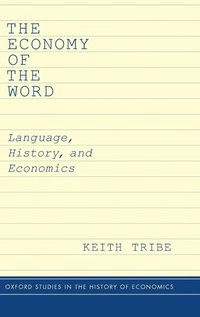
The Economy of the Word
Language, History, and Economics
Published on 2. April 2015
Book
Hardback
352 pages
978-0-19-021161-5 (ISBN)
Description
It was only in the sixteenth century that texts began to refer to the significance of "economic activity"---of sustaining life. This was not because the ordinary business of life was thought unimportant, but because the principles governing economic conduct were thought to be obvious or uncontroversial. The subsequent development of economic writing thus parallels the development of capitalism in Western Europe. From the seventeenth to the twenty-first century there has been a constant shift in content, audience, and form of argument as the literature of economic argument developed. This book proposes that to understand the various forms that economic literature has taken, we need to adopt a more literary approach in economics specifically, to adopt the instruments and techniques of philology. This way we can conceive the history of economic thought to be an on-going work in progress, rather than the story of the emergence of modern economic thinking. This approach demands that we pay attention to the construction of particular texts, showing the work of economic argument in different contexts. In sum, we need to pay attention to the economy of the word. ^l The Economy of the Word is divided into three parts. The first explains what the term economy has meant from Antiquity to Modernity, coupling this conceptual history with an examination of how the idea of national income was turned into a number during the first half of the twentieth century. The second part is devoted to Adam Smith's Wealth of Nations, considering first the manner in which Smith deals with international trade, and then the way in which the book was read in the course of the nineteenth century. Part III examines the sources used by Karl Marx and Leon Walras in developing their economic analysis, drawing attention to their shared intellectual context in French political economy.
Reviews / Votes
He keeps it lively, not arcane; he is witty and rarely tedious. The prose is interesting and engaging for its readers better educated. This is a book that can be read by non-specialists for enlightenment, enjoyment, and pleasure. * Cecil E. Bohanon (Ball State University), Journal of the History of Economic * Keith Tribe has a message for the economics profession: words matter.... The prose is interesting and engaging for both the specialist and generalist, and is bound to leave all its readers better educated. * Journal of the History of Economic 01/07/2017 * Keith Tribe shows that if one pays careful attention to how they were written and how they were read, much can still be learned from re-reading some well-known texts. This book offers a refreshing and original approach to the history of economics. * Roger E. Backhouse, University of Birmingham * This powerful book offers a learned, penetrating, and beautifully-written account of the creation and development of economics. Sensitive to the issue of the language of political economy, Keith Tribe identifies the key turning points in his reading of the canonical texts of the discipline such as Adam Smith's Wealth of Nations, Karl Marx's Das Kapital, and Leon Walras's Elements d'economie pure and shows how these works shaped modern economics. The Economy of the Word is simply one of the best books ever written on the historiography of economics. * Loic Charles, University of Paris 8 and Ined * Keith Tribe has always been the most interdisciplinary and wide-ranging of scholars, and The Economy of the Word is a compelling challenge to traditional research in every area of economic thought. The result is a remarkable set of essays from Smith to Marx to Walras and after. The Economy of the Word should be read by every intellectual historian and everyone interested in the relationship between social science and history. * Richard Whatmore, University of St. Andrews * In an age where the rhetoric of economics has a higher premium than almost anything else, he is surely right to say that the languages of economics and of the economy have actually been cheapened, and our understanding of what we are talking about when we use those languages correspondingly weakened. Showing us again the riches and surprises to be found in the real history of economic ideas and its various idioms and iterations, Tribe's exemplary detective work clarifies the meaning behind the words of the past, and in so doing becomes full of interest for thinking about the possibilities of understanding the present. * Duncan Kelly, University of Cambridge * excellent * Christopher Brooke, Max Weber Studies *More details
Series
Language
English
Place of publication
New York
United States
Target group
College/higher education
Dimensions
Height: 240 mm
Width: 161 mm
Thickness: 25 mm
Weight
751 gr
ISBN-13
978-0-19-021161-5 (9780190211615)
Copyright in bibliographic data and cover images is held by Nielsen Book Services Limited or by the publishers or by their respective licensors: all rights reserved.
Schweitzer Classification
Other editions
Additional editions
E-Book
02/2015
1st Edition
OUP eBook
€94.99
Available for download
E-Book
02/2015
1st Edition
OUP eBook
€94.99
Available for download
Person
After doing his graduate work in the social and political sciences in Cambridge during the 1970s, Keith Tribe spent most of the first half of the 1980s in Germany studying the development of eighteenth-century German economics, and developing an interest in the work of Max Weber. During this period he was also a member of the Department of Economics at Keele University, where he taught until leaving university employment in 2002. Since then he has worked as a professional rowing coach and as a translator.
Content
1. Introduction: Not a Method, But a Grammar ; PART I: WORD AND NUMBER ; 2. The Word: Economy ; 3. The Measurement of Economic Activity and the Growth Metric: Constructing National Income in Britain, 1907-1941 ; PART II: READING - RECEPTION ; 4. Reading "Trade" in The Wealth of Nations ; 5. Das Adam Smith Problem and the Origins of Smith Scholarship ; PART III: ECONOMICS AS THE THEORY OF INDUSTRIAL SOCIETY ; 6. Karl Marx's Critique of Political Economy: A Critique ; 7. "The Price is Right": le prix juste and the Algebra of Action ; 8. Sources, Arguments, and Prospect