

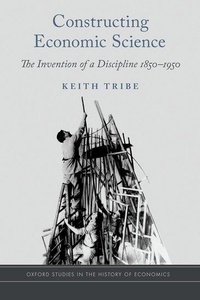
Constructing Economic Science
The Invention of a Discipline 1850-1950
Published on 27. April 2022
Book
Hardback
440 pages
978-0-19-049174-1 (ISBN)
Description
An accessible account of the role of the modern university in the creation of economics
During the late nineteenth century concerns about international commercial rivalry were often expressed in terms of national provision for training and education, and the role of universities in such provision. It was in this context that the modern university discipline of economics emerged. The first undergraduate economics program was inaugurated in Cambridge in 1903; but this was merely a starting point.
Constructing Economic Science charts the path through commercial education to the discipline of economics and the creation of an economics curriculum that could then be replicated around the world. Rather than describing this transition epistemologically, as a process of theoretical creation, Keith Tribe shows how the new "science" of economics was primarily an institutional creation of the modern university. He demonstrates how finance, student numbers, curricula, teaching, new media, the demands of employment, and more broadly, the international perception that industrializing economies required a technically-skilled workforce, all played their part in shaping economics as we know it today. This study explains the conditions originally shaping the science of economics, providing in turn a foundation for an understanding of the way in which this new language transformed public policy.
During the late nineteenth century concerns about international commercial rivalry were often expressed in terms of national provision for training and education, and the role of universities in such provision. It was in this context that the modern university discipline of economics emerged. The first undergraduate economics program was inaugurated in Cambridge in 1903; but this was merely a starting point.
Constructing Economic Science charts the path through commercial education to the discipline of economics and the creation of an economics curriculum that could then be replicated around the world. Rather than describing this transition epistemologically, as a process of theoretical creation, Keith Tribe shows how the new "science" of economics was primarily an institutional creation of the modern university. He demonstrates how finance, student numbers, curricula, teaching, new media, the demands of employment, and more broadly, the international perception that industrializing economies required a technically-skilled workforce, all played their part in shaping economics as we know it today. This study explains the conditions originally shaping the science of economics, providing in turn a foundation for an understanding of the way in which this new language transformed public policy.
Reviews / Votes
Tribe's book is a worthy recipient of the best book prize of the European Society for the History of Economic Thought (2022) and will be a work of reference on the formation of economics as an academic discipline for years to come. * Harro Maas, Oeconomia * Keith Tribe's new book is fascinating. * Fabio Masini, Roma Tre University * Constructing Economic Science is a valuable and empirically rich book that explores the making of economics as an academic discipline in the UK in the period 1850-1950. * H-Soz-Kult * Constructing Economic Science is an outstanding monograph. * Rodger Middleton, University of Bristol, Journal of Modern History * This is a book that should bear a health and safety advisory: in places it gives the reader a jolt and different people will be jolted at different moments. * Tiago Mata, Wiley * I highly recommend this book to all economists who are interested in how our subjecthas come to be studied and taught up to the present day. * Susan Howson, The European Journal of the History of EconomicThought *More details
Series
Language
English
Place of publication
New York
United States
Target group
Professional and scholarly
Product notice
sewn/stitched
Cloth over boards
Dimensions
Height: 239 mm
Width: 161 mm
Thickness: 34 mm
Weight
772 gr
ISBN-13
978-0-19-049174-1 (9780190491741)
Copyright in bibliographic data and cover images is held by Nielsen Book Services Limited or by the publishers or by their respective licensors: all rights reserved.
Schweitzer Classification
Other editions
Additional editions
E-Book
11/2021
OUP eBook
€84.49
Available for download
E-Book
11/2021
OUP eBook
€84.49
Available for download
Person
Keith Tribe is an economic historian and independent scholar with a long-standing interest in language and translation. He is currently a Senior Research Fellow in History at the University of Tartu and teaches history of economics at the University of Birmingham. He is the author of The Economy of the Word (OUP, 2015).
Content
Acknowledgements
Note to Readers
PART I. From Public Knowledge to Institutional Discourse
1. Discourse and Discipline
2. Re-organising the University: The German Model, the American Version of that Model, and the University of London
3. The Social Mediation of Economic Discourse
PART II. The Cambridge Moment
4. The Moral Sciences Tripos and Cambridge Political Economy
5. The Cambridge Tripos in Economic and Political Science: Structure and Outcome
6. What is "Marshallianism"?
PART III. Alternative Histories
7. Why not Oxford?
8. The Unrealised Prospect of Historical Economics
PART IV. Commerce and Economics
9. Models for Commercial Education: The USA, France, and Germany
10. Higher Commercial Education in Great Britain and Ireland - Late Start, Early Dissolution
11. Commerce and Economics at the London School of Economics
12. The Scientisation of Economics
13. Concluding Remarks
Appendices
Bibliography
Note to Readers
PART I. From Public Knowledge to Institutional Discourse
1. Discourse and Discipline
2. Re-organising the University: The German Model, the American Version of that Model, and the University of London
3. The Social Mediation of Economic Discourse
PART II. The Cambridge Moment
4. The Moral Sciences Tripos and Cambridge Political Economy
5. The Cambridge Tripos in Economic and Political Science: Structure and Outcome
6. What is "Marshallianism"?
PART III. Alternative Histories
7. Why not Oxford?
8. The Unrealised Prospect of Historical Economics
PART IV. Commerce and Economics
9. Models for Commercial Education: The USA, France, and Germany
10. Higher Commercial Education in Great Britain and Ireland - Late Start, Early Dissolution
11. Commerce and Economics at the London School of Economics
12. The Scientisation of Economics
13. Concluding Remarks
Appendices
Bibliography