

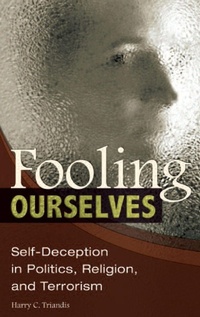
Fooling Ourselves
Self-Deception in Politics, Religion, and Terrorism
Published on 30. December 2008
Book
Hardback
276 pages
978-0-313-36438-9 (ISBN)
Description
Self-deception occurs because we often see the world the way we would like it to be, rather than the way it is. Our brains so long for things the way we want them, we might not even be aware we are fooling ourselves, explains author Harry Triandis, a widely known Professor Emeritus of Psychology. Across cultures and around the world, self-deception is a phenomenon that has subtle and profound effects on everyday life, explains Triandis, also former president of the International Association of Cross-Cultural Psychology. In this work, he not only explains how and why self-deceptions occur in three areas - politics, religion, and terrorism - but also how to recognize and reduce the frequency of fooling ourselves.
Insights here include consideration of personal and societal self-deceptions, as well as extensive understanding of how politics, ideologies, and religions can frame reality for each of us in such a way that it is, in our minds, warped so the stage is well-set for self-deception. This text will be of special interest to general readers drawn to politics and religion, as well as scholars of psychology, anthropology, and sociology.
Insights here include consideration of personal and societal self-deceptions, as well as extensive understanding of how politics, ideologies, and religions can frame reality for each of us in such a way that it is, in our minds, warped so the stage is well-set for self-deception. This text will be of special interest to general readers drawn to politics and religion, as well as scholars of psychology, anthropology, and sociology.
Reviews / Votes
A respected, internationally known expert on cross-cultural issues in psychology, Triandis (emer., Univ. of Illinois)offers here what is perhaps his most important piece of work. . . . Required reading for all concerned citizens. Summing Up: Highly recommended. * Choice * After first seeking to demonstrate the widespread nature of self-deception and its harmful effects on well-being, he
discusses cultural similarities and differences of individualist and collective self-deception, the ways that self-deception leads to poor information processing in politics, the self- deception of religion and the paradoxical human need for spirituality, the kinds of self- deception among terrorists, and means to decrease self-deception. * Reference & Research Book News *
More details
Series
Language
English
Place of publication
United States
Publishing group
Bloomsbury Publishing Plc
Target group
College/higher education
Professional and scholarly
Interest Age: From 7 to 17 years
Dimensions
Height: 240 mm
Width: 161 mm
Thickness: 19 mm
Weight
581 gr
ISBN-13
978-0-313-36438-9 (9780313364389)
Copyright in bibliographic data and cover images is held by Nielsen Book Services Limited or by the publishers or by their respective licensors: all rights reserved.
Schweitzer Classification
Other editions
Additional editions
E-Book
12/2008
1st Edition
Praeger Publishers Inc
€55.99
Available for download
Person
Harry C. Triandis is Professor Emeritus of Psychology at the University of Illinois and a Fellow of three divisions of the American Psychological Association. His awards include APA's Distinguished International Psychologist of the Year, Distinguished Lecturer of the Year, and the award for Distinguished Contributions to International Psychology. He also earned the American Psychological Society's prestigious James M. Cattell Award. Triandis is a former Guggenheim Fellow, Ford Foundation Faculty Fellow, Fellow of the American Association for the Advancement of Science, and Fellow of the International Association of Cross-Cultural Psychology. He also served as a Distinguished Fulbright Professor and as President for the Society for the Psychological Study of Social Issues. He has authored seven books, including Culture and Social Behavior, and edited the six-volume Handbook of Cross-Cultural Psychology.
Content
PREFACE
1. HOW CAN WE AVOID FOOLING OURSELVES
2. INFORMATION PROCESSING
3. FOOLING OURSELVES ACROSS CULTURES
4. FOOLING OURSELVES IN POLITICS
5. FOOLING OURSELVES IN RELIGION
6. FOOLING OURSELVES IN TERRORISM
7. WHAT CAN WE DO?
REFERENCES
1. HOW CAN WE AVOID FOOLING OURSELVES
2. INFORMATION PROCESSING
3. FOOLING OURSELVES ACROSS CULTURES
4. FOOLING OURSELVES IN POLITICS
5. FOOLING OURSELVES IN RELIGION
6. FOOLING OURSELVES IN TERRORISM
7. WHAT CAN WE DO?
REFERENCES