

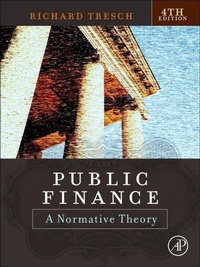
Public Finance
A Normative Theory
4th Edition
Published on 25. April 2022
Book
Paperback/Softback
568 pages
978-0-12-822864-7 (ISBN)
Description
Public Finance: A Normative Theory, Fourth Edition provides a classic text on the normative theory of government policy. This valuable and accessible resource covers the welfare aspects of public economics, with considerable coverage of European examples. The work presents detailed and comprehensive coverage of theoretical literature, empirical work, environmental issues, social insurance, behavioral economics and international tax issues. The book is organized logically, written in an engaging manner, and is both sufficiently rigid for use by those with PhDs in math and accessible to students less well trained in math.
Reviews / Votes
"...a detailed introduction to theoretical work on many of the core issues in contemporary public economics. Careful and comprehensive, it will provide readers with an ideal springboard to further research." --James M. Poterba, Mitsui Professor of Economics, Massachusetts Institute of Technology, Cambridge, USA"... outstanding in the breadth of its coverage, in the quality of exposition, and in the balance between theory and policy... especially good at melding newer approaches to the normative study of the public sector with traditional ones." --Robin Boadway, Queen's University in Kingston, Ontario, Canada
"I have hoped for years that Richard Tresch would revise his Public Finance text. This volume is well worth the wait. It is comprehensive, up-to-date, and very clearly written. It is a natural reading for a graduate course in public finance. It will also serve as a fine reference for specialists in the field." --Harvey Rosen, Department of Economics, Princeton University, Princeton, USA
More details
Edition
4th edition
Language
English
Place of publication
San Diego
United States
Publishing group
Elsevier Science Publishing Co Inc
Target group
College/higher education
Advanced undergraduate and graduate students studying public finance and public economics, and more broadly welfare economics.
Product notice
Paperback (trade)
Unsewn / adhesive bound
Illustrations
Approx. 200 illustrations
Dimensions
Height: 219 mm
Width: 281 mm
Thickness: 32 mm
Weight
1500 gr
ISBN-13
978-0-12-822864-7 (9780128228647)
Copyright in bibliographic data and cover images is held by Nielsen Book Services Limited or by the publishers or by their respective licensors: all rights reserved.
Schweitzer Classification
Other editions
Additional editions
E-Book
01/2022
4th Edition
Academic Press
€82.95
Available for download
Previous edition

Book
10/2018
3rd Edition
Academic Press
€68.19
The article will not be published
Person
Richard Tresch earned a bachelor's degree in 1965 from Williams College and a doctorate in
economics in 1973 from the Massachusetts Institute of Technology, where he was a teaching assistant
prior to joining Boston College. He joined the Boston College faculty in 1969, and during his
49-year-long career in the college, Dr. Tresch has served as the Chairman of the Department of
Economics, Director of Graduate Studies, and Director of Undergraduate Studies. Currently, he is
Professor Emeritus of Economics at Boston College. In 1996, he was chosen as the Massachusetts
Professor of the Year by the Carnegie Foundation for the Advancement of Teaching. He was one
of 585 national entrants in the foundation's U.S. Professors of the Year Program, which salutes
outstanding undergraduate instructors, with the award recognized as one of the most prestigious
honors to be bestowed on professors. Dr. Tresch, a member of the American Economic Association,
has served on the board of editors of the American Economic Review and contributed to the New
England Journal of Business and Economics and Public Finance. Moreover, he is the editor of a fourvolume
major reference work on public sector economics.
economics in 1973 from the Massachusetts Institute of Technology, where he was a teaching assistant
prior to joining Boston College. He joined the Boston College faculty in 1969, and during his
49-year-long career in the college, Dr. Tresch has served as the Chairman of the Department of
Economics, Director of Graduate Studies, and Director of Undergraduate Studies. Currently, he is
Professor Emeritus of Economics at Boston College. In 1996, he was chosen as the Massachusetts
Professor of the Year by the Carnegie Foundation for the Advancement of Teaching. He was one
of 585 national entrants in the foundation's U.S. Professors of the Year Program, which salutes
outstanding undergraduate instructors, with the award recognized as one of the most prestigious
honors to be bestowed on professors. Dr. Tresch, a member of the American Economic Association,
has served on the board of editors of the American Economic Review and contributed to the New
England Journal of Business and Economics and Public Finance. Moreover, he is the editor of a fourvolume
major reference work on public sector economics.
Content
Part I: Introduction: The Content and Methodology of Public Sector Theory
1. Introduction to Normative Public Sector Theory
2. A General Equilibrium Model for Public Sector Analysis
3. First-Best and Second-Best Analysis and the Political Economy of Public Sector Economics
Part II: The Theory of Public Expenditures and Taxation-First-Best Analysis
4. The Social Welfare Function in Policy Analysis
5. The Problem of Externalities--An Overview
6. Consumption Externalities
7. Production Externalities
8. Global Warming: An Application of Externality Theory
9. The Theory of Decreasing Cost Production
10. The First-Best Theory of Taxation
11. Applying First-Best Principles of Taxation-What to Tax and How
Part III: The Theory of Public Expenditures and Taxation: Second-Best Analysis
12. Introduction to Second-Best Analysis
13. The Second-Best Theory of Taxation in One-Consumer Economies with Linear Production Technology
14. The Second-Best Theory of Taxation with General Production Technologies and Many Consumers
15. Taxation Under Asymmetric Information
16. The Theory and Measurement of Tax Incidence
17. Expenditure Incidence and Economy-Wide Incidence Studies
18. The Second-Best Theory of Public Expenditures: Overview
19. Transfer Payments and Private Information
20. Social Insurance: Medical Care
21. Social Insurance: Social Security
22. Externalities in a Second-Best Environment
23. Decreasing Costs and the Theory of the Second-Best-The Boiteux Problem
24. General Production Rules in a Second-Best Environment
25. Behavioral Public Sector Economics
Part IV: Fiscal Federalism and International Public Finance
26. Optimal Federalism: Sorting the Functions of Government Within the Fiscal Hierarchy
27. Optimal Federalism: The Sorting of People within the Fiscal Hierarchy
28. The Role of Grants-in-Aid in a Federalist System of Governments
29. International Public Finance
1. Introduction to Normative Public Sector Theory
2. A General Equilibrium Model for Public Sector Analysis
3. First-Best and Second-Best Analysis and the Political Economy of Public Sector Economics
Part II: The Theory of Public Expenditures and Taxation-First-Best Analysis
4. The Social Welfare Function in Policy Analysis
5. The Problem of Externalities--An Overview
6. Consumption Externalities
7. Production Externalities
8. Global Warming: An Application of Externality Theory
9. The Theory of Decreasing Cost Production
10. The First-Best Theory of Taxation
11. Applying First-Best Principles of Taxation-What to Tax and How
Part III: The Theory of Public Expenditures and Taxation: Second-Best Analysis
12. Introduction to Second-Best Analysis
13. The Second-Best Theory of Taxation in One-Consumer Economies with Linear Production Technology
14. The Second-Best Theory of Taxation with General Production Technologies and Many Consumers
15. Taxation Under Asymmetric Information
16. The Theory and Measurement of Tax Incidence
17. Expenditure Incidence and Economy-Wide Incidence Studies
18. The Second-Best Theory of Public Expenditures: Overview
19. Transfer Payments and Private Information
20. Social Insurance: Medical Care
21. Social Insurance: Social Security
22. Externalities in a Second-Best Environment
23. Decreasing Costs and the Theory of the Second-Best-The Boiteux Problem
24. General Production Rules in a Second-Best Environment
25. Behavioral Public Sector Economics
Part IV: Fiscal Federalism and International Public Finance
26. Optimal Federalism: Sorting the Functions of Government Within the Fiscal Hierarchy
27. Optimal Federalism: The Sorting of People within the Fiscal Hierarchy
28. The Role of Grants-in-Aid in a Federalist System of Governments
29. International Public Finance