

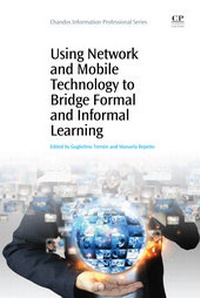
Using Network and Mobile Technology to Bridge Formal and Informal Learning
Published on 8. February 2013
Book
Paperback/Softback
248 pages
978-1-84334-699-9 (ISBN)
Description
An ever-widening gap exists between how students and schools use communication technology. Using Network and Mobile Technology to Bridge Formal and Informal Learning introduces new methods (inspired by 'pedagogy 2.0') of harnessing the potential of communication technologies for teaching and learning. This book considers how attitudes towards network and mobile technology (NMT) gained outside the school can be shunted into new educational paradigms combining formal and informal learning processes. It begins with an overview of these paradigms, and their sustainability. It then considers the pedagogical dimension of formal/informal integration through NMT, moving on to teachers' professional development. Next, the organizational development of schools in the context of formal and informal learning is detailed. Finally, the book covers the role of technologies supporting formal/informal integration into subject-oriented education.
Reviews / Votes
"All contributing authors are suitably qualified and are from a range of locations (US, UK, New Zealand, Europe). The chapters have a clear, logical flow, as does the text as a whole. Overall, this is highly recommended reading for educators keen to modernize techniques and pedagogy."--The Australian Library Journal, Vol. 63, No. 1, 2014 "...each individual reader of this book will find different sections more interesting or relevant to them personally and/or professionally...The chapters are all set within an established learning theory or pedagogical framework with references included for further reading."--Managing Information, Vol. 20, Issue 7/8, 2013More details
Series
Language
English
Place of publication
Witney
United Kingdom
Publishing group
Woodhead Publishing Ltd
Target group
Professional and scholarly
Weight
430 gr
ISBN-13
978-1-84334-699-9 (9781843346999)
Copyright in bibliographic data and cover images is held by Nielsen Book Services Limited or by the publishers or by their respective licensors: all rights reserved.
Schweitzer Classification
Other editions
Additional editions
E-Book
02/2013
Chandos Publishing (Oxford) Ltd
€58.95
Available for download
Persons
Guglielmo Trentin is senior researcher and project manager at the Institute for Educational Technology (ITD) of the Italian National Research Council (CNR). His studies have largely focused on the use of ICT in formal and informal learning. In this field he has managed several projects and scientific activities, developing technological applications and methodological approaches to support networked learning and knowledge sharing. He teaches Network Technology and Knowledge Flow at the University of Turin. He has published extensively on technology enhanced formal and informal learning. Manuela Repetto is researcher at the Institute for Educational Technology (ITD) of the Italian National Research Council (CNR). She earned her master degree in Adult Education at the University of Genoa and her Doctorate in Education and Cognition at the University of Venice. Her research interests include the definition of models and methods for studying virtual learning communities, and the use of web-based approaches to innovate learning and professional practices.
Content
List of figures and tables
List of abbreviations
Preface
About the contributors
Chapter 1: Tapping the motivational potential of mobile handhelds: defining the research agenda
Abstract:
Introduction
Educational technology and motivation: past, present and future
Proposed research strands for motivation and mobile handheld technology
Methodological considerations for research in mobile learning and motivation
Conclusion
Chapter 2: Using social network sites and mobile technology to scaffold equity of access to cultural resources
Abstract:
Introduction
Resources for learning: self-representation and writing in a school context
Key concepts
Using NMT for bridging social capital
Conclusions
Chapter 3: A mobile Web 2.0 framework: reconceptualising teaching and learning
Abstract:
Introduction
Background
Mobile Web 2.0 design framework: some examples of use
Mobile Web 2.0 framework: key aspects
Discussion
Conclusion
Chapter 4: Facing up to it: blending formal and informal learning opportunities in higher education contexts
Abstract:
Introduction
The blurring of formal and informal learning
A new model for the knowledge economy
Methodology
Discussion
Conclusion
Chapter 5: Networked lives for learning: digital media and young people across formal and informal contexts
Abstract:
Introduction
Networked lives
Learning lives
Methodology and research context
Three portraits
Learning identity
Interpretation of the portraits
Conclusion
Chapter 6: Network and mobile technologies in education: a call for e-teachers
Abstract:
Introduction
The key issues
From teacher to e-teacher
E-teacher education and professional development
Some conclusive reflections on e-teacher status
Chapter 7: Networked informal learning and continuing teacher education
Abstract:
Introduction
The Aladin project: general approach and activities
The Aladin project: results and attestations
Conclusion
Note
Chapter 8: A conclusive thought: the opportunity to change education is, literally, at hand
Abstract:
Introduction
Technology = opportunity
The Age of Mobilism = opportunity for K-12 to finally change
Scaffolding the 'demanded thinking'
Barriers to change
Stay tuned!
Index
List of abbreviations
Preface
About the contributors
Chapter 1: Tapping the motivational potential of mobile handhelds: defining the research agenda
Abstract:
Introduction
Educational technology and motivation: past, present and future
Proposed research strands for motivation and mobile handheld technology
Methodological considerations for research in mobile learning and motivation
Conclusion
Chapter 2: Using social network sites and mobile technology to scaffold equity of access to cultural resources
Abstract:
Introduction
Resources for learning: self-representation and writing in a school context
Key concepts
Using NMT for bridging social capital
Conclusions
Chapter 3: A mobile Web 2.0 framework: reconceptualising teaching and learning
Abstract:
Introduction
Background
Mobile Web 2.0 design framework: some examples of use
Mobile Web 2.0 framework: key aspects
Discussion
Conclusion
Chapter 4: Facing up to it: blending formal and informal learning opportunities in higher education contexts
Abstract:
Introduction
The blurring of formal and informal learning
A new model for the knowledge economy
Methodology
Discussion
Conclusion
Chapter 5: Networked lives for learning: digital media and young people across formal and informal contexts
Abstract:
Introduction
Networked lives
Learning lives
Methodology and research context
Three portraits
Learning identity
Interpretation of the portraits
Conclusion
Chapter 6: Network and mobile technologies in education: a call for e-teachers
Abstract:
Introduction
The key issues
From teacher to e-teacher
E-teacher education and professional development
Some conclusive reflections on e-teacher status
Chapter 7: Networked informal learning and continuing teacher education
Abstract:
Introduction
The Aladin project: general approach and activities
The Aladin project: results and attestations
Conclusion
Note
Chapter 8: A conclusive thought: the opportunity to change education is, literally, at hand
Abstract:
Introduction
Technology = opportunity
The Age of Mobilism = opportunity for K-12 to finally change
Scaffolding the 'demanded thinking'
Barriers to change
Stay tuned!
Index