

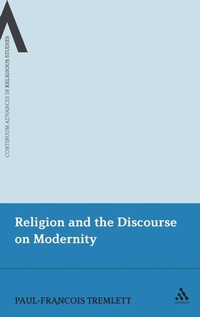
Religion and the Discourse on Modernity
Published on 8. January 2009
Book
Hardback
170 pages
978-0-8264-9823-6 (ISBN)
Description
The point of departure for this book is the debate about whether religious studies should privilege explanation or understanding. Engaging with contemporary scholarship in the field, Tremlett argues that the study of religions has always involved the conflation of facts and values and indeed has been structured in advance by the value-saturated discourse on disenchanted modernity. He argues that phenomenological and post-modern approaches to religions lack both theoretical and methodological coherence, and in their stead proposes a Marxist approach to religions that is at once empirical and informed by values pertaining to social justice, freedom and autonomy.
More details
Series
Language
English
Place of publication
London
United Kingdom
Publishing group
Bloomsbury Publishing PLC
Target group
Professional and scholarly
Dimensions
Height: 240 mm
Width: 161 mm
Thickness: 14 mm
Weight
426 gr
ISBN-13
978-0-8264-9823-6 (9780826498236)
Copyright in bibliographic data and cover images is held by Nielsen Book Services Limited or by the publishers or by their respective licensors: all rights reserved.
Schweitzer Classification
Other editions
Additional editions
Paul-Francois Tremlett
Religion and the Discourse on Modernity
E-Book
01/2009
1st Edition
Continuum Publishing Corporation
€42.99
Available for download
Person
Paul-Francois Tremlett is a Research Associate at the School of Oriental and African Studies and a Visiting Lecturer at the Institute of Ismaili Studies in London, UK. He has published essays on theory and method in the study of religions, on aspects of religion and culture in the Philippines and on the anthropology of religion on Taiwan.
Content
Acknowledgements; Preface; Introduction; 1. The discourse on modernity; 2. The aesthetic critique of modernity; Part I; 3. The phenomenology of religion; 4. Nietzsche; 5. Marx; 6. Freud; 7. Facts or values?; 8. Rational history, rational speech; 9. Of writing, representing and evoking; 10. The aesthetics of the sacred; 11. Summary; Part II; 12. On madness: Michel Foucault; 13. The possession at Loudun: Michel de Certeau; 14. Religion and the absence of God: Jacques Derrida; 15. Summary; Part III; 16.Phenomenology and post-modernism revisited; 17. A return to ideology; 18. Summary; Part IV; 19. Conclusions; Bibliography; Index.