

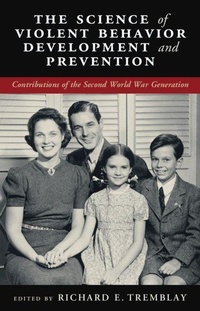
The Science of Violent Behavior Development and Prevention
Contributions of the Second World War Generation
Published on 18. February 2021
Book
Hardback
400 pages
978-1-108-83481-0 (ISBN)
Description
This book describes the lives of 12 people born in Europe and North America during the Second World War. They became leading scholars on the development and prevention of violent human behavior. From the first to the last page, the book introduces contrasting life-stories and shows how their paths crossed to create a relatively unified body of knowledge on how human violence develops and possible prevention methods. The authors describe the similarities and differences in their family background, university training, theories, and collaborations. Not to mention how they differ in research methods, scientific conclusions, and their influence on the research published today. These comparisons celebrates the diversity of their experience and, in turn, their achievements. By knowing this, you can stand on the shoulders of these giants to look to the future of this subject and potentially contribute to its next steps.
Reviews / Votes
'Edited by a world-leading authority, this one-of-a-kind volume is an invaluable resource for all scholars studying how violence develops early in life, and what we can do to stop that progression. Academic books are rarely page-turners, yet this one is. It is at once a heart-rending, educational, and fun read. It has my highest recommendation.' Adrian Raine, Richard Perry University Professor of Criminology, University of Pennsylvania 'Here is a tale of hardship, resilience, and a series of lucky events. This is a fascinating account of the origins of violent behaviour and the beginnings of those who established the foundation of its study. This book is a tribute to mentorship and collaboration.' Louise Arseneault, Professor of Developmental Psychology at the Institute of Psychiatry, King's College London 'Recommended.' C. J. Jones, ChoiceMore details
Language
English
Place of publication
Cambridge
United Kingdom
Target group
Professional and scholarly
Product notice
sewn/stitched
Cloth over boards
Illustrations
Worked examples or Exercises
Dimensions
Height: 232 mm
Width: 154 mm
Thickness: 28 mm
Weight
694 gr
ISBN-13
978-1-108-83481-0 (9781108834810)
Copyright in bibliographic data and cover images is held by Nielsen Book Services Limited or by the publishers or by their respective licensors: all rights reserved.
Schweitzer Classification
Other editions
Additional editions
Richard E. Tremblay
The Science of Violent Behavior Development and Prevention
Contributions of the Second World War Generation
Book
12/2022
Cambridge University Press
€35.00
Shipment within 15-20 days
Richard E. Tremblay
Science of Violent Behavior Development and Prevention
Contributions of the Second World War Generation
E-Book
02/2021
Cambridge University Press
€83.99
Available for download
Person
Content
1. Introduction Richard E. Tremblay; 2. From birth in a British orphanage to assessments of American Indians' development Elizabeth Jane Costello; 3. From rationing, illness and stress to the creation of a major longitudinal birth cohort Jean Golding; 4. From a country girl in south Finland to longitudinal research on alternatives to aggression and violence Lea Pulkkinen; 5. From occupied Netherlands to the Pittsburgh longitudinal studies Magda Stouthamer-Louber and Rolf Loeber; 6. From delinquent development to old age crime David P. Farrington; 7. Nurture and nature - surviving in the shadows of war Menno R. Kruk; 8. From an unruly child to a political protester and a promoter of ecology-minded concept of human development Rainer K.Silbereisen; 9. From the frustration-aggression hypothesis to moral reasoning and action Gian-Vittorio Caprara; 10. A torturous path towards understanding and preventing the development of chronic physical aggression Richard E. Tremblay; 11. From a ruined German neighborhood to resilient human development Friedrich Losel; 12. The last war baby Benjamin B. Lahey; 13. Comments on the autobiographies of the World War II babies by younger peers.