

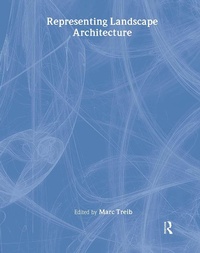
Representing Landscape Architecture
1st Edition
Will be published approx. on 20. December 2007
Book
Hardback
240 pages
978-0-415-70042-9 (ISBN)
Description
Representing Landscape Architecture offers a broad investigation of how the designed landscape is and has been represented: for design study, for criticism and even for its realization.
It has been said that we can only realize what we can imagine. But in order to realize we must convey ideas to others as well as to ourselves. Representation is by no means neutral and the process of communication, the process by which the imagination takes its first form, itself necessarily limits the range of our design possibilities. Computers further remove from cognitive processes and raise new questions about methods and limits.
Written by a team of renowned practitioners and academics, this book is the best available reference to date on the many dimensions of landscape representation.
It has been said that we can only realize what we can imagine. But in order to realize we must convey ideas to others as well as to ourselves. Representation is by no means neutral and the process of communication, the process by which the imagination takes its first form, itself necessarily limits the range of our design possibilities. Computers further remove from cognitive processes and raise new questions about methods and limits.
Written by a team of renowned practitioners and academics, this book is the best available reference to date on the many dimensions of landscape representation.
Reviews / Votes
"Marc Treib is one of the most prolific and erudite writers on designed, rather than found, landscapes. His beautifully illustrated and edited collection of essays on how designers have visualised and represented gardens and landscapes in plans, drawings, sketches, models, photographs and computer-generated images, is a delight.""Treib is particularly sensitive to the gap between the plan and the reality, and is not afraid to name those parks which appeared inspired on paper but failed to win public affection or garner enjoyable use when constructed. He is a critic one can always trust."
GREEN PLACES, April 2008
"A very useful book and highly recommended for students in landscape architecture in order to broaden their perspective on the topic and encourage them to explore other modes of representation. It will also appeal to anybody interested in the landscape architecture profession and its evolution."
JOURNAL OF THE GARDEN HISTORY SOCIETY, Spring 2008
More details
Language
English
Place of publication
London
United Kingdom
Target group
College/higher education
Product notice
sewn/stitched
Cloth over boards
Illustrations
65 s/w Photographien bzw. Rasterbilder, 60 s/w Zeichnungen
60 Line drawings, black and white; 65 Halftones, black and white
Dimensions
Height: 252 mm
Width: 207 mm
Thickness: 20 mm
Weight
907 gr
ISBN-13
978-0-415-70042-9 (9780415700429)
Copyright in bibliographic data and cover images is held by Nielsen Book Services Limited or by the publishers or by their respective licensors: all rights reserved.
Schweitzer Classification
Other editions
Additional editions
Marc Treib
Representing Landscape Architecture
E-Book
02/2008
1st Edition
Taylor & Francis
€89.99
Available for download
Marc Treib
Representing Landscape Architecture
E-Book
02/2008
Taylor & Francis
€89.99
Available for download
Marc Treib
Representing Landscape Architecture
Book
12/2007
1st Edition
Taylor & Francis
€99.29
Shipment within 15-20 days
Person
Marc Treib is Professor of Architecture at the University of California, Berkeley, and the author of numerous articles on architecture, landscape, and design. He has held Fulbright, Guggenheim, and Japan Foundation fellowships, as well as an advanced design fellowship at the American Academy in Rome. Recent books include Noguchi in Paris: The Unesco Garden and Settings and Stray Paths: Writings on Landscapes and Gardens, published by Routledge in 2005.
Content
Part 1: Looking Backward and Forward Part 2: Representing the Landscape Design Process Part 3: Drawings and Models Part 4: Words and Media