

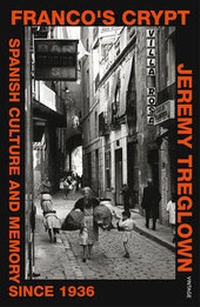
Franco's Crypt
Spanish Culture and Memory Since 1936
Book
Paperback/Softback
336 pages
978-1-84595-080-4 (ISBN)
Description
History is written by the victors. It's a cliche, but a reliable one - except in the case of the Spanish Civil War. Many believe - wrongly, as it turns out - that under Franco's dictatorship, nothing truthful or imaginatively worthwhile could be said or written or created. And this myth reinforces another: that there is a national pact to forget what really happened. In the four decades since Franco's death foreign narratives - For Whom the Bell Tolls, Casablanca, Homage to Catalonia - still have greater credibility than Spanish ones. Yet La Guerra de Espana was, as its name asserts, Spain's own war, and in recent years the country has begun to reclaim this crucial aspect of its history. In a compelling investigation of collective memory Jeremy Treglown talks to the descendants of men and women killed during the civil war and ensuing dictatorship and stands on a hillside with them as remains are excavated; he attends a Sunday service in the basilica dedicated to Franco's memory, examines monuments, paintings, novels, films, computer games and finds that despite state censorship, creativity under Franco was burgeoning and events of the time were in fact vividly recorded.
In this groundbreaking and captivating new book Jeremy Treglown examines the very tenet of our cultural identity: how we remember. Franco's Crypt is a much-needed re-examination of a history we only thought we knew.
In this groundbreaking and captivating new book Jeremy Treglown examines the very tenet of our cultural identity: how we remember. Franco's Crypt is a much-needed re-examination of a history we only thought we knew.
Reviews / Votes
"This is the most comprehensive, most perceptive book on Spain that I have read for a long time. I'm full of admiration for the scale of Treglown's undertaking, for its fine balance between storytelling and reflection and its subtle and deep political and aesthetic judgments, which touch on practically everything that irritates or pains me most about my country. Normally these matters are presented abroad with exasperating stereotypes and, at home, with intolerable factionalism. Spain, so obsessed with memory, is extraordinarily forgetful. This is a book that must be read, in Spain and abroad, by anyone who wants to understand the country's history, her present and future" -- Antonio Munoz Molina "One of the best books I have read on the recent history of the country...His sensitivity unfolds endless insights. He writes with such economy and clarity that one can hardly bear to stop reading" -- Felipe Fernandez-Armesto TLS "A discerning, provocative book, part travelogue, part reflection on how memory passes into history, and part cultural narrative" -- Valerie Miles New York Times "In a book ranging elegantly between travel writing, history, literary criticism and investigative journalism, Treglown unpicks the puzzle of Spain" -- Giles Foden Conde Nast Traveller "Evocative and melancholy" Sunday Business PostMore details
Language
English
Place of publication
London
United Kingdom
Publishing group
Vintage Publishing
Product notice
Paperback (UK-B)
Dimensions
Height: 198 mm
Width: 129 mm
ISBN-13
978-1-84595-080-4 (9781845950804)
Copyright in bibliographic data and cover images is held by Nielsen Book Services Limited or by the publishers or by their respective licensors: all rights reserved.
Schweitzer Classification
Person
Jeremy Treglown is a writer and critic who spends part of every year in Spain and has written about the country for Granta and other magazines. His previous books include biographies of Roald Dahl, Henry Green (Dictionary of Literary Biography Award), and V. S. Pritchett (short-listed for the Whitbread Award for Biography; Duff Cooper Prize for Literature). A former editor of The Times Literary Supplement, he has taught at University College London, Oxford, Princeton, and Warwick, and has written for The New Yorker and The New York Times Book Review. He lives in London.