

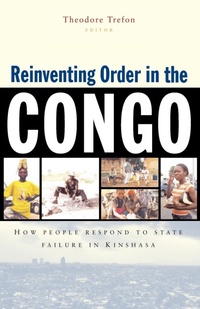
Reinventing Order in the Congo
How People Respond to State Failure in Kinshasa
Published on 1. December 2004
Book
Paperback/Softback
234 pages
978-1-84277-491-5 (ISBN)
Description
Kinshasa is sub-Saharan Africa's second largest city. The seven million Congolese who live there have a rich reputation for the courageous and innovative ways in which they survive in a harsh urban environment. They have created new social institutions, practices, networks and ways of living to deal with the collapse of public provision and a malfunctioning political system.
This book describes how ordinary people, in the absence of formal sector jobs, hustle for a modest living; the famous 'bargaining' system ordinary Kinois have developed; and how they access food, water supplies, health and education. The NGO-ization of service provision is analysed, as is the quite rare incidence of urban riots. The contributors also look at popular discourses, including street rumor, witchcraft, and attitudes to 'big men' such as musicians and preachers. This is urban sociology at its best - richly empirical, unjargonized, descriptive of the lives of ordinary people, and weaving into its analysis how they see and experience life.
This book describes how ordinary people, in the absence of formal sector jobs, hustle for a modest living; the famous 'bargaining' system ordinary Kinois have developed; and how they access food, water supplies, health and education. The NGO-ization of service provision is analysed, as is the quite rare incidence of urban riots. The contributors also look at popular discourses, including street rumor, witchcraft, and attitudes to 'big men' such as musicians and preachers. This is urban sociology at its best - richly empirical, unjargonized, descriptive of the lives of ordinary people, and weaving into its analysis how they see and experience life.
Reviews / Votes
'This is an outstanding social anthropology of Kinshasa in the context of state collapse, the development of numerous survival strategies for food, water, healthcare and dealing with the sickness and death of loved ones, together with the mushrooming of NGOs dependent on external assistance for coping with the tragedy.'Georges Nzongola-Ntalaja, Oslo Governance Centre
'This is a pioneering work whose relevance extends well beyond the confines of Kinshasa, and applies not only to Africa, but also to other so-called "developing" areas.'
Edouard Bustin, Boston University
'A superb contribution to our understanding of the informal economy of sub-Saharan Africa's second largest city.'
Rene Lemarchand, University of Florida
'The contributors provide multiple perspectives through which to theorize African urbanization.'
African Studies Review
More details
Language
English
Place of publication
United Kingdom
Publishing group
Bloomsbury Publishing PLC
Target group
College/higher education
Professional and scholarly
Illustrations
Index, Bibliography, Notes, tabl., Map
Dimensions
Height: 216 mm
Width: 140 mm
Thickness: 14 mm
Weight
339 gr
ISBN-13
978-1-84277-491-5 (9781842774915)
Copyright in bibliographic data and cover images is held by Nielsen Book Services Limited or by the publishers or by their respective licensors: all rights reserved.
Schweitzer Classification
Other editions
Additional editions
E-Book
04/2013
1st Edition
Zed Books Ltd
€35.49
Available for download
E-Book
02/2008
1st Edition
Zed Books Ltd
€35.49
Available for download
Person
Dr Theodore Trefon was educated at Boston University. He is an independent researcher and consultant currently based at the Free University of Brussels. He is also President of the Brussels Centre of African Studies.
Content
1. Introduction: Reinventing Order; 2. The Kinshasa Bargain; 3. The Tap is on Strike: Water (Non-)Distribution and Supply Strategies; 4. Food Security in Kinshasa: Coping with Adversity; 5. The Miracle of Life in Kinshasa: New approaches to Public Health; 6. The Diploma Paradox: University of Kinshasa between Crisis and Salvation; 7. Acting on Behalf (and in spite) of the State: NGOs and Civil Society Associations in Kinshasa; 8. Hidden Families, Single Mothers and Cibalabala: Economic Regress and Changing Household Composition in Kinshasa; 9. When Kinois Take to the Streets; 10. On Being Shege in Kinshasa: Children, the Occult and the Street; 11. The Elusive Lupemba: Rumours About Fame and (Mis)Fortune in Kinshasa