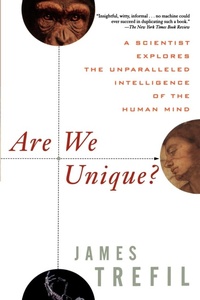
Acclaim for Are We Unique?
"In his masterful book, Trefil shares with readers some of the most recent research in neurology, evolution, primate research, computer science, and philosophy. Trefil's prose is lively and engaging." --Boston Globe
"Trefil's race through the science that could explain the brain is highly readable." --Sunday Times of London
"In a provocative essay, Trefil argues that the science of artificial intelligence is progressing rapidly. Machines, he theorizes, will one day develop a new kind of intelligence and self-awareness. So, maybe the real question is: Are we ready?" --San Diego Union-Tribune
"A highly readable and engaging treatment of a fascinating question. Trefil makes a case for human uniqueness while at the same time celebrating the achievements of creations ranging from lobsters to neural nets. A provocative and enjoyable book." --Daniel L. Schacter Professor and Chair of Psychology, Harvard University author of Searching for Memory
Language
Place of publication
Publishing group
Turner Publishing Company
Product notice
Paperback (trade)
Unsewn / adhesive bound
Dimensions
Height: 203 mm
Width: 157 mm
Thickness: 17 mm
Weight
ISBN-13
978-0-471-24946-7 (9780471249467)
Copyright in bibliographic data and cover images is held by Nielsen Book Services Limited or by the publishers or by their respective licensors: all rights reserved.
Schweitzer Classification
JAMES TREFIL is Robinson Professor of Physics at George Mason University. He is the author of fifteen books, including coauthorship of the bestselling Science Matters and the perennially popular Sharks Have No Bones. A regular contributor to Smithsonian magazine, he is also a science commentator for National Public Radio. Mr. Trefil lives in Fairfax, Virginia.
Is There Anything Left For Us? Humans and Animals: The Same but Different. Of Fleeing Anemones and Smart Lobsters. Can Animals Talk? The Brain. Of Tamping Rods and Grandmother Cells: How the Brain Works. How Did We Get to Be So Smart?: The Evolution of Intelligence. Moving Wheels and Moving Electrons: How a Computer Works. Artificial Intelligence, Learning Machines, and Chinese Rooms. Why the Brain Is Not a Computer. Can the Brain Do Something a Computer Can't?: Godel and Penrose. The Problem of Consciousness. Consciousness and Complexity. Is There Anything Left for Us? Bibliography. Acknowledgments. Index.