

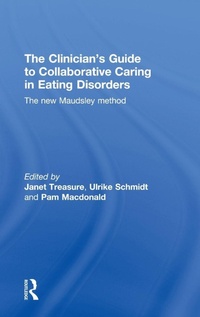
The Clinician's Guide to Collaborative Caring in Eating Disorders
The New Maudsley Method
1st Edition
Published on 4. September 2009
Book
Hardback
304 pages
978-0-415-48424-4 (ISBN)
Description
Caring for a loved one with an eating disorder is a difficult task; carers often find it hard to cope, and this can contribute to the maintenance of the disorder. The Clinician's Guide to Collaborative Caring in Eating Disorders shows how active collaboration between professional and non-professional carers can maximise the quality of life for both the sufferer and all other family members.
The book provides straightforward guidance for clinicians who work with families and carers. It suggests ways of ensuring that interpersonal elements that can maintain eating disorders are minimised and indicates skills and knowledge that can be taught to the carer for both managing their personal reaction to the illness, and for providing a practically and emotionally supportive environment that is conducive to change. The appendices of the book contain a Toolkit for Carers, a series of worksheets designed to help carers recognise their own unique caring styles.
This book is worthwhile reading for all health professionals working with people with eating disorders. It is relevant across a variety of settings and client groups including inpatients, out-patients, community and day patients.
The book provides straightforward guidance for clinicians who work with families and carers. It suggests ways of ensuring that interpersonal elements that can maintain eating disorders are minimised and indicates skills and knowledge that can be taught to the carer for both managing their personal reaction to the illness, and for providing a practically and emotionally supportive environment that is conducive to change. The appendices of the book contain a Toolkit for Carers, a series of worksheets designed to help carers recognise their own unique caring styles.
This book is worthwhile reading for all health professionals working with people with eating disorders. It is relevant across a variety of settings and client groups including inpatients, out-patients, community and day patients.
Reviews / Votes
"This book is a valuable companion piece to Treasure et al.'s existing volume, providing useful information, resources and skills for clinicians. However, this book's biggest contribution is the way in which it stresses that clinicians should see the family as a resource (rather than a nuisance or an irrelevance)." - Professor Glenn Waller, Consultant Clinical Psychologist, Vincent Square Eating Disorders Service, CNWL NHS Foundation Trust, UK "This book is a valuable companion piece to Treasure et al.'s existing volume, providing useful information, resources and skills for clinicians. However, this book's biggest contribution is the way in which it stresses that clinicians should see the family as a resource (rather than a nuisance or an irrelevance)." - Professor Glenn Waller, Consultant Clinical Psychologist, Vincent Square Eating Disorders Service, CNWL NHS Foundation Trust, UK"This is an extremely well written, informative and practical book that should be essential reading for professionals working in the eating disorders field. Throughout, the thorny problem of how to facilitate change, whilst simultaneously avoiding the inadvertent guilt, is firmly grasped, with much practical advice and examples." - David Wood, Child & Adolescent Mental Health, 16 [1], Feb 2011
More details
Language
English
Place of publication
London
United Kingdom
Publishing group
Taylor & Francis Ltd
Target group
Professional and scholarly
Postgraduate, Professional, and Professional Practice & Development
Product notice
Paper over boards
Illustrations
24 s/w Zeichnungen, 24 s/w Abbildungen
24 Line drawings, black and white; 24 Illustrations, black and white
Dimensions
Height: 240 mm
Width: 161 mm
Thickness: 21 mm
Weight
622 gr
ISBN-13
978-0-415-48424-4 (9780415484244)
Copyright in bibliographic data and cover images is held by Nielsen Book Services Limited or by the publishers or by their respective licensors: all rights reserved.
Schweitzer Classification
Other editions
Additional editions
Janet Treasure | Ulrike Schmidt | Pam Macdonald
The Clinician's Guide to Collaborative Caring in Eating Disorders
The New Maudsley Method
E-Book
09/2009
Routledge
€55.49
Available for download
Janet Treasure | Ulrike Schmidt | Pam Macdonald
The Clinician's Guide to Collaborative Caring in Eating Disorders
The New Maudsley Method
E-Book
09/2009
Routledge
€55.49
Available for download
Janet Treasure | Ulrike Schmidt | Pam Macdonald
The Clinician's Guide to Collaborative Caring in Eating Disorders
The New Maudsley Method
Book
09/2009
1st Edition
Routledge
€63.70
Shipment within 15-20 days
Persons
Janet Treasure is a Psychiatrist at the Maudsley Hospital and a Professor at King's College London.
Ulrike Schmidt is a Consultant Psychiatrist at the Maudsley Hospital and a Professor at the Institute of Psychiatry, King's College London.
Pam Macdonald is working on a PhD at the Institute of Psychiatry, King's College, London.
Ulrike Schmidt is a Consultant Psychiatrist at the Maudsley Hospital and a Professor at the Institute of Psychiatry, King's College London.
Pam Macdonald is working on a PhD at the Institute of Psychiatry, King's College, London.
Content
Part I: Introduction to Collaborative Care Between Carers of People with Eating Disorders and Professional Services. Treasure, Introduction. Treasure, Schmidt, Eating Disorders and the Concept of Working with Families and Other Carers. Kamerling, Smith, The Carers' Perspective. Baldock, An Ethico-legal Account of Working with Carers in Eating Disorders. Part II: Introduction to the Theoretical Underpinning. Treasure, How Do Families Cope When a Relative has an Eating Disorder. Treasure, Williams, Schmidt, Family Processes as Maintaining Factors for Eating Disorders. Treasure, Understanding Models of Health Behaviours and the Processes Used to Facilitate Change. Treasure, Changing Behaviours in the Family. Part III: Different Forms of Intervention. Treasure, Working with Carers on an Outpatient Basis: The Assessment of the Family. Treasure, Whitney, Writing as a Tool for Developing Reflective Capacity and Emotional Processing. Treasure, Sepulveda, Whittaker, Todd, Lopez, Family and Carer Workshops, Whitaker, Treasure, Todd, An Intensive Three-day Programme with Families Preparing for Transition from Inpatient to Outpatient Care. Macdonald, Grover, Coaching Methods of Supportive Skills-based Training for Carers. Part IV: Special Cases. Treasure, Micali, Monneyron, Reproductive Function and Parenting in People with an Eating Disorder History. Kyriacou, Treasure, Raenker, The Influence and Importance of Parents in Care and Treatment of an Eating Disorder. Part V: Conclusion and Appendices. Treasure, Macdonald, Goddard, What the Patients Say: An Examination of What Patients Think about Family Interventions. Todd, Whitaker, Macdonald, The Professional Perspective. Appendix I: Toolkit for Carers: The Caring Role in Eating Disorders. Appendix II: Eating Disorders Symptom Impact Scale (EDSIS). Appendix III: Accommodation and Enabling Scale for Eating Disorders (AESED).