

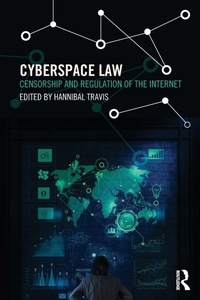
Cyberspace Law
Censorship and Regulation of the Internet
1st Edition
Published on 25. April 2013
Book
Paperback/Softback
280 pages
978-0-415-63031-3 (ISBN)
Description
This book explores what the American Civil Liberties Union calls the "third era" in cyberspace, in which filters "fundamentally alter the architectural structure of the Internet, with significant implications for free speech." Although courts and nongovernmental organizations increasingly insist upon constitutional and other legal guarantees of a freewheeling Internet, multi-national corporations compete to produce tools and strategies for making it more predictable. When Google attempted to improve our access to information containing in books and the World Wide Web, copyright litigation began to tie up the process of making content searchable, and resulted in the wrongful removal of access to thousands if not millions of works. Just as the courts were insisting that using trademarks online to criticize their owners is First Amendment-protected, corporations and trade associations accelerated their development of ways to make Internet companies liable for their users' infringing words and actions, potentially circumventing free speech rights. And as social networking and content-sharing sites have proliferated, so have the terms of service and content-detecting tools for detecting, flagging, and deleting content that makes one or another corporation or trade association fear for its image or profits. The book provides a legal history of Internet regulation since the mid-1990s, with a particular focus on efforts by patent, trademark, and copyright owners to compel Internet firms to monitor their online offerings and remove or pay for any violations of the rights of others.
This book will be of interest to students of law, communications, political science, government and policy, business, and economics, as well as anyone interested in free speech and commerce on the internet.
This book will be of interest to students of law, communications, political science, government and policy, business, and economics, as well as anyone interested in free speech and commerce on the internet.
More details
Series
Language
English
Place of publication
London
United Kingdom
Publishing group
Taylor & Francis Ltd
Target group
College/higher education
Dimensions
Height: 234 mm
Width: 156 mm
Thickness: 15 mm
Weight
430 gr
ISBN-13
978-0-415-63031-3 (9780415630313)
Copyright in bibliographic data and cover images is held by Nielsen Book Services Limited or by the publishers or by their respective licensors: all rights reserved.
Schweitzer Classification
Other editions
Additional editions
E-Book
08/2013
1st Edition
Routledge
€64.49
Available for download
E-Book
08/2013
1st Edition
Routledge
€64.49
Available for download
Book
04/2013
1st Edition
Routledge
€205.80
Shipment within 15-20 days
Person
Hannibal Travis has taught Internet Law at Florida International University and Villanova University. He is the author of numerous articles about the law and practice of Internet-related innovation, especially relating to blogs, digital libraries, and online videos. He is a graduate of Harvard Law School.
Content
1. Claiming Web Addresses as Property, Margreth Barrett 2. The Promise of Information Justice, Lateef Mtima 3. Owning Methods of Conducting Business in Cyberspace, Johanna K.P. Dennis 4. Red Flags of "Piracy" Online, Amir Hassanpour 5. Who Controls the Internet? The Second Circuit on YouTube, Hannibal Travis 6. Is eBay Counterfeiting?, Jasmine Abdel-Khalik 7. Bad Samaritanism: Barnes v. Yahoo and Section 230 ISP Immunity, Ann Bartow 8. Internet Responsibility, Geographic Boundaries, and Business Ethics, Raphael Cohen-Almagor 9. Neutralizing the "Open Internet", Hannibal Travis 10. The "Monster" that Ate Social Networking?, Hannibal Travis 11. Conclusion.