

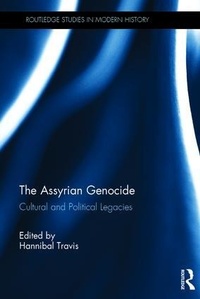
The Assyrian Genocide
Cultural and Political Legacies
1st Edition
Published on 27. July 2017
Book
Hardback
316 pages
978-1-138-28405-0 (ISBN)
Description
For a brief period, the attention of the international community has focused once again on the plight of religious minorities in Iraq, Syria, and Turkey. In particular, the abductions and massacres of Yezidis and Assyrians in the Sinjar, Mosul, Nineveh Plains, Baghdad, and Hasakah regions in 2007-2015 raised questions about the prevention of genocide. This book, while principally analyzing the Assyrian genocide of 1914-1925 and its implications for the culture and politics of the region, also raises broader questions concerning the future of religious diversity in the Middle East. It gathers and analyzes the findings of a broad spectrum of historical and scholarly works on Christian identities in the Middle East, genocide studies, international law, and the politics of the late Ottoman Empire, as well as the politics of the Ottomans' British and Russian rivals for power in western Asia and the eastern Mediterranean basin.
A key question the book raises is whether the fate of the Assyrians maps onto any of the concepts used within international law and diplomatic history to study genocide and group violence. In this light, the Assyrian genocide stands out as being several times larger, in both absolute terms and relative to the size of the affected group, than the Srebrenica genocide, which is recognized by Turkey as well as by international tribunals and organizations. Including its Armenian and Greek victims, the Ottoman Christian Genocide rivals the Rwandan, Bengali, and Biafran genocides. The book also aims to explore the impact of the genocide period of 1914-1925 on the development or partial unraveling of Assyrian group cohesion, including aspirations to autonomy in the Assyrian areas of northern Iraq, northwestern Iran, and southeastern Turkey. Scholars from around the world have collaborated to approach these research questions by reference to diplomatic and political archives, international legal materials, memoirs, and literary works.
A key question the book raises is whether the fate of the Assyrians maps onto any of the concepts used within international law and diplomatic history to study genocide and group violence. In this light, the Assyrian genocide stands out as being several times larger, in both absolute terms and relative to the size of the affected group, than the Srebrenica genocide, which is recognized by Turkey as well as by international tribunals and organizations. Including its Armenian and Greek victims, the Ottoman Christian Genocide rivals the Rwandan, Bengali, and Biafran genocides. The book also aims to explore the impact of the genocide period of 1914-1925 on the development or partial unraveling of Assyrian group cohesion, including aspirations to autonomy in the Assyrian areas of northern Iraq, northwestern Iran, and southeastern Turkey. Scholars from around the world have collaborated to approach these research questions by reference to diplomatic and political archives, international legal materials, memoirs, and literary works.
Reviews / Votes
"One of the fortuitous aspects of the development of comparative genocide studies has been attention to a number of cases of genocide and genocidal massacres that previously were not included in a manner commensurate with the crime. For example, after a century the genocide of the numerically small Herero people has finally entered the consciousness of many scholars and students. The same is happening with the Assyrian genocide, recognition of which I have personally advocated for a long time. Each genocide is different, however, and care should be taken as there are pitfalls in attempting to equate one with the other in every way. For decades, the Assyrian genocide, like the Armenian genocide, had become a 'forgotten genocide.' Armenian activists and scholars martialed their resources relatively early to gradually eliminate the adjective 'forgotten.' Assyrians and Greeks tarried, in part because they themselves did not pay sufficient heed to the challenge. It is gratifying that this has changed in recent decades and the fact that both Assyrians and non-Assyrians authors are contributors to The Assyrian Genocide: Cultural and Political Legacies is strong testimony to that fact."Richard G. Hovannisian, Professor Emeritus, University of California, Los Angeles, President's Fellow, Chapman University, and Scholarly Advisor, Shoah Foundation, University of Southern California.
More details
Series
Language
English
Place of publication
London
United Kingdom
Publishing group
Taylor & Francis Ltd
Target group
College/higher education
Product notice
sewn/stitched
Cloth over boards
Illustrations
15 s/w Abbildungen, 6 s/w Photographien bzw. Rasterbilder, 4 s/w Zeichnungen, 5 s/w Tabellen
5 Tables, black and white; 4 Line drawings, black and white; 6 Halftones, black and white; 15 Illustrations, black and white
Dimensions
Height: 241 mm
Width: 159 mm
Thickness: 27 mm
Weight
646 gr
ISBN-13
978-1-138-28405-0 (9781138284050)
Copyright in bibliographic data and cover images is held by Nielsen Book Services Limited or by the publishers or by their respective licensors: all rights reserved.
Schweitzer Classification
Other editions
Additional editions
Book
07/2019
1st Edition
Routledge
€83.20
Shipment within 15-20 days
E-Book
07/2017
Routledge
€76.49
Available for download
E-Book
07/2017
Routledge
€76.49
Available for download
Person
Hannibal Travis publishes work and teaches classes at Florida International University relating to international law, Internet law, and intellectual property. He has also served as Visiting Associate Professor of Law at Villanova University. He graduated magna cum laude from Harvard Law School in 1999, where he served as a teaching assistant in Harvard College. He has published widely on genocide studies and human rights law, including Genocide in the Middle East: The Ottoman Empire, Iraq, and Sudan (2010); "Genocide in Sudan: The Role of Oil Exploration and the Entitlement of the Victims to Reparations," in The Top Ten Global Justice Law Review Articles 2008 (Amos Guiora ed., 2009), 107-162; "On the Original Understanding of the Crime of Genocide," Genocide Studies and Prevention 7 (2012): 30-55; "Did the Armenian Genocide Inspire Hitler?" Middle East Quarterly 20, no. 1, Winter 2013, pp. 27-35; and "Why Was Benghazi 'Saved,' But Sinjar Allowed to Be Lost?: New Failures of Genocide Prevention, 2007-2015," Genocide Studies International 10, no. 2 (2017), https://muse.jhu.edu/journal/690.
Content
List of figures and tables
List of contributors
Acknowledgements
Glossary
List of judicial decisions cited
Table of legislation
1. The Assyrian genocide across history: collective memory, legal theory, and power politics
Hannibal Travis
2. The term Seyfo in historical perspective
Michael Abdalla
3. The atrocities against the Assyrians in 1915: a legal perspective
Sara Demir
4. The Ottoman genocide of the Assyrians in Persia
Anahit Khosroeva
5. Abduction, rape and genocide: Urmia's Assyrian girls and women
Eden Naby
6. Genocide/Seyfo - and how resistance became a way of life
Sait Cetinoglu (Abdulmesih BarAbraham, trans.)
7. Lady Surma: the pillar of the Assyrian nation, 1883-1975
Stavros Stavridis
8. The Assyrian delegation in the Paris Peace Conference
Racho Donef
9. The Assyrian "concept of unity" after Seyfo
Aryo Makko
10. Exile or extinction: the Assyrian genocide from 1915 to 2015
Hannibal Travis
11. Epilogue: tombstones and inverted crosses
Nineb Lamassu
Index
List of contributors
Acknowledgements
Glossary
List of judicial decisions cited
Table of legislation
1. The Assyrian genocide across history: collective memory, legal theory, and power politics
Hannibal Travis
2. The term Seyfo in historical perspective
Michael Abdalla
3. The atrocities against the Assyrians in 1915: a legal perspective
Sara Demir
4. The Ottoman genocide of the Assyrians in Persia
Anahit Khosroeva
5. Abduction, rape and genocide: Urmia's Assyrian girls and women
Eden Naby
6. Genocide/Seyfo - and how resistance became a way of life
Sait Cetinoglu (Abdulmesih BarAbraham, trans.)
7. Lady Surma: the pillar of the Assyrian nation, 1883-1975
Stavros Stavridis
8. The Assyrian delegation in the Paris Peace Conference
Racho Donef
9. The Assyrian "concept of unity" after Seyfo
Aryo Makko
10. Exile or extinction: the Assyrian genocide from 1915 to 2015
Hannibal Travis
11. Epilogue: tombstones and inverted crosses
Nineb Lamassu
Index