

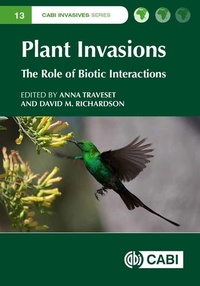
Plant Invasions
The Role of Biotic Interactions
Published on 6. January 2021
Book
Hardback
480 pages
978-1-78924-217-1 (ISBN)
Description
There are many books on aspects of plant invasions, but none that focus on the key role of species interactions in mediating invasions. This book reviews exciting new findings and explores how new methods and tools are shedding new light on crucial processes in plant invasions. In 23 chapters, with contributions from 51 authors, the book addresses: ? the main theories and hypotheses in plant invasion ecology that invoke species interactions; ? plant invasions that are facilitated by, or benefit from, by mutualistic interactions and release from enemies; ? antagonistic interactions that prevent or hinder plant invasions; ? impacts of plant invasions on native species interactions and ecosystem functioning; ? the interaction-network approach to understanding plant invasions; ? the importance of considering species interactions in managing plant invasions
More details
Series
Language
English
Place of publication
Wallingford
United Kingdom
Target group
College/higher education
Professional and scholarly
Product notice
sewn/stitched
Cloth over boards
Dimensions
Height: 252 mm
Width: 179 mm
Thickness: 27 mm
Weight
1114 gr
ISBN-13
978-1-78924-217-1 (9781789242171)
Copyright in bibliographic data and cover images is held by Nielsen Book Services Limited or by the publishers or by their respective licensors: all rights reserved.
Schweitzer Classification
Other editions
Additional editions
E-Book
11/2020
CABI Publishing
€165.99
Available for download
Persons
Anna Traveset (Edited By)
- Anna Traveset is a Research Professor of the Spanish Research Council based at the Mediterranean Institute of Advanced studies in Mallorca, Balearic Islands, Spain. Her research focuses on species interactions, mostly on island ecosystems, and how these are influenced by different drivers of global change. She has published more than 200 papers in scientific journals and as book chapters, and has edited several special issues, one in Journal of Biogeography (2012) and the other in AoB PLANTS (2015). She belongs to the editorial board of five scientific journals. In 2017, she was awarded the Prize King Jaume I in the category of 'Environmental Protection'.
David M. Richardson (Edited By)
David M. Richardson was Director of the DSI-NRF Centre of Excellence for Invasion Biology in South Africa between 2011 and 2022. He is currently a Distinguished Professor in the Department of Botany and Zoology at Stellenbosch University, South Africa. His research focuses on biological invasions, mainly plant invasions. David is author or co-author of over 500 journal papers and book chapters and several books, including Invasion Dynamics (Oxford University Press, 2017) and Invading Ecological Networks (Cambridge University Press, 2022). He has edited or co-edited nine books, including Ecology and Biogeography of Pinus (Cambridge University Press, 1998), Fifty Years of Invasion Ecology (Wiley-Blackwell, 2011), Biological Invasions in South Africa (Springer, 2022) and Plant Invasions: The Role of Biotic Interactions (CABI, 2022). He was Editor-in-Chief of the journal Diversity and Distributions between 1998 and 2015. David was awarded the Hans Sigrist Prize for 2006 by the University of Bern, Switzerland, in 2012 received the John F.W. Herschel Medal, the senior medal of the Royal Society of South Africa, and in 2019 was recipient of the African Union's Kwame Nkrumah Award for Scientific Excellence (Continental). Most of his work on this book was done while he was on sabbatical leave with support from the Institute of Botany of the Czech Academy of Sciences in Prague, Czech Republic.
- Anna Traveset is a Research Professor of the Spanish Research Council based at the Mediterranean Institute of Advanced studies in Mallorca, Balearic Islands, Spain. Her research focuses on species interactions, mostly on island ecosystems, and how these are influenced by different drivers of global change. She has published more than 200 papers in scientific journals and as book chapters, and has edited several special issues, one in Journal of Biogeography (2012) and the other in AoB PLANTS (2015). She belongs to the editorial board of five scientific journals. In 2017, she was awarded the Prize King Jaume I in the category of 'Environmental Protection'.
David M. Richardson (Edited By)
David M. Richardson was Director of the DSI-NRF Centre of Excellence for Invasion Biology in South Africa between 2011 and 2022. He is currently a Distinguished Professor in the Department of Botany and Zoology at Stellenbosch University, South Africa. His research focuses on biological invasions, mainly plant invasions. David is author or co-author of over 500 journal papers and book chapters and several books, including Invasion Dynamics (Oxford University Press, 2017) and Invading Ecological Networks (Cambridge University Press, 2022). He has edited or co-edited nine books, including Ecology and Biogeography of Pinus (Cambridge University Press, 1998), Fifty Years of Invasion Ecology (Wiley-Blackwell, 2011), Biological Invasions in South Africa (Springer, 2022) and Plant Invasions: The Role of Biotic Interactions (CABI, 2022). He was Editor-in-Chief of the journal Diversity and Distributions between 1998 and 2015. David was awarded the Hans Sigrist Prize for 2006 by the University of Bern, Switzerland, in 2012 received the John F.W. Herschel Medal, the senior medal of the Royal Society of South Africa, and in 2019 was recipient of the African Union's Kwame Nkrumah Award for Scientific Excellence (Continental). Most of his work on this book was done while he was on sabbatical leave with support from the Institute of Botany of the Czech Academy of Sciences in Prague, Czech Republic.
Editor
Institut Mediterrani d'Estudis Avancats (CSIC-UIB), Spain
Centre for Invasion Biology, South Africa
Contributions
University of Florida, USA
Instituto de Investigaciones en Biodiversidad y Medio Ambiente (INIBIOMA), Argentina
The Bio-Protection Research Centre, New Zealand
INRAE Val de Loire, France
Australian Research Council Centre of Excellence for Coral Reef Studies, Australia
University of Montana, USA
King's College London, UK
Universidad de Concepcion, Chile
Content
Part I: Background Chapter 1: Plant invasions: the role of biotic interactions - An overview Chapter 2: The role of biotic interactions in invasion ecology: theories and hypotheses Part II: Positive and negative interactions in the soil Chapter 3: Soil biota and non-native plant invasions Part III: Mutualistic interactions that promote plant invasions Chapter 4: Pollination interactions promoting plant invasions- Chapter 5: Seed dispersal interactions promoting plant invasions Chapter 6: Ungulates as dispersal vectors of non-native plants Chapter 7: The role of plant-plant facilitation in non-native plant invasions Chapter 8: How direct and indirect non-native interactions can promote plant invasions, lead to invasional meltdown, and inform management decisions Part IV: Antagonistic interactions that hinder plant invasions Chapter 9: Biotic resistance to plant invasions Chapter 10: EICA 2.0: A general model of enemy release and defence in plant and animal invasions Chapter 11: The role of pathogens in plant invasions Chapter 12: Direct and indirect effects of herbivores influencing plant invasions Part V: Consequences of plant invasions for biotic interactions among native species Chapter 13: Impacts of non-native plants on plant-pollinator interactions Chapter 14: The effect of non-native plant invasions on seed dispersal of native plants Chapter 15: Allelopathic disruptions of biotic interactions due to non-native plants Chapter 16: Competition between native and non-native plants Chapter 17: Indirect biotic interactions between non-native plants and native plants and animals Part VI: Novel techniques and experimental approaches in the study of plant invasions Chapter 18: How a network approach has advanced the field of plant invasion ecology Chapter 19: Molecular ecology of plant-microbial interactions during invasions: progress and challenges Part VII: Biotic interactions and the management of ecosystems invaded by non-native plants Chapter 20: How can progress in the understanding of antagonistic interactions be applied to improve biological control of plant invasions? Chapter 21: Restoration of pollination interactions in communities invaded by non-native plants Chapter 22: Restoration of seed dispersal interactions in communities invaded by non-native plants Chapter 23: Multiple feedbacks due to biotic interactions across trophic levels can lead to persistent novel conditions that hinder restoration