

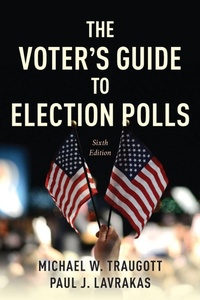
The Voter's Guide to Election Polls
6th Edition
Published on 20. November 2023
Book
Paperback/Softback
272 pages
978-1-5381-8739-5 (ISBN)
Description
Everything you need to know about election polls can be found in this compact, conversational, and current volume. When it comes to tapping the public's opinion on candidates and issues at the ballot box, the stakes are high. Acclaimed scholars Michael W. Traugott and Paul J. Lavrakas-who also have regularly conducted polls, not just studied them-cover the latest technologies used for data collection and data analysis, including internet polls, as well as how polls are used in campaigns and media organizations.
In straightforward language and an accessible question-and-answer format, the authors cover issues such as: How do political candidates and organizations use poll data? How do news organizations collect and report polls? Why do pollsters use samples? Can internet polls really reflect a representative swath of the population? They also examine common problems and complaints about polls, such as the increasing use of "push polls" and whether polls can impact how citizens vote. Their decades of experience and insight not only answer the nuts and bolts questions, but most importantly, why it all matters in American democracy.
In straightforward language and an accessible question-and-answer format, the authors cover issues such as: How do political candidates and organizations use poll data? How do news organizations collect and report polls? Why do pollsters use samples? Can internet polls really reflect a representative swath of the population? They also examine common problems and complaints about polls, such as the increasing use of "push polls" and whether polls can impact how citizens vote. Their decades of experience and insight not only answer the nuts and bolts questions, but most importantly, why it all matters in American democracy.
Reviews / Votes
The Voter's Guide to Election Polls is an accessible text that stands as a valuable resource for anyone interested in understanding how polling works and the role it plays in informing electoral politics. It is notable that the authors discuss essential terminology and concepts using timely examples that help readers make connections to modern electoral politics while also illuminating the practice of survey research generally, since it has applications beyond the political sphere. Consequently, this text efficiently traverses many academic domains as well as being of potential interest to the discerning non-academician who wants to know how polling works. -- Amy Sue Goodin, University of Oklahoma In a political environment where anyone can run a 'poll,' public trust in survey research has declined. The Voter's Guide to Election Polls offers a comprehensive review of survey research and practice in a way that is accessible and useful to consumers of polls. Traugott and Lavrakas' book is a powerful tool to clarify misconceptions about the science of polling, especially in the context of political campaigns. -- Thessalia Merivaki, Mississippi State University A simple fact about survey research and polling is that journalists, students, and citizens alike need to know how survey data were gathered and analyzed to accurately judge their quality. The science of survey research and polling has advanced rapidly over the years as researchers have adjusted to changes in the telephone system, people's communication habits, and expectations of privacy, among many other things. The authors present a clear guide to these matters. Mike and Paul-now in their sixth edition of this very useful book-are world-class experts who have vast professional experiences related to the issues they discuss. -- Gerald M. Kosicki, Ph.D., Director of Journalism Programs, School of Communication, The Ohio State University This highly accessible guide offers a comprehensive overview of the good, the bad, and the ugly of election polling. The book clearly explains foundational concepts necessary to understand current controversies in political polling. It is a classic source for any course in public opinion or campaigns and elections. Traugott and Lavrakas's years of experience shine through these pages. -- D. Sunshine Hillygus, Duke UniversityMore details
Edition
6th edition
Language
English
Place of publication
United States
Publishing group
Bloomsbury Publishing Plc
Target group
College/higher education
US School Grade: From College Freshman to College Graduate Student, Interest Age: From 18 to 22 years
Illustrations
4 tables; 1 graph
Dimensions
Height: 229 mm
Width: 152 mm
Thickness: 15 mm
Weight
399 gr
ISBN-13
978-1-5381-8739-5 (9781538187395)
Copyright in bibliographic data and cover images is held by Nielsen Book Services Limited or by the publishers or by their respective licensors: all rights reserved.
Schweitzer Classification
Other editions
Additional editions
Michael W. Traugott | Paul J. Lavrakas
The Voter's Guide to Election Polls
E-Book
11/2023
6th Edition
Rowman & Littlefield Publishers
€32.99
Available for download
Persons
Michael W. Traugott, PhD, is a political scientist and survey methodologist. He is professor emeritus at the University of Michigan. He has served as the president of the American Association for Public Opinion Research (AAPOR) and the World Association for Public Opinion Research.
Paul J. Lavrakas, PhD, is a research psychologist and methodological research consultant. He was the founding faculty director of survey centers at Northwestern and Ohio State universities, a chief methodologist for Nielsen Media Research, as well as former president of the AAPOR.
Paul J. Lavrakas, PhD, is a research psychologist and methodological research consultant. He was the founding faculty director of survey centers at Northwestern and Ohio State universities, a chief methodologist for Nielsen Media Research, as well as former president of the AAPOR.
Content
Introduction
Chapter 1 What Are Polls and Surveys? And Why Are They Conducted?
Chapter 2 What Are Election Polls? How Are They Conducted?
Chapter 3 How Do Political Candidates and Organizations Use Poll Data?
Chapter 4 How Do News Organizations Collect and Report Poll Data?
Chapter 5 Why Do Pollsters Use Samples?
Chapter 6 How Are Questionnaires Put Together?
Chapter 7 How Are Data Gathered for Election Polls?
Chapter 8 How Do Media Organizations Analyze Polls?
Chapter 9 How Can I Evaluate Published Poll Results?
Chapter 10 What Are Some Common Problems and Complaints about Polls and the Media's Use of Them?
Epilogue
Appendix A: Standards for Disclosing Information about the Methodology of Public Polls
Appendix B: Sample Tolerances (Sampling Errors) for Samples of Different Sizes
Glossary
Selected References
About the Authors
Chapter 1 What Are Polls and Surveys? And Why Are They Conducted?
Chapter 2 What Are Election Polls? How Are They Conducted?
Chapter 3 How Do Political Candidates and Organizations Use Poll Data?
Chapter 4 How Do News Organizations Collect and Report Poll Data?
Chapter 5 Why Do Pollsters Use Samples?
Chapter 6 How Are Questionnaires Put Together?
Chapter 7 How Are Data Gathered for Election Polls?
Chapter 8 How Do Media Organizations Analyze Polls?
Chapter 9 How Can I Evaluate Published Poll Results?
Chapter 10 What Are Some Common Problems and Complaints about Polls and the Media's Use of Them?
Epilogue
Appendix A: Standards for Disclosing Information about the Methodology of Public Polls
Appendix B: Sample Tolerances (Sampling Errors) for Samples of Different Sizes
Glossary
Selected References
About the Authors