

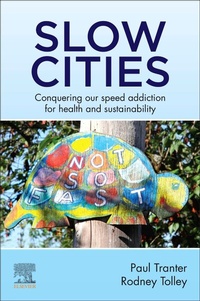
Slow Cities
Conquering our Speed Addiction for Health and Sustainability
Published on 17. June 2020
Book
Paperback/Softback
422 pages
978-0-12-815316-1 (ISBN)
Description
Slow Cities: Conquering Our Speed Addiction for Health and Sustainability demonstrates, counterintuitively, that reducing the speed of travel within cities saves time for residents and creates more sustainable, liveable, prosperous and healthy environments.
This book examines the ways individuals and societies became dependent on transport modes that required investment in speed. Using research from multiple disciplinary perspectives, the book demonstrates ways in which human, economic and environmental health are improved with a slowing of city transport. It identifies effective methods, strategies and policies for decreasing the speed of motorised traffic and encouraging a modal shift to walking, cycling and public transport. This book also offers a holistic assessment of the impact of speed on daily behaviours and life choices, and shows how a move to slow down will - perhaps surprisingly - increase accessibility to the city services and activities that support healthy, sustainable lives and cities.
This book examines the ways individuals and societies became dependent on transport modes that required investment in speed. Using research from multiple disciplinary perspectives, the book demonstrates ways in which human, economic and environmental health are improved with a slowing of city transport. It identifies effective methods, strategies and policies for decreasing the speed of motorised traffic and encouraging a modal shift to walking, cycling and public transport. This book also offers a holistic assessment of the impact of speed on daily behaviours and life choices, and shows how a move to slow down will - perhaps surprisingly - increase accessibility to the city services and activities that support healthy, sustainable lives and cities.
Reviews / Votes
"This book challenges paradigms suggesting personal independence depends on high-speed automobile travel. The book is densely referenced and introduces key terms such as "complete streets." The authors also discuss the difficulty of adopting their recommendations, but this book will become an important contribution." -- (c) Doody's Review Service, 2020, John T. Pierce, MBBS(MD) PhD(Navy Environmental Health Center) reviewer, expert opinion"Slow cities give you more time. How that works goes to how we conceive and colonise planet Earth. Two new works bookend this question in a way that seems tailored to this particular historical instant. One is David Attenborough's extraordinary new film, A Life on Our Planet, which recounts humanity's "greatest mistake" - and how we can fix it. The other is a book - Slow Cities by Paul Tranter and Rodney Tolley - examining the same issue from the other end of the telescope.
The 20th century was focused largely on burning the past to expand the present. For a century, speed and efficiency have been our gods. But they're dangerous and duplicitous deities, making us destroy our cities and our planet and still not delivering the promised time savings.
Our speed addiction is every bit as destructive as dependence on speed of the other sort. As with most destructive behaviours, the excuse is economic, but Tranter and Tolley point out that this too is illusory. Slow cities foster cafe economies: resilient, small-scale, healthy, with far lower health, land, infrastructure and transport costs. Plus there's the economic benefit of actually surviving.
Planners, listen up. There's not much point in building our way out of pandemic if it drives us over the cliff of climate change. The future, if we're to have one, will be slower, closer and inestimably more interesting." --Farrelly, E. 2020, Build slower cities or keep careering towards disaster, Sydney Morning Herald, 17 October, 2020. A Sydney Morning Herald article by Elizabeth Farrelly provides a commentary on Slow Cities: Conquering our speed addiction for health and sustainability relating the ideas in the book to David Attenborough's new film A Life On Our Planet.
More details
Language
English
Place of publication
United States
Target group
College/higher education
Researchers, practitioners, policy makers and graduate students in Urban Transportation and Planning, Geography, Economics and Management, Public and Environmental Health, Sustainable Futures, and Urban Design, as well as concerned citizens with an interest in health and sustainability.
Dimensions
Height: 229 mm
Width: 152 mm
Weight
610 gr
ISBN-13
978-0-12-815316-1 (9780128153161)
Copyright in bibliographic data and cover images is held by Nielsen Book Services Limited or by the publishers or by their respective licensors: all rights reserved.
Schweitzer Classification
Other editions
Additional editions
Paul Tranter | Rodney Tolley
Slow Cities
Conquering our Speed Addiction for Health and Sustainability
E-Book
06/2020
Elsevier
€109.00
Available for download
Persons
Paul is an Honorary Associate Professor of Geography in the School of Science at UNSW Canberra, Australia, where his research focuses on two critical and related issues for modern cities: children's well-being and the dominance of speed and mobility in urban planning and society. His research demonstrates that child-friendly modes (walking, cycling and public transport) are also the modes that (paradoxically) reduce time pressure for urban residents. He co-authored Children and Their Urban Environment: Changing Worlds (Routledge, 2011), and co-edited Risk, Protection, Provision and Policy, Volume 12 in Geographies of Children and Young People (Springer, 2017). Rodney Tolley has researched and written in the field of active, sustainable transport for over 40 years. He was Reader in Geography at Staffordshire University in the UK until 2004, and is now the Conference Director of Walk21, a global partnership of walking researchers and practitioners. He is the Founding Director of Rodney Tolley Walks and is an experienced international speaker and consultant. He makes time to walk every day.
Content
Part 1: Speed1. Introduction: changing cultures of speed 2. The benefits of speed for individuals: real or illusory?3. The benefits of speed for economy and society: Challenging the dominant narrative4. The 'slow paradox': how speed steals our time
Part 2: Health5. Keeping the doctor away: Promoting human health through slower travel6. Advancing environmental health in future 'slow cities7. Slower, richer, fairer: better economic health in 'slow cities'
Part 3: Strategies8. Hit the brakes: slowing existing motorised traffic9. Slow modes, slow design, slow spaces: new goals for traffic management and planning10. A new vision for the city: transforming behaviours, values and cultures11. Conclusion: re-imagining the city for a healthier future
Part 2: Health5. Keeping the doctor away: Promoting human health through slower travel6. Advancing environmental health in future 'slow cities7. Slower, richer, fairer: better economic health in 'slow cities'
Part 3: Strategies8. Hit the brakes: slowing existing motorised traffic9. Slow modes, slow design, slow spaces: new goals for traffic management and planning10. A new vision for the city: transforming behaviours, values and cultures11. Conclusion: re-imagining the city for a healthier future