

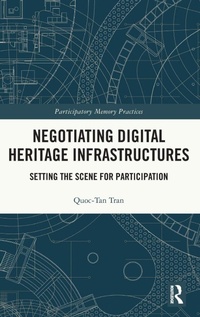
Negotiating Digital Heritage Infrastructures
Setting the Scene for Participation
1st Edition
Published on 18. September 2025
Book
Hardback
146 pages
978-1-032-73513-9 (ISBN)
Description
Negotiating Digital Heritage Infrastructures examines the infrastructural qualities of museum work that influence the ability of cultural institutions to support participatory and socially inclusive missions.
Drawing on data gathered in Scotland, Sweden, and Germany and taking an infrastructure studies approach, the book focuses on the socio-technical negotiations underpinning the everyday practices of museum staff. The book examines the work that is done behind the scenes, including the everyday tasks of collecting, archiving, displaying museum objects and retrieving information. Tran argues that while the technical components of infrastructure are necessary for memory-making and knowledge production, it is the social part of museum infrastructure that enables more open and decentralised modes of memory-making. The book shows how these negotiations affect the ability of museum infrastructures to accommodate and support growth and development, expanding access and establishing modes of connection to external partners and services. It illuminates the less visible practices of museums, which nevertheless directly affect their more public, outward-facing activities.
Negotiating Digital Heritage Infrastructures will be of interest to academics and students who are engaged in the study of museums and heritage. It will be particularly useful to those with an interest in public participation, social inclusion, heritage management, the digitisation of collections, data aggregation, and human-centred design approaches.
Drawing on data gathered in Scotland, Sweden, and Germany and taking an infrastructure studies approach, the book focuses on the socio-technical negotiations underpinning the everyday practices of museum staff. The book examines the work that is done behind the scenes, including the everyday tasks of collecting, archiving, displaying museum objects and retrieving information. Tran argues that while the technical components of infrastructure are necessary for memory-making and knowledge production, it is the social part of museum infrastructure that enables more open and decentralised modes of memory-making. The book shows how these negotiations affect the ability of museum infrastructures to accommodate and support growth and development, expanding access and establishing modes of connection to external partners and services. It illuminates the less visible practices of museums, which nevertheless directly affect their more public, outward-facing activities.
Negotiating Digital Heritage Infrastructures will be of interest to academics and students who are engaged in the study of museums and heritage. It will be particularly useful to those with an interest in public participation, social inclusion, heritage management, the digitisation of collections, data aggregation, and human-centred design approaches.
More details
Series
Language
English
Place of publication
London
United Kingdom
Publishing group
Taylor & Francis Ltd
Target group
College/higher education
Professional and scholarly
Academic and Postgraduate
Illustrations
8 s/w Abbildungen, 8 s/w Photographien bzw. Rasterbilder
8 Halftones, black and white; 8 Illustrations, black and white
Dimensions
Height: 240 mm
Width: 161 mm
Thickness: 13 mm
Weight
411 gr
ISBN-13
978-1-032-73513-9 (9781032735139)
Copyright in bibliographic data and cover images is held by Nielsen Book Services Limited or by the publishers or by their respective licensors: all rights reserved.
Schweitzer Classification
Other editions
Additional editions
E-Book
09/2025
Routledge
€56.49
Available for download
E-Book
09/2025
Routledge
€56.49
Available for download
Person
Quoc-Tan Tran holds a PhD in Cultural Anthropology from the University of Hamburg and an MRes in Library and Information Science from the University of Lille. He is a former Marie Sklodowska-Curie Fellow in the POEM network (Participatory Memory Practices) and he has been a postdoctoral researcher at Bielefeld University since 2025, working on the ROARA project (Repercussions of Open Access on Research Assessment). His research areas include open culture, data infrastructure, and the sociology of scientific knowledge.
Content
1. Infrastructural Setting of Memory Institutions; 2. Backstage Uncertainties; 3. Boundaries of Responsibility; 4. Negotiating Boundaries of Access; 5. Sustaining Infrastructure: Staff, Resources, and Constraints; 6. Conclusion: An Infrastructure-Based Approach to Backstage Participation