

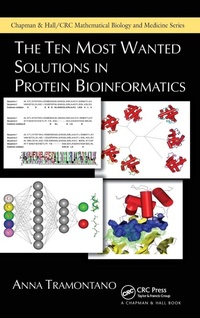
The Ten Most Wanted Solutions in Protein Bioinformatics
1st Edition
Published on 24. May 2005
Book
Hardback
218 pages
978-1-58488-491-0 (ISBN)
Description
Utilizing high speed computational methods to extrapolate to the rest of the protein universe, the knowledge accumulated on a subset of examples, protein bioinformatics seeks to accomplish what was impossible before its invention, namely the assignment of functions or functional hypotheses for all known proteins.
The Ten Most Wanted Solutions in Protein Bioinformatics considers the ten most significant problems occupying those looking to identify the biological properties and functional roles of proteins.
- Problem One considers the challenge involved with detecting the existence of an evolutionary relationship between proteins.
- Two and Three studies the detection of local similarities between protein sequences and analysis in order to determine functional assignment.
- Four, Five, and Six look at how the knowledge of the three-dimensional structures of proteins can be experimentally determined or inferred, and then exploited to understand the role of a protein.
- Seven and Eight explore how proteins interact with each other and with ligands, both physically and logically.
- Nine moves us out of the realm of observation to discuss the possibility of designing completely new proteins tailored to specific tasks.
- And lastly, Problem Ten considers ways to modify the functional properties of proteins.
After summarizing each problem, the author looks at and evaluates the current approaches being utilized, before going on to consider some potential approaches.
The Ten Most Wanted Solutions in Protein Bioinformatics considers the ten most significant problems occupying those looking to identify the biological properties and functional roles of proteins.
- Problem One considers the challenge involved with detecting the existence of an evolutionary relationship between proteins.
- Two and Three studies the detection of local similarities between protein sequences and analysis in order to determine functional assignment.
- Four, Five, and Six look at how the knowledge of the three-dimensional structures of proteins can be experimentally determined or inferred, and then exploited to understand the role of a protein.
- Seven and Eight explore how proteins interact with each other and with ligands, both physically and logically.
- Nine moves us out of the realm of observation to discuss the possibility of designing completely new proteins tailored to specific tasks.
- And lastly, Problem Ten considers ways to modify the functional properties of proteins.
After summarizing each problem, the author looks at and evaluates the current approaches being utilized, before going on to consider some potential approaches.
Reviews / Votes
"The book is comprehensive and succinct; people on busy schedules can read it in a short period of time. ...I believe that it is a great book. I will definitely include it as a recommended text for one of my Bioinformatics Graduate courses. I highly recommend this text to anyone interested in protein bioinformatics."-Kay C Wiese, Biomedical Engineering OnLine
"It succeeds in providing an introduction ... [for] someone with little or no knowledge of protein bioinformatics. For such a reader it would provide a fairly comprehensive, but necessarily brief overview of the research challenges the field faces. ... I would recommend this book to a new prospective researcher..."
-D.R.Westhead, UK Nonlinear News
"...Clarity and conciseness is apparent throughout the text, and at no point does it get weighted down by excessive detail. The text is equally adroit in its description of biological processes and structures. These are detailed in such a manner as to be easily understood by those with only a limited understanding of protein biology, without oversimplification ... [This book] has something to offer both biologists and informaticians alike, treating computation techniques and biological processes in balanced amounts. If a general high-level and broad ranging discussion of the state of research in protein bioinformatics is sought, then this book comes recommended."
-Dr. Matthew J. Sullivan, Proteomics
"To introduce newcomers to this area is not an easy task and this book is a serious attempt to help many of them."
-Short Book Reviews of the ISI
More details
Series
Language
English
Place of publication
Oxford
United States
Publishing group
Taylor & Francis Inc
Target group
Professional and scholarly
Professional
Illustrations
80 s/w Abbildungen, 24 farbige Abbildungen, 15 s/w Photographien bzw. Rasterbilder, 10 s/w Tabellen
10 Tables, black and white; 15 Halftones, black and white; 24 Illustrations, color; 80 Illustrations, black and white
Dimensions
Height: 235 mm
Width: 157 mm
Thickness: 17 mm
Weight
476 gr
ISBN-13
978-1-58488-491-0 (9781584884910)
Copyright in bibliographic data and cover images is held by Nielsen Book Services Limited or by the publishers or by their respective licensors: all rights reserved.
Schweitzer Classification
Other editions
Additional editions
Anna Tramontano
The Ten Most Wanted Solutions in Protein Bioinformatics
E-Book
05/2005
Chapman & Hall/CRC
€73.49
Available for download
Anna Tramontano
The Ten Most Wanted Solutions in Protein Bioinformatics
E-Book
05/2005
Chapman and Hall
€73.99
Available for download
Person
Content
Sequence alignment. Feature prediction from sequence. Protein structure prediction. Membrane proteins. Function prediction. Active site identification. Docking. Networks and pathways. Protein design. Mutant design.