

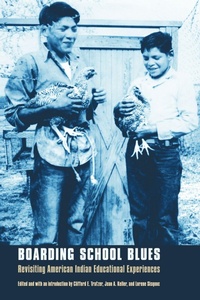
Boarding School Blues
Revisiting American Indian Educational Experiences
Published on 1. September 2006
Book
Paperback/Softback
274 pages
978-0-8032-9463-9 (ISBN)
Description
Like the figures in the ancient oral literature of Native Americans, children who lived through the American Indian boarding school experience became heroes, bravely facing a monster not of their own making. Sometimes the monster swallowed them up. More often, though, the children fought the monster and grew stronger. This volume draws on the full breadth of this experience in showing how American Indian boarding schools provided both positive and negative influences for Native American children. The boarding schools became an integral part of American history, a shared history that resulted in Indians "turning the power" by using their school experiences to grow in wisdom and benefit their people. The first volume of essays ever to focus on the American Indian boarding school experience, and written by some of the foremost experts and most promising young scholars of the subject, Boarding School Blues ranges widely in scope, addressing issues such as sports, runaways, punishment, physical plants, and Christianity. With comparative studies of the various schools, regions, tribes, and aboriginal peoples of the Americas and Australia, the book reveals both the light and the dark aspects of the boarding school experience and illuminates the vast gray area in between.
More details
Series
Language
English
Place of publication
Lincoln
United States
Target group
Professional and scholarly
Product notice
Paperback (trade)
Illustrations
Illus.
Dimensions
Height: 224 mm
Width: 151 mm
Thickness: 17 mm
Weight
398 gr
ISBN-13
978-0-8032-9463-9 (9780803294639)
Copyright in bibliographic data and cover images is held by Nielsen Book Services Limited or by the publishers or by their respective licensors: all rights reserved.
Schweitzer Classification
Persons
Clifford E. Trafzer is a professor of American Indian history, director of public history, and director of graduate studies at the University of California, Riverside. His many books include As Long as the Grass Shall Grow and Rivers Flow: A History of Native Americans. Jean A. Keller is an adjunct professor of American Indian studies at Palomar College in San Marcos, California, and a private cultural resources consultant. She is the author of Empty Beds: Indian Student Health at Sherman Institute, 1902-1922. Lorene Sisquoc is the curator of the Sherman Indian Museum in Riverside, California. She teaches Native American traditions to high school students and instructs extension classes in Native American studies.
Content
Introduction: Clifford E. Trafzer (University of California-Riverside), Jean A. Keller (Palomar College), and Lorene Sisquoc (Sherman Indian Museum), "Origin and Development of the American Indian Boarding School System: An Introduction"; 1: David Wallace Adams (Cleveland State University), "Beyond Bleakness: The Brighter Side of Indian Boarding Schools, 1870-1940"; 2: Clyde Ellis (Elon University), "'We Had A Lot of Fun, But Of Course, That Wasn't the School Part': Life at the Rainy Mountain Boarding School, 1893-1920"; 3: Jacqueline Fear-Segal (University of East Anglia, England), "The Man-on-the-band-stand at Carlisle Indian School: can he help reveal the children's experiences"; 4: Barbara C. Landis (Cumberland County Historical Society), "Putting Lucy Pretty Eagle to Rest"; 5: Scott Riney (Independent scholar), "Loosening the Bonds: The Rapid City Indian School in the 1920s"; 6: Tanya Rathbun (Independent scholar), "Hail Mary: The Catholic Experience at St. Boniface Indian School"; 7: Katrina A. Paxton (Independent scholar), "Learning Gender: Female Students at the Sherman Institute"; 8: Margaret Connell Szasz (University of New Mexico), "Viewing Boarding Schools Through a Wide-Angle Lens"; 9: Margaret D. Jacobs (University of Nebraska-Lincoln), "Indian Boarding Schools in Comparative Perspective: The Removal of Indigenous Children in the United States and Australia, 1880-1940"; 10: Patricia Dixon (Palomar College) and Clifford E. Trafzer (University of California-Riverside), "The Place of Indian Boarding Schools in Contemporary Society"