

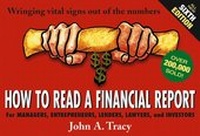
How to Read a Financial Report
Wringing Vital Signs Out of the Numbers
6th Edition
Published on 27. February 2004
Book
Paperback/Softback
216 pages
978-0-471-47867-6 (ISBN)
Description
Hidden somewhere among all the numbers in a financial report is vitally important information about where a company has been and where it is going. This is especially relevant in light of the recent corporate scandals. The sixth edition of the bestselling How to Read a Financial Reportis designed to help anyone who works with financial reports-but has neither the time nor the need for an in-depth knowledge of accounting-cut through the maze of accounting information to find out what those numbers really mean. Readers will receive a quick, but thorough introduction to financial reports, and learn how to decipher the information in them.
More details
Edition
6., Auflage
Language
English
Place of publication
New York
United States
Publishing group
John Wiley and Sons Ltd
Target group
College/higher education
Professional and scholarly
Edition type
Revised edition
Illustrations
Illustrations
Dimensions
Height: 25.1 cm
Width: 17.5 cm
Thickness: 13 mm
Weight
365 gr
ISBN-13
978-0-471-47867-6 (9780471478676)
Schweitzer Classification
Other editions
New editions

Book
05/2009
7th Edition
Wiley
€19.90
Article exhausted; check for reprint
Previous edition

Book
03/1999
5th Edition
Wiley
€19.90
Article exhausted; check for reprint
Person
JOHN A. TRACY is an award-winning professor of accounting at the University of Colorado at Boulder. He is also the author of The Fast Forward MBA in Finance.
Content
1. Starting with Cash Flows.
2. Introducing the Balance Sheet and Income Statement.
3. Profit Isn't Everything.
4. Sales Revenue and Accounts Receivable.
5. Cost of Goods Sold Expense and Inventory.
6. Inventory and Accounts Payable.
7. Operating Expenses and Accounts Payable.
8. Operating Expenses and Prepaid Expenses.
9. Long-Term Operating Assets: Depreciation and Amortization Expense.
10. Accruing Unpaid Operating Expenses and Interest Expense.
11. Income Tax Expense and Income Tax Payable.
12. Net Income and Retained Earnings; Earnings per Share (EPS).
13. Cash Flow from Profit and Loss.
14. Cash Flows from Investing and Financing Activities.
15. Growth, Decline, and Cash Flow.
16. Footnotes--The Fine Print in Financial Reports.
17. CPAs, Audits, and Audit Failures.
18. Choosing Accounting Methods and Quality of Earnings.
19. Making and Changing Accounting Standards.
20. Cost of Goods Sold Conundrum.
21. Depreciation Dilemmas.
22. Ratios for Creditors and Investors.
23. A Look Inside Management Accounting.
24. A Few Parting Comments.
Index.
2. Introducing the Balance Sheet and Income Statement.
3. Profit Isn't Everything.
4. Sales Revenue and Accounts Receivable.
5. Cost of Goods Sold Expense and Inventory.
6. Inventory and Accounts Payable.
7. Operating Expenses and Accounts Payable.
8. Operating Expenses and Prepaid Expenses.
9. Long-Term Operating Assets: Depreciation and Amortization Expense.
10. Accruing Unpaid Operating Expenses and Interest Expense.
11. Income Tax Expense and Income Tax Payable.
12. Net Income and Retained Earnings; Earnings per Share (EPS).
13. Cash Flow from Profit and Loss.
14. Cash Flows from Investing and Financing Activities.
15. Growth, Decline, and Cash Flow.
16. Footnotes--The Fine Print in Financial Reports.
17. CPAs, Audits, and Audit Failures.
18. Choosing Accounting Methods and Quality of Earnings.
19. Making and Changing Accounting Standards.
20. Cost of Goods Sold Conundrum.
21. Depreciation Dilemmas.
22. Ratios for Creditors and Investors.
23. A Look Inside Management Accounting.
24. A Few Parting Comments.
Index.