

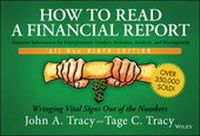
How to Read a Financial Report: Wringing Vital Signs Out of the Numbers
Wringing Vital Signs Out of the Numbers
9th Edition
Published on 5. February 2020
Book
Paperback/Softback
208 pages
978-1-119-60646-8 (ISBN)
Description
The updated new edition of the comprehensive guide to reading and understanding financial reports
Financial reports are used to provide a range of vital information, including an organization's cash flow, financial condition, and profit performance (aka The Big Three Financial Statements). Financial statements are often complex and extremely difficult to understand for anyone other than accounting and finance professionals. How to Read a Financial Report enablesinvestors, lenders, business leaders, analysts, and managers to read, analyze, and interpret financial accounting reports. Designed specifically for non-specialists, this reader-friendly resource covers the fundamentals of financial reporting in jargon-free English. Topics such as sales revenue & recognition, costs of goods sold, sources & uses of capital/cash, non-cash expenses (e.g., depreciation expense), income tax obligations, understanding profits & financial stability, and financial statement ratios & analysis are covered throughout the book.
Now in its ninth edition, this bestselling guide has been thoroughly revised to reflect changes in accounting and financial reporting rules, current practices, and recent trends. New and expanded content explains managing cash flow, illustrates the deceitful misrepresentation of profits in some financial reports (aka Financial Engineering), and more. Further, end-of-chapter activities help readers learn the intricacies of the balance sheet and cash flow statement, while updated sections address shifts in regulatory standards. Written by two highly experienced experts in financial accounting, this resource:
* Enables readers to cut through the noise and focus on what financial reports and financial statements are really saying about a company
* Clarifies commonly misunderstood aspects of financial reporting and how companies can "financially engineer" operating results
* Offers comprehensive, step-by-step guidance on analyzing financial reports
* Provides numerous examples and explanations of various types of financial reports and analysis tools
Financial reports are used to provide a range of vital information, including an organization's cash flow, financial condition, and profit performance (aka The Big Three Financial Statements). Financial statements are often complex and extremely difficult to understand for anyone other than accounting and finance professionals. How to Read a Financial Report enablesinvestors, lenders, business leaders, analysts, and managers to read, analyze, and interpret financial accounting reports. Designed specifically for non-specialists, this reader-friendly resource covers the fundamentals of financial reporting in jargon-free English. Topics such as sales revenue & recognition, costs of goods sold, sources & uses of capital/cash, non-cash expenses (e.g., depreciation expense), income tax obligations, understanding profits & financial stability, and financial statement ratios & analysis are covered throughout the book.
Now in its ninth edition, this bestselling guide has been thoroughly revised to reflect changes in accounting and financial reporting rules, current practices, and recent trends. New and expanded content explains managing cash flow, illustrates the deceitful misrepresentation of profits in some financial reports (aka Financial Engineering), and more. Further, end-of-chapter activities help readers learn the intricacies of the balance sheet and cash flow statement, while updated sections address shifts in regulatory standards. Written by two highly experienced experts in financial accounting, this resource:
* Enables readers to cut through the noise and focus on what financial reports and financial statements are really saying about a company
* Clarifies commonly misunderstood aspects of financial reporting and how companies can "financially engineer" operating results
* Offers comprehensive, step-by-step guidance on analyzing financial reports
* Provides numerous examples and explanations of various types of financial reports and analysis tools
More details
Other editions
New editions

Book
10/2024
10th Edition
Wiley
€31.50
Shipment within 15-20 days
Previous edition

Book
04/2014
8th Edition
Wiley
€24.90
Article exhausted; check for reprint
Persons
JOHN A. TRACY is a professor of accounting, emeritus, at the University of Colorado at Boulder. Before his 35-year tenure at Boulder, he was on the business faculty at the University of California, Berkeley. John is the author of several best-selling books on accounting and finance.
TAGE C. TRACY is the founder of TMK and Associates, a financial consulting firm focused on providing executive-level accounting, financial, and business management support. Tage has coauthored a total of six books with his father, John Tracy.
TAGE C. TRACY is the founder of TMK and Associates, a financial consulting firm focused on providing executive-level accounting, financial, and business management support. Tage has coauthored a total of six books with his father, John Tracy.
Content
List of Exhibits
Preface to the Ninth Edition
Part One--Fundamentals
1 Starting with Cash Flows
2 Two Bedrock Financial Statements
3 Reporting Cash Flow
4 Fitting Together Financial Statements
Part Two--Connections
5 Sales Revenue and Accounts Receivable
6 Cost of Goods Sold Expense and Inventory
7 Inventory and Accounts Payable
8 Operating Expenses and Accounts Payable
9 Operating Expenses and Prepaid Expenses
10 Depreciation Expense and Property, Plant, and Equipment; Intangible Assets
11 Accruing Liability for Unpaid Expenses
12 Income Tax Expense and Its Liability
13 Net Income and Retained Earnings; Earnings per Share (EPS)
14 Cash Flow from Operating (Profit Seeking) Activities
15 Cash Flow from Investing and Financing Activities
Part Three--Using Financial Statements
16 Footnotes and Management Discussions
17 Financial Statement Ratios and Analysis
18 Financial Engineering
19 CPAs and Financial Reports
20 Basic Questions, Basic Answers
About the Authors
Index
Preface to the Ninth Edition
Part One--Fundamentals
1 Starting with Cash Flows
2 Two Bedrock Financial Statements
3 Reporting Cash Flow
4 Fitting Together Financial Statements
Part Two--Connections
5 Sales Revenue and Accounts Receivable
6 Cost of Goods Sold Expense and Inventory
7 Inventory and Accounts Payable
8 Operating Expenses and Accounts Payable
9 Operating Expenses and Prepaid Expenses
10 Depreciation Expense and Property, Plant, and Equipment; Intangible Assets
11 Accruing Liability for Unpaid Expenses
12 Income Tax Expense and Its Liability
13 Net Income and Retained Earnings; Earnings per Share (EPS)
14 Cash Flow from Operating (Profit Seeking) Activities
15 Cash Flow from Investing and Financing Activities
Part Three--Using Financial Statements
16 Footnotes and Management Discussions
17 Financial Statement Ratios and Analysis
18 Financial Engineering
19 CPAs and Financial Reports
20 Basic Questions, Basic Answers
About the Authors
Index