

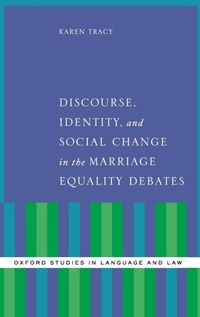
Discourse, Identity, and Social Change in the Marriage Equality Debates
Published on 13. May 2016
Book
Hardback
224 pages
978-0-19-021796-9 (ISBN)
Description
Karen Tracy examines the identity-work of judges and attorneys in state supreme courts as they debated the legality of existing marriage laws. Exchanges in state appellate courts are juxtaposed with the talk that occurred between citizens and elected officials in legislative hearings considering whether to revise state marriage laws. The book's analysis spans ten years, beginning with the U.S. Supreme Court's overturning of sodomy laws in 2003 and ending in 2013 when
the U.S. Supreme Court declared the federal government's Defense of Marriage Act (DOMA) unconstitutional, and it particularly focuses on how social change was accomplished through and reflected in these law-making and law-interpreting discourses. Focal materials are the eight cases about same-sex
marriage and civil unions that were argued in state supreme courts between 2005 and 2009, and six of a larger number of hearings that occurred in state judicial committees considering bills regarding who should be able to marry. Tracy concludes with analysis of the 2011 Senate Judiciary Committee Hearing on DOMA, comparing it to the initial 1996 hearing and to the 2013 Supreme Court oral argument about it. The book shows that social change occurred as the public discourse that treated sexual
orientation as a "lifestyle " was replaced with a public discourse of gays and lesbians as a legitimate category of citizen.
the U.S. Supreme Court declared the federal government's Defense of Marriage Act (DOMA) unconstitutional, and it particularly focuses on how social change was accomplished through and reflected in these law-making and law-interpreting discourses. Focal materials are the eight cases about same-sex
marriage and civil unions that were argued in state supreme courts between 2005 and 2009, and six of a larger number of hearings that occurred in state judicial committees considering bills regarding who should be able to marry. Tracy concludes with analysis of the 2011 Senate Judiciary Committee Hearing on DOMA, comparing it to the initial 1996 hearing and to the 2013 Supreme Court oral argument about it. The book shows that social change occurred as the public discourse that treated sexual
orientation as a "lifestyle " was replaced with a public discourse of gays and lesbians as a legitimate category of citizen.
Reviews / Votes
"Tracy uses transcripts of marriage equality debates in state supreme courts and state legislatures to chart a vertiginous change, from 2003 to 2013, in discourse as well as in society regarding this matter. She studies the transcripts to reveal concepts and strategies as well as the characteristics of the speakers, and to charter the evolution of debates regarding same sex marriage... Finally, Tracy highlights the transformation of moral arguments from being used mainly by those against marriage equality from a religious viewpoint, to becoming central for those in favor because it is 'the right thing to do.'"--ChoiceMore details
Other editions
Additional editions
E-Book
04/2016
1st Edition
OUP eBook
€53.49
Available for download
Person
Karen Tracy is Professor and Chair of Communication at the University of Colorado at Boulder. She was elected a Distinguished Scholar at the National Communication Association in 2010 and a Fellow in the International Communication Association in 2013. Tracy is a discourse analyst who studies and teaches about institutional talk, particularly in justice, academic, and governance sites.