

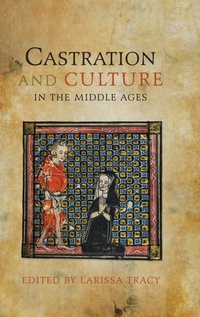
Castration and Culture in the Middle Ages
Published on 18. July 2013
Book
Hardback
365 pages
978-1-84384-351-1 (ISBN)
Description
Essays exploring medieval castration, as reflected in archaeology, law, historical record, and literary motifs.
Castration and castrati have always been facets of western culture, from myth and legend to law and theology, from eunuchs guarding harems to the seventeenth- and eighteenth-century castrati singers. Metaphoric castration pervadesa number of medieval literary genres, particularly the Old French fabliaux - exchanges of power predicated upon the exchange or absence of sexual desire signified by genitalia - but the plain, literal act of castration and its implications are often overlooked.
This collection explores this often taboo subject and its implications for cultural mores and custom in Western Europe, seeking to demystify and demythologize castration. Its subjects includearchaeological studies of eunuchs; historical accounts of castration in trials of combat; the mutilation of political rivals in medieval Wales; Anglo-Saxon and Frisian legal and literary examples of castration as punishment; castration as comedy in the Old French fabliaux; the prohibition against genital mutilation in hagiography; and early-modern anxieties about punitive castration enacted on the Elizabethan stage. The introduction reflects on these topics in the context of arguably the most well-known victim of castration in the middle ages, Abelard.
LARISSA TRACY is Associate Professor of Medieval Literature at Longwood University.
Contributors: Larissa Tracy, Kathryn Reusch, Shaun Tougher, Jack Collins, Rolf H. Bremmer Jr, Jay Paul Gates, Charlene M. Eska, Mary A. Valante, Anthony Adams, Mary E. Leech, Jed Chandler, Ellen Lorraine Friedrich, Robert L.A. Clark, Karin Sellberg, LenaWanggren
Castration and castrati have always been facets of western culture, from myth and legend to law and theology, from eunuchs guarding harems to the seventeenth- and eighteenth-century castrati singers. Metaphoric castration pervadesa number of medieval literary genres, particularly the Old French fabliaux - exchanges of power predicated upon the exchange or absence of sexual desire signified by genitalia - but the plain, literal act of castration and its implications are often overlooked.
This collection explores this often taboo subject and its implications for cultural mores and custom in Western Europe, seeking to demystify and demythologize castration. Its subjects includearchaeological studies of eunuchs; historical accounts of castration in trials of combat; the mutilation of political rivals in medieval Wales; Anglo-Saxon and Frisian legal and literary examples of castration as punishment; castration as comedy in the Old French fabliaux; the prohibition against genital mutilation in hagiography; and early-modern anxieties about punitive castration enacted on the Elizabethan stage. The introduction reflects on these topics in the context of arguably the most well-known victim of castration in the middle ages, Abelard.
LARISSA TRACY is Associate Professor of Medieval Literature at Longwood University.
Contributors: Larissa Tracy, Kathryn Reusch, Shaun Tougher, Jack Collins, Rolf H. Bremmer Jr, Jay Paul Gates, Charlene M. Eska, Mary A. Valante, Anthony Adams, Mary E. Leech, Jed Chandler, Ellen Lorraine Friedrich, Robert L.A. Clark, Karin Sellberg, LenaWanggren
Reviews / Votes
Anyone interested in the multiple premodern meanings of castration will enjoy this morbidly fascinating collection; it deserves the attention of all who work on ancient, medieval or early modern masculinities. * REVIEW OF ENGLISH STUDIES * Each contribution is equally engaging and provides an account that can be read as a stand-alone work; likewise, read in conjunction, the fourteen essays sit well together to provide a detailed picture of castration in medieval society. * PARERGON * Its wide temporal and geographical range, its sheaf of disciplinary approaches, make Castration and Culture a valuable collection and one that achieves a notable coherence. * OENACH *More details
Language
English
Place of publication
Cambridge
United Kingdom
Publishing group
Boydell & Brewer Ltd
Target group
College/higher education
Product notice
Cloth over boards
Illustrations
5 s/w Abbildungen
5 b/w illus.
Dimensions
Height: 240 mm
Width: 161 mm
Thickness: 24 mm
Weight
716 gr
ISBN-13
978-1-84384-351-1 (9781843843511)
Copyright in bibliographic data and cover images is held by Nielsen Book Services Limited or by the publishers or by their respective licensors: all rights reserved.
Schweitzer Classification
Other editions
Additional editions
Larissa Tracy
Castration and Culture in the Middle Ages
Book
03/2019
D.S. Brewer
€40.80
Shipment within 3-4 weeks
E-Book
07/2013
1st Edition
De Gruyter
€48.99
Available for download
Persons
Larissa Tracy is Professor of Medieval Literature at Longwood University. She has published extensively on medieval violence and its intersections with literature, law, medicine, and social identity. Larissa Tracy is Professor of Medieval Literature at Longwood University. She has published extensively on medieval violence and its intersections with literature, law, medicine, and social identity.
Content
Introduction: A History of Calamities: The Culture of Castration - Larissa Tracy
Raised Voices: The Archaeology of Castration - Kathryn Reusch
The Aesthetics of Castration: The Beauty of Roman Eunuchs - Shaun Tougher
Appropriation and Development of Castration as Symbol and Practice in Early Christianity - Jack Collins
'Al defouleden is holie bodi': Castration, the Sexualization of Torture, and Anxieties of Identity in the South English Legendary - Larissa Tracy
The Children He Never Had; The Husband She Never Served: Castration and Genital Mutilation in Medieval Frisian Law - Rolf H. Bremmer
The Fulmannod Society: Social Valuing of the (Male) Legal Subject - Jay Paul Gates
'Imbrued in their owne bloud': Castration in Early Welsh and Irish Sources - Charlene Eska
Castrating Monks: Vikings, the Slave Trade, and the Value of Eunuchs - Mary A. Valante
'He took a stone away': Castration and Cruelty in the Old Norse Sturlunga saga - Anthony Adams
The Castrating of the Shrew: The Performance of Masculinity and Masculine Identity in La dame escolliee - Mary E Leech
Eunuchs of the Grail - Jed Chandler
Insinuating Indeterminate Gender: A Castration Motif in Guillaume de Lorris's Romans de la rose - Ellen Lorraine Friedrich
Culture Loves a Void: Eunuchry in Eunuchry in De Vetula and Jean Le Fevre's La Vieille - Robert L. A. Clark
The Dismemberment of Will: Early Modern Fear of Castration - Lena Wanggren and Karin Sellberg
Raised Voices: The Archaeology of Castration - Kathryn Reusch
The Aesthetics of Castration: The Beauty of Roman Eunuchs - Shaun Tougher
Appropriation and Development of Castration as Symbol and Practice in Early Christianity - Jack Collins
'Al defouleden is holie bodi': Castration, the Sexualization of Torture, and Anxieties of Identity in the South English Legendary - Larissa Tracy
The Children He Never Had; The Husband She Never Served: Castration and Genital Mutilation in Medieval Frisian Law - Rolf H. Bremmer
The Fulmannod Society: Social Valuing of the (Male) Legal Subject - Jay Paul Gates
'Imbrued in their owne bloud': Castration in Early Welsh and Irish Sources - Charlene Eska
Castrating Monks: Vikings, the Slave Trade, and the Value of Eunuchs - Mary A. Valante
'He took a stone away': Castration and Cruelty in the Old Norse Sturlunga saga - Anthony Adams
The Castrating of the Shrew: The Performance of Masculinity and Masculine Identity in La dame escolliee - Mary E Leech
Eunuchs of the Grail - Jed Chandler
Insinuating Indeterminate Gender: A Castration Motif in Guillaume de Lorris's Romans de la rose - Ellen Lorraine Friedrich
Culture Loves a Void: Eunuchry in Eunuchry in De Vetula and Jean Le Fevre's La Vieille - Robert L. A. Clark
The Dismemberment of Will: Early Modern Fear of Castration - Lena Wanggren and Karin Sellberg