

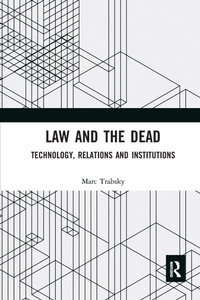
Law and the Dead
Technology, Relations and Institutions
1st Edition
Published on 30. September 2020
Book
Paperback/Softback
142 pages
978-0-367-66024-6 (ISBN)
Description
The governance of the dead in the eighteenth and nineteenth centuries gave rise to a new arrangement of thanato-politics in the West. Legal, medical and bureaucratic institutions developed innovative technologies for managing the dead, maximising their efficacy and exploiting their vitality. Law and the Dead writes a history of their institutional life in the nineteenth and twentieth centuries.
With a particular focus on the technologies of the death investigation process, including place-making, the forensic gaze, bureaucratic manuals, record-keeping and radiography, this book examines how the dead came to be incorporated into legal institutions in the modern era. Drawing on the writings of philosophers, historians and legal theorists, it offers tools for thinking through how the dead dwell in law, how their lives persist through the conduct of office, and how coroners assume responsibility for taking care of the dead.
This historical and interdisciplinary book offers a provocative challenge to conventional thinking about the sequestration of the dead in the nineteenth and twentieth centuries. It asks the reader to think through and with legal institutions when writing a history of the dead, and to trace the important role assumed by coroners in the governance of the dead. This book will be of interest to scholars working in law, history, sociology and criminology.
With a particular focus on the technologies of the death investigation process, including place-making, the forensic gaze, bureaucratic manuals, record-keeping and radiography, this book examines how the dead came to be incorporated into legal institutions in the modern era. Drawing on the writings of philosophers, historians and legal theorists, it offers tools for thinking through how the dead dwell in law, how their lives persist through the conduct of office, and how coroners assume responsibility for taking care of the dead.
This historical and interdisciplinary book offers a provocative challenge to conventional thinking about the sequestration of the dead in the nineteenth and twentieth centuries. It asks the reader to think through and with legal institutions when writing a history of the dead, and to trace the important role assumed by coroners in the governance of the dead. This book will be of interest to scholars working in law, history, sociology and criminology.
Reviews / Votes
The book was awarded the LSAANZ Book Prize 2019More details
Language
English
Place of publication
London
United Kingdom
Publishing group
Taylor & Francis Ltd
Target group
College/higher education
Dimensions
Height: 234 mm
Width: 156 mm
Thickness: 8 mm
Weight
231 gr
ISBN-13
978-0-367-66024-6 (9780367660246)
Copyright in bibliographic data and cover images is held by Nielsen Book Services Limited or by the publishers or by their respective licensors: all rights reserved.
Schweitzer Classification
Other editions
Additional editions
Book
03/2019
1st Edition
Routledge
€205.70
Shipment within 15-20 days
E-Book
03/2019
1st Edition
Routledge
€61.99
Available for download
E-Book
03/2019
1st Edition
Routledge
€61.99
Available for download
Person
Dr Marc Trabsky is a Senior Lecturer in Law at La Trobe University, Melbourne.
Content
Acknowledgements
Introduction
1 Law in the Necropolis
2 Visual Regimes of the Dead
3 The Bureaucratic Logic of Office
4 Dead Records
5 Screening the Corpse
Bibliography
Index
Introduction
1 Law in the Necropolis
2 Visual Regimes of the Dead
3 The Bureaucratic Logic of Office
4 Dead Records
5 Screening the Corpse
Bibliography
Index