

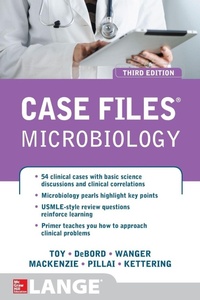
Case Files Microbiology, Third Edition
3rd Edition
Published on 16. October 2014
Book
Paperback/Softback
416 pages
978-0-07-182023-3 (ISBN)
Description
Publisher's Note: Products purchased from Third Party sellers are not guaranteed by the publisher for quality, authenticity, or access to any online entitlements included with the product.
LEARN MICROBIOLOGY IN THE CONTEXT OF REAL-LIFE PATIENTS AND PREPARE FOR THE USMLE STEP 1A Doody's Core Title for 2015!
Experience with clinical cases is key to excelling on the USMLE Step 1 and shelf exams, and ultimately to providing patients with competent clinical care. Case Files: Microbiology provides 54 true-to-life cases thatillustrate essential concepts in this field. Each case includes an easy-tounderstand discussion correlated to essential basic science concepts, definitions of key terms, microbiology pearls, and USMLE-style reviewquestions. With Case Files, you'll learn instead of memorize.
Learn from 54 high-yield cases, each with board-style questions and key-point pearls
Master complex concepts through clear and concise discussions
Practice with review questions to reinforce learning
Polish your approach to clinical problem-solving
Perfect for medical and dental students preparing for course exams and the Boards
LEARN MICROBIOLOGY IN THE CONTEXT OF REAL-LIFE PATIENTS AND PREPARE FOR THE USMLE STEP 1A Doody's Core Title for 2015!
Experience with clinical cases is key to excelling on the USMLE Step 1 and shelf exams, and ultimately to providing patients with competent clinical care. Case Files: Microbiology provides 54 true-to-life cases thatillustrate essential concepts in this field. Each case includes an easy-tounderstand discussion correlated to essential basic science concepts, definitions of key terms, microbiology pearls, and USMLE-style reviewquestions. With Case Files, you'll learn instead of memorize.
Learn from 54 high-yield cases, each with board-style questions and key-point pearls
Master complex concepts through clear and concise discussions
Practice with review questions to reinforce learning
Polish your approach to clinical problem-solving
Perfect for medical and dental students preparing for course exams and the Boards
More details
Edition
3rd edition
Language
English
Place of publication
United States
Publishing group
McGraw-Hill Education - Europe
Target group
College/higher education
Illustrations
10 Illustrations
Dimensions
Height: 229 mm
Width: 152 mm
Thickness: 22 mm
Weight
600 gr
ISBN-13
978-0-07-182023-3 (9780071820233)
Schweitzer Classification
Other editions
Additional editions
Eugene Toy | Cynthia R. Skinner DeBord | Audrey Wanger
Case Files Microbiology, Third Edition
E-Book
09/2014
1st Edition
McGraw-Hill Education
€57.53
Available for download
Persons
Eugene C. Toy, MD is a dual certified family physician and ob/gyn. He is the John S. Dunn Senior Academic Chair and Program Director of the Obstetrics and Gynecology Residency Program; Vice Chair of Academic Affairs in the Department of Obstetrics and Gynecology at The Methodist Hospital--Houston; Clerkship Director and Assistant Clinical Professor in the Department of Obstetrics and Gynecology at The University of Texas--Houston Medical School (Houston, Texas).
Cynthia R. Skinner DeBord, PhD, is Adjunct Faculty, Biology, at Tomball College in Tomball, TX. She was formerly the microbiology course director at UT-Houston School of Medicine.
Dr. Audrey Wanger is Associate Professor in the Department of Pathology & Laboratory Medicine at the University of Texas--Houston Medical School.
James D. Kettering, PhD is Emeritus Professor in the Department of Biochemistry and Microbiology at Loma Linda University Schools of Medicine. He also holds an Emeritus Professor position at the School of Dentistry, Dental Educatin Services.
Assistant Professor-Research Department of Microbiology and Molecular Genetics The University of Texas Health Science Center at Houston Houston, Texas
Cynthia R. Skinner DeBord, PhD, is Adjunct Faculty, Biology, at Tomball College in Tomball, TX. She was formerly the microbiology course director at UT-Houston School of Medicine.
Dr. Audrey Wanger is Associate Professor in the Department of Pathology & Laboratory Medicine at the University of Texas--Houston Medical School.
James D. Kettering, PhD is Emeritus Professor in the Department of Biochemistry and Microbiology at Loma Linda University Schools of Medicine. He also holds an Emeritus Professor position at the School of Dentistry, Dental Educatin Services.
Assistant Professor-Research Department of Microbiology and Molecular Genetics The University of Texas Health Science Center at Houston Houston, Texas
Content
Section I: Applying the Basic Sciences to Clinical Medicine
Part 1. Approach to Learning Microbiology
Part 2. Approach to Disease
Part 3. Approach to ReadingSection II: Antimicrobial Therapy
Part 1. Antibacterial Agenst
Part 2. Antiviral Agents
Part 3. Antifungal Agents
Part 4. Antiparasitic Agents
Section III: Clinical Cases
1. Bacillus anthracis
2. Bacteroides fragilis
3. Borrelia burgdorferi
4. Campylobacter jejuni
5. Chlamydia tractomatis
6. Clostridia
7. Corynebacterium diphtheriae
8. Enterococcus faecalis
9. Escherichia coli
10. Helicobacter pylori
11. Haemophilus influenzae
12. Klebsiella pneumoniae
13. Listeria monocytogenes
14. Mycobacterium
15. Mycoplasma
16. Neisseria
17. Proteus mirabilis
18. Psudomonas aeruginosa
19. Salmonella and shigella
20. Streptococcus
21. Staphylococci
22. Treponema pallidum
23. Vibrio cholerae
24. Adenovirus
25. Cytomegalovirus
26. Epstein-barr virus
27. Hepatitis viruses
28. Herpes simplex viruses
29. HIV
30. Human papillomavirus
31. Molluscum contagiosum
32. Mumps
33. Parvovirus
34. Poliovirus
35. Rotavirus
36. Respiratory syncytial virus
37. Smallpox
38. Varicella zoster virus
39. Aspergillus
40. Blastomycosis, coccidioidomycosis, and histoplasmosis
41. Candida
42. Cryptococcus neoformans
43. Pneumocystis jirovecii
44. Sporothrix schenckii
45. Ascariasis
46. Cryptosporidiosis
47. Enterobiasis or pinwrom infection
48. Malaria
49. Schistosomiais
50. Trichomoniasis
51. West nile virus
52. Rickettsia rickettsii
53. Brucella melitensis
54. Giardia
Section IV: Listing of Cases
Listing by Case Number
Listing by Disorder (Alphabetical)
Index
Part 1. Approach to Learning Microbiology
Part 2. Approach to Disease
Part 3. Approach to ReadingSection II: Antimicrobial Therapy
Part 1. Antibacterial Agenst
Part 2. Antiviral Agents
Part 3. Antifungal Agents
Part 4. Antiparasitic Agents
Section III: Clinical Cases
1. Bacillus anthracis
2. Bacteroides fragilis
3. Borrelia burgdorferi
4. Campylobacter jejuni
5. Chlamydia tractomatis
6. Clostridia
7. Corynebacterium diphtheriae
8. Enterococcus faecalis
9. Escherichia coli
10. Helicobacter pylori
11. Haemophilus influenzae
12. Klebsiella pneumoniae
13. Listeria monocytogenes
14. Mycobacterium
15. Mycoplasma
16. Neisseria
17. Proteus mirabilis
18. Psudomonas aeruginosa
19. Salmonella and shigella
20. Streptococcus
21. Staphylococci
22. Treponema pallidum
23. Vibrio cholerae
24. Adenovirus
25. Cytomegalovirus
26. Epstein-barr virus
27. Hepatitis viruses
28. Herpes simplex viruses
29. HIV
30. Human papillomavirus
31. Molluscum contagiosum
32. Mumps
33. Parvovirus
34. Poliovirus
35. Rotavirus
36. Respiratory syncytial virus
37. Smallpox
38. Varicella zoster virus
39. Aspergillus
40. Blastomycosis, coccidioidomycosis, and histoplasmosis
41. Candida
42. Cryptococcus neoformans
43. Pneumocystis jirovecii
44. Sporothrix schenckii
45. Ascariasis
46. Cryptosporidiosis
47. Enterobiasis or pinwrom infection
48. Malaria
49. Schistosomiais
50. Trichomoniasis
51. West nile virus
52. Rickettsia rickettsii
53. Brucella melitensis
54. Giardia
Section IV: Listing of Cases
Listing by Case Number
Listing by Disorder (Alphabetical)
Index