

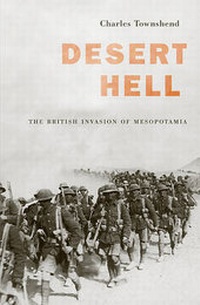
Desert Hell
The British Invasion of Mesopotamia
Published on 31. March 2011
Book
Hardback
624 pages
978-0-674-05999-3 (ISBN)
Description
The U.S.-led conquest and occupation of Iraq have kept that troubled country in international headlines since 2003. For America's major Coalition ally, Great Britain, however, this latest incursion into the region played out against the dramatic backdrop of imperial history: Britain's fateful invasion of Mesopotamia in 1914 and the creation of a new nation from the shards of war.
The objectives of the expedition sent by the British Government of India were primarily strategic: to protect the Raj, impress Britain's military power upon Arabs chafing under Ottoman rule, and secure the Persian oil supply. But over the course of the Mesopotamian campaign, these goals expanded, and by the end of World War I Britain was committed to controlling the entire region from Suez to India. The conquest of Mesopotamia and the creation of Iraq were the central acts in this boldly opportunistic bid for supremacy. Charles Townshend provides a compelling account of the atrocious, unnecessary suffering inflicted on the expedition's mostly Indian troops, which set the pattern for Britain's follow-up campaigns in Iraq and Afghanistan over the next seven years. He chronicles the overconfidence, incompetence, and dangerously vague policy that distorted the mission, and examines the steps by which an initially cautious strategic operation led to imperial expansion on a vast scale.
Desert Hell is a cautionary tale for makers of national policy. And for those with an interest in imperial history, it raises searching questions about Britain's quest for global power and the indelible consequences of those actions for the Middle East and the world.
The objectives of the expedition sent by the British Government of India were primarily strategic: to protect the Raj, impress Britain's military power upon Arabs chafing under Ottoman rule, and secure the Persian oil supply. But over the course of the Mesopotamian campaign, these goals expanded, and by the end of World War I Britain was committed to controlling the entire region from Suez to India. The conquest of Mesopotamia and the creation of Iraq were the central acts in this boldly opportunistic bid for supremacy. Charles Townshend provides a compelling account of the atrocious, unnecessary suffering inflicted on the expedition's mostly Indian troops, which set the pattern for Britain's follow-up campaigns in Iraq and Afghanistan over the next seven years. He chronicles the overconfidence, incompetence, and dangerously vague policy that distorted the mission, and examines the steps by which an initially cautious strategic operation led to imperial expansion on a vast scale.
Desert Hell is a cautionary tale for makers of national policy. And for those with an interest in imperial history, it raises searching questions about Britain's quest for global power and the indelible consequences of those actions for the Middle East and the world.
Reviews / Votes
Once its troops defeated the fading Ottoman forces, Britain had to deal with unanticipated long-term responsibilities. In a book packed with colorful personalities and military and political details, Townshend's focus on these painful war years spurs the reader to wonder whether 21st-century American leaders would have been more cautious about Iraq if they'd understood this history. -- Elizabeth R. Hayford * Library Journal * [A] riveting history of Britain's initially ill-fated invasion of Mesopotamia (it only became Iraq when the British created that country and gave it a king in 1921), it is difficult to escape the conclusion that foreign powers invariably receive a bloody nose when they intervene in Iraq. -- Justin Marozzi * Literary Review * This book is an exquisite history of the excruciatingly difficult, perhaps pointless, often disastrous British invasion and occupation of Mesopotamia between 1914 and 1924...Townshend skillfully limns the diverse and amazing characters who populated Britain's imperial "moment" in the Middle East. He has a nice touch for personality as well as a prodigious ability to relate military conflict, from the insane courage of soldiers in insect-infested swamps and the acrid, parched hellhole of Kut, where a British army starved and surrendered, to the grander conversations among field marshals, generals, and viceroys. His rendition of the giant battle of British egos, especially among the adventurous upper class, is among the best that I have read...But the great joy in reading Townshend comes from his intimate knowledge of the British Army. Townshend is an historian of movement: the reader can see clearly the British and Indian units attacking--the intrepid engineering on land and water that made the British military so feared and respected in the nineteenth century. With Townshend as a sure guide, the reader can feel the suffering and admire the sheer doggedness of the empire's soldiers, who in the Mesopotamian campaign fought in some of the worst conditions imaginable. -- Reuel Marc Gerecht * New Republic online * It is a harrowing story of a failure of strategic vision, policy drift, a massive disunity of effort, and poor execution. For the soldiers tasked with implementing the campaign, it truly was a "desert hell." -- Mackubin Thomas Owens * Weekly Standard * Townshend has written more than a campaign history; his book pays equal attention to civil affairs and diplomacy, following events to the establishment of the Iraqi monarchy in 1921. -- J. R. Breihan * Choice *More details
Language
English
Place of publication
Cambridge, Mass.
United States
Publishing group
Harvard University Press
Target group
US School Grade: College Graduate Student
Illustrations
16 halftones, 3 maps
Dimensions
Height: 235 mm
Width: 156 mm
ISBN-13
978-0-674-05999-3 (9780674059993)
Copyright in bibliographic data and cover images is held by Nielsen Book Services Limited or by the publishers or by their respective licensors: all rights reserved.
Schweitzer Classification
Person
Charles Townshend is Professor of International History at Keele University.