

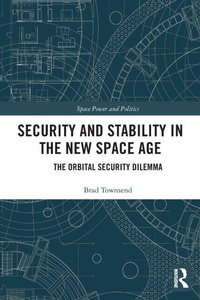
Security and Stability in the New Space Age
The Orbital Security Dilemma
1st Edition
Published on 1. August 2022
Book
Paperback/Softback
256 pages
978-0-367-52947-5 (ISBN)
Description
This book examines the drivers behind great power security competition in space to determine whether realistic strategic alternatives exist to further militarization.
Space is an area of increasing economic and military competition. This book offers an analysis of actions and events indicative of a growing security dilemma in space, which is generating an intensifying arms race between the US, China, and Russia. It explores the dynamics behind a potential future war in space and investigates methods of preventing an arms race from an international relations theory and military-strategy standpoint. The book is divided into three parts: the first section offers a broad discussion of the applicability of international relations theory to current conditions in space; the second is a direct application of theory to the space environment to determine whether competition or cooperation is the optimal strategic choice; the third section focuses on testing the hypotheses against reality, by analyzing novel alternatives to three major categories of space systems. The volume concludes with a study of the practical limitations of applying a strategy centered on commercialization as a method of defusing the orbital security dilemma.
This book will be of interest to students of space power, strategic studies, and international relations.
Space is an area of increasing economic and military competition. This book offers an analysis of actions and events indicative of a growing security dilemma in space, which is generating an intensifying arms race between the US, China, and Russia. It explores the dynamics behind a potential future war in space and investigates methods of preventing an arms race from an international relations theory and military-strategy standpoint. The book is divided into three parts: the first section offers a broad discussion of the applicability of international relations theory to current conditions in space; the second is a direct application of theory to the space environment to determine whether competition or cooperation is the optimal strategic choice; the third section focuses on testing the hypotheses against reality, by analyzing novel alternatives to three major categories of space systems. The volume concludes with a study of the practical limitations of applying a strategy centered on commercialization as a method of defusing the orbital security dilemma.
This book will be of interest to students of space power, strategic studies, and international relations.
More details
Series
Language
English
Place of publication
London
United Kingdom
Publishing group
Taylor & Francis Ltd
Target group
College/higher education
Postgraduate, Professional, and Undergraduate Advanced
Illustrations
18 s/w Abbildungen, 6 s/w Photographien bzw. Rasterbilder, 12 s/w Zeichnungen, 9 s/w Tabellen
9 Tables, black and white; 12 Line drawings, black and white; 6 Halftones, black and white; 18 Illustrations, black and white
Dimensions
Height: 234 mm
Width: 156 mm
Thickness: 15 mm
Weight
409 gr
ISBN-13
978-0-367-52947-5 (9780367529475)
Copyright in bibliographic data and cover images is held by Nielsen Book Services Limited or by the publishers or by their respective licensors: all rights reserved.
Schweitzer Classification
Other editions
Additional editions
Book
07/2020
1st Edition
Routledge
€207.80
Shipment within 15-20 days
E-Book
07/2020
1st Edition
Routledge
€59.49
Available for download
E-Book
07/2020
1st Edition
Routledge
€59.49
Available for download
Person
Brad Townsend is currently an Army Space Officer assigned as a space policy advisor on the Pentagon Joint Staff, and has a Ph.D. in Military Strategy from the Air University.
Content
1. Introduction 2. The Orbital Security Dilemma 3. Power, Motive, Intent, and Information 4. Deterrence and Reassurance 5. Military Satellite Communications 6. Remote Sensing 7. Missile Warning 8. Competition or Cooperation? Conclusion