

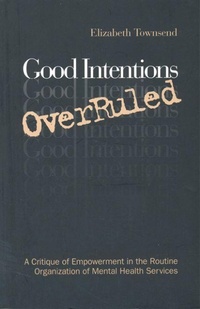
Good Intentions OverRuled
A Critique of Empowerment in the Routine Organization of Mental Health Services
2nd Edition
Will be published approx. on 7. February 1998
Book
Paperback/Softback
240 pages
978-0-8020-7802-5 (ISBN)
Description
Good Intentions OverRuled is about empowerment; so it is also about power. This book shows how power is exerted in the routine organizational processes that determine what can be done in everyday life, since modern societies are controlled by regulations, policies, professional practice, legislation, budgets, and other forms of organization.
Against the backdrop of an ideal vision of empowerment, this critique highlights both the Good Intentions of professionals and the organizational processes through which empowerment is OverRuled. Professionals who promote empowerment for those with little power, such as people with long-standing mental health problems, experience tension, a disjuncture between enabling participation in empowerment and engaging in caregiving processes that perpetuate dependence. Attempts to enable participation are undermined by processes of objectification, individualized accountability, hierarchical decision making, simulation-based education, risk management, and exclusion, which protect but also control people. The significance of this critique extends beyond mental health services because similar processes are used in the routine organization of power in education, employment insurance, transportation, and other sectors of society.
Good Intentions OverRuled sparks debate about empowerment by using a method called institutional ethnography, developed by the Canadian sociologist Dorothy Smith. Mental health day programs are explored from the perspective of seven occupational therapists in Atlantic Canada. Described in this ethnography are the local, provincial, federal, and international processes used to organize power in Canada's mental health services. The aim is to inspire professional, lay, academic, and other persons (including those who use mental health services) to change the organization of power so that we promote rather than overrule empowerment.
Against the backdrop of an ideal vision of empowerment, this critique highlights both the Good Intentions of professionals and the organizational processes through which empowerment is OverRuled. Professionals who promote empowerment for those with little power, such as people with long-standing mental health problems, experience tension, a disjuncture between enabling participation in empowerment and engaging in caregiving processes that perpetuate dependence. Attempts to enable participation are undermined by processes of objectification, individualized accountability, hierarchical decision making, simulation-based education, risk management, and exclusion, which protect but also control people. The significance of this critique extends beyond mental health services because similar processes are used in the routine organization of power in education, employment insurance, transportation, and other sectors of society.
Good Intentions OverRuled sparks debate about empowerment by using a method called institutional ethnography, developed by the Canadian sociologist Dorothy Smith. Mental health day programs are explored from the perspective of seven occupational therapists in Atlantic Canada. Described in this ethnography are the local, provincial, federal, and international processes used to organize power in Canada's mental health services. The aim is to inspire professional, lay, academic, and other persons (including those who use mental health services) to change the organization of power so that we promote rather than overrule empowerment.
More details
Edition
2nd edition
Language
English
Place of publication
Toronto
Canada
Target group
College/higher education
Professional and scholarly
Product notice
Paperback (trade)
Dimensions
Height: 228 mm
Width: 153 mm
Thickness: 18 mm
Weight
363 gr
ISBN-13
978-0-8020-7802-5 (9780802078025)
Copyright in bibliographic data and cover images is held by Nielsen Book Services Limited or by the publishers or by their respective licensors: all rights reserved.
Schweitzer Classification
Person
Elizabeth Townsend is an associate professor in the School of Occupational Therapy, Dalhousie University.