

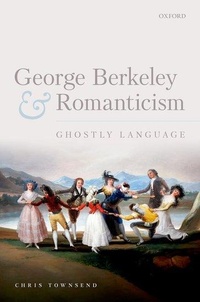
George Berkeley and Romanticism
Ghostly Language
Published on 5. May 2022
Book
Hardback
240 pages
978-0-19-284678-5 (ISBN)
Description
George Berkeley's mainstream legacy amongst critics and philosophers, from Samuel Johnson to Bertrand Russell, has tended to concern his claim that the objects of perception are in fact nothing more than our ideas. Yet there's more to Berkeley than idealism alone, and the poets now grouped under the label 'Romanticism' took up Berkeley's ideas in especially strange and surprising ways. As this book shows, the poets Blake, Wordsworth, Coleridge, and Shelley focused less on Berkeley's arguments for idealism than they did on his larger, empirically-derived claim that nature constitutes a kind of linguistic system. It is through that 'ghostly language' that we might come to know ourselves, each other, and even God.
This book is a reappraisal of the role that Berkeley's ideas played in Romanticism, and it pursues his spiritualized philosophy across a range of key Romantic-period poems. But it is also a re-reading of Berkeley himself, as a thinker who was deeply concerned with language and with written--even literary--style. In that sense, it offers an incisive case study into the reception of philosophical ideas into the workings of poetry, and of the role of poetics within the history of ideas more broadly.
This book is a reappraisal of the role that Berkeley's ideas played in Romanticism, and it pursues his spiritualized philosophy across a range of key Romantic-period poems. But it is also a re-reading of Berkeley himself, as a thinker who was deeply concerned with language and with written--even literary--style. In that sense, it offers an incisive case study into the reception of philosophical ideas into the workings of poetry, and of the role of poetics within the history of ideas more broadly.
Reviews / Votes
In this book, Townsend argues for "a pervasive 'Berkeleian' undercurrent in the major English Romantic canon" (p. 17), specifically, the poetry of Blake, Coleridge, Wordsworth, and Shelley. In the opening chapter, Townsend offers what he calls "an original reading of Berkeley's work" (p. 9). He presents the centrality of spirit in Berkeley's ontology and his conception of nature as a divine visual language as key themes that connect Berkeley with the Romantic poets. Each of the remaining four chapters is devoted to one of the four poets. * Choice * Townsend's study is essential reading for any scholar with an interest in the philosophy of the Romantic period, its reception of Enlightenment, and its thinking about poetic form. * Tom Marshall, British Association of Romantic Studies *More details
Language
English
Place of publication
Oxford
United Kingdom
Target group
Professional and scholarly
Product notice
sewn/stitched
Cloth over boards
Dimensions
Height: 238 mm
Width: 164 mm
Thickness: 19 mm
Weight
526 gr
ISBN-13
978-0-19-284678-5 (9780192846785)
Copyright in bibliographic data and cover images is held by Nielsen Book Services Limited or by the publishers or by their respective licensors: all rights reserved.
Schweitzer Classification
Other editions
Additional editions
E-Book
04/2022
1st Edition
OUP eBook
€49.99
Available for download
E-Book
04/2022
1st Edition
OUP eBook
€49.99
Available for download
Person
Chris Townsend is a College Teaching Officer in English Literature at Christ's College, University of Cambridge, and a researcher working mainly on Romantic poetics and aesthetics. His published articles include work on rhythm in Keats, rhyme in Rossetti, and prose-borne pentameters in Woolf.
Content
Part One
Introduction: Ghostly Language
1: Berkeley and the Language of Philosophy
Part Two
2: Spiritual Bodies and Mental Realities in Blake
3: Inside Outness in Coleridge
4: Wordsworth's Ghostly Language
5: Shelley's Uncreative Mind
Conclusion: Berkeley and Romanticism
Introduction: Ghostly Language
1: Berkeley and the Language of Philosophy
Part Two
2: Spiritual Bodies and Mental Realities in Blake
3: Inside Outness in Coleridge
4: Wordsworth's Ghostly Language
5: Shelley's Uncreative Mind
Conclusion: Berkeley and Romanticism