

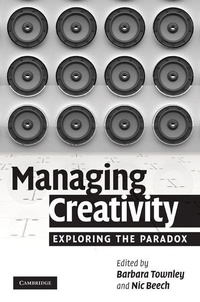
Managing Creativity
Exploring the Paradox
1st Edition
Published on 24. December 2009
Book
Hardback
364 pages
978-0-521-51853-6 (ISBN)
Description
What are the challenges and opportunities of managing people in creative industries? How are the tensions between creative and commercial pressures mediated? The creative industries are an area of increasing economic importance. Yet creative industries and creative-based organizations are rife with problems such as whether and how control of the creative process should be exercised; the extent to which knowledge of creative production may be made explicit; and how the 'connection' between producer and consumer should be mediated. In Managing Creativity a team of experts from a diverse range of fields - including management, fine art, music, the internet, design, theatre and publishing - discuss these and other problems concerning the relationship between management and creativity. Developing an appreciation of these problems is theoretically productive, not only because it throws light onto our understanding of creative-based organizations, but also because it can be revelatory about organizations more generally.
More details
Language
English
Place of publication
Cambridge
United Kingdom
Target group
Professional and scholarly
Dimensions
Height: 235 mm
Width: 157 mm
Thickness: 26 mm
Weight
741 gr
ISBN-13
978-0-521-51853-6 (9780521518536)
Copyright in bibliographic data and cover images is held by Nielsen Book Services Limited or by the publishers or by their respective licensors: all rights reserved.
Schweitzer Classification
Other editions
Additional editions
Book
10/2011
Cambridge University Press
€63.80
Shipment within 15-20 days
Persons
Barbara Townley is Professor of Management and Director of the Institute for Capitalising on Creativity at the University of St Andrews. Her research concerns the introduction of managerial technologies (appraisal systems, business planning and performance measures) and the impact of these on institutional logics that inform organizational functioning. Her most recent book is Reason's Neglect (2008). Nic Beech is Professor of Management at the University of St Andrews. He is the founding chair of the British Academy of Management special interest group on identity and co-chair of the Scottish Network on Organizational Vitality. His research is mainly focused on the social dynamics of organizational life - the intertwining of people's identities, relationships and practices. He is co-author (with Eugene McKenna) of The Essence of HRM (2008, 2nd edition).
Content
List of figures; List of tables; List of contributors; Acknowledgements; Introduction: 1. The discipline of creativity Barbara Townley and Nic Beech; Part I. Inherent Unknowability: 2. To draw thought - how can this be done differently? Aileen M. Stackhouse; 3. Labour, work and action in the creative process Martin Dixon; 4. Popular culture as carnival: the clash, play and transgression in the aesthetic economy Stephen Linstead; Part II. Art for Art's Sake: 5. Art for art's sake: was it ever thus? A historical perspective Julian M. Luxford; 6. The logics of art: analysing theatre as a cultural field Doris Ruth Eikhof; 7. Turning rebellion into money: the clash, creativity and resistance to commodification Stephen Linstead; Part III. Infinite Variety: 8. Communication, artists and the audience Christopher Randall; 9. Art or honesty? Breaking the rules of the game with immersive museum theatre Paul Johnson; 10. User-generated content and the participative market Gregor White; Part IV. The Motley Crew: 11. The missing middle: management in the creative industries Chris Warhurst; 12. Playing the system: design consultancies, professionalisation and value Guy Julier; 13. Organising creativity in a music festival Jane Donald, Louise Mitchell and Nic Beech; Part V. Ars Longa: 14. Juicy Salif as a cultish totem Laura Gonzalez; 15. 'Time past': the value of remembrance in aesthetic experience Amy Parker; 16. What is a creative field? Elizabeth Gulledge and Barbara Townley; Managing creativity: concluding thoughts; Index.