

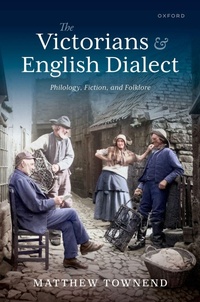
The Victorians and English Dialect
Philology, Fiction, and Folklore
Published on 9. July 2024
Book
Hardback
336 pages
978-0-19-888812-3 (ISBN)
Description
The Victorians and English Dialect tells the story of the Victorians' discovery of English dialect, and of the revaluation of local language that was brought about by the new, historical philology of the nineteenth century. Regional dialects came to be seen not as corrupt or pernicious, but rather as venerable and precious.
The book examines the work of the ground-breaking collectors of the 1840s and 1850s, who first alerted their contemporaries to the importance of local dialect - and also to the perils that threatened it with extinction.It traces the connection between dialect and literature, in the flourishing of dialect poetry and the foregrounding of regional voices in Victorian fiction. It explains how the antiquity of regional dialects cast light on the national past - the Celts, Anglo-Saxons, and Vikings - and how dialect study was also at the heart of the discovery of local folklore and oral culture: old words, old customs, old beliefs. And it tells the story of the three great monuments of Victorian dialect study that marked the apogee of regional philology: the 80 publications of the English Dialect Society (1873-96), an organization run by a committee of journalists and local historians in Manchester; the nationwide survey of The Existing Phonology of English Dialects (1889), which listened in on local speech in market squares and third-class railway carriages; and the multi-volume English Dialect Dictionary (1898-1905), which collected all the previous labours together, and made an enduring record of Victorian dialect.
The book examines the work of the ground-breaking collectors of the 1840s and 1850s, who first alerted their contemporaries to the importance of local dialect - and also to the perils that threatened it with extinction.It traces the connection between dialect and literature, in the flourishing of dialect poetry and the foregrounding of regional voices in Victorian fiction. It explains how the antiquity of regional dialects cast light on the national past - the Celts, Anglo-Saxons, and Vikings - and how dialect study was also at the heart of the discovery of local folklore and oral culture: old words, old customs, old beliefs. And it tells the story of the three great monuments of Victorian dialect study that marked the apogee of regional philology: the 80 publications of the English Dialect Society (1873-96), an organization run by a committee of journalists and local historians in Manchester; the nationwide survey of The Existing Phonology of English Dialects (1889), which listened in on local speech in market squares and third-class railway carriages; and the multi-volume English Dialect Dictionary (1898-1905), which collected all the previous labours together, and made an enduring record of Victorian dialect.
More details
Language
English
Place of publication
Oxford
United Kingdom
Target group
College/higher education
Product notice
sewn/stitched
Cloth over boards
Dimensions
Height: 239 mm
Width: 163 mm
Thickness: 33 mm
Weight
680 gr
ISBN-13
978-0-19-888812-3 (9780198888123)
Copyright in bibliographic data and cover images is held by Nielsen Book Services Limited or by the publishers or by their respective licensors: all rights reserved.
Schweitzer Classification
Other editions
Additional editions
E-Book
07/2024
1st Edition
OUP eBook
€48.99
Available for download
E-Book
06/2024
1st Edition
OUP eBook
€48.99
Available for download
Person
Matthew Townend is Professor in the Department of English and Related Literature, and the Centre for Medieval Studies, at the University of York, where he has taught since 1999. He is an expert both on medieval language and literature (especially Old Norse, Old English, and the history of the English language) and also on nineteenth- and twentieth-century 'medievalism' (that is, the re-imagining of the Middle Ages in modern literature and culture). He teaches widely - from undergraduate courses to PhD supervision - in the areas of medieval language and literature, and also modern medievalism.
Content
1: The Pioneers
2: The Phoneticians
3: Dialect and Literature
4: The English Dialect Society
5: Folklore and the Past
6: The English Dialect Dictionary
2: The Phoneticians
3: Dialect and Literature
4: The English Dialect Society
5: Folklore and the Past
6: The English Dialect Dictionary