

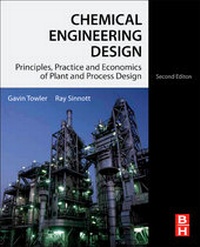
Chemical Engineering Design
Principles, Practice and Economics of Plant and Process Design
2nd Edition
Published on 18. February 2012
Book
Hardback
1320 pages
978-0-08-096659-5 (ISBN)
Description
Chemical Engineering Design, Second Edition, deals with the application of chemical engineering principles to the design of chemical processes and equipment. Revised throughout, this edition has been specifically developed for the U.S. market.
It provides the latest US codes and standards, including API, ASME and ISA design codes and ANSI standards. It contains new discussions of conceptual plant design, flowsheet development, and revamp design; extended coverage of capital cost estimation, process costing, and economics; and new chapters on equipment selection, reactor design, and solids handling processes.
A rigorous pedagogy assists learning, with detailed worked examples, end of chapter exercises, plus supporting data, and Excel spreadsheet calculations, plus over 150 Patent References for downloading from the companion website. Extensive instructor resources, including 1170 lecture slides and a fully worked solutions manual are available to adopting instructors.
This text is designed for chemical and biochemical engineering students (senior undergraduate year, plus appropriate for capstone design courses where taken, plus graduates) and lecturers/tutors, and professionals in industry (chemical process, biochemical, pharmaceutical, petrochemical sectors).
It provides the latest US codes and standards, including API, ASME and ISA design codes and ANSI standards. It contains new discussions of conceptual plant design, flowsheet development, and revamp design; extended coverage of capital cost estimation, process costing, and economics; and new chapters on equipment selection, reactor design, and solids handling processes.
A rigorous pedagogy assists learning, with detailed worked examples, end of chapter exercises, plus supporting data, and Excel spreadsheet calculations, plus over 150 Patent References for downloading from the companion website. Extensive instructor resources, including 1170 lecture slides and a fully worked solutions manual are available to adopting instructors.
This text is designed for chemical and biochemical engineering students (senior undergraduate year, plus appropriate for capstone design courses where taken, plus graduates) and lecturers/tutors, and professionals in industry (chemical process, biochemical, pharmaceutical, petrochemical sectors).
Reviews / Votes
"An essential support text for the traditional design product. ...Well written, it is easy to read and is superbly indexed" --Trans IChemE"Bottom line: For a holistic view of chemical engineering design, this book provides as much, if not more, than any other book available on the topic. Nearly every subject is accompanied by examples and new technologies are also addressed. In short, a complete, well-written and illustrated resource that is a pleasure to use." --From www.cheresources.com (Chemical Engineering Resources)
"Chemical Engineering Design is a complete text for students of chemical engineering. Written for the senior design course, and also suitable for introduction to chemical engineering courses, it covers the basics of unit operations and the latest aspects of process design, equipment selection, plant and operating economics, safety and loss prevention. It includes detailed worked examples, case studies, end-of-chapter exercises, plus supporting data, spreadsheet calculations and equipment specification sheets for downloading." --Chemical Engineering Progress
"The book was originally written by British chemical engineer Sinnott as Volume Six of the Chemical Engineering series edited by Coulson and Richardson. It was intended as a stand-alone design textbook for undergraduate design projects that would supplement the other volumes, so it was no long stretch to publish it separately in 2008. Towler (chemical engineering, Northwestern U., Illinois) helped update and revise it, and integrated US laws, codes, and standards into it. This second edition takes account of comments about strengths and weaknesses by students and instructors. It also is rearranged to fit a typical two-course senior design sequence better, focusing first on process design then on plant design." --Reference and Research Book News, Inc.
More details
Edition
2nd edition
Language
English
Place of publication
Oxford
United Kingdom
Publishing group
Elsevier Science & Technology
Target group
College/higher education
Chemical and Biochemical Engineering students (3rd yr or graduate level); professionals in industry ¬- chemical process, biochemical, pharmaceutical, petrochemical sectors
Dimensions
Height: 235 mm
Width: 191 mm
Weight
2000 gr
ISBN-13
978-0-08-096659-5 (9780080966595)
Copyright in bibliographic data and cover images is held by Nielsen Book Services Limited or by the publishers or by their respective licensors: all rights reserved.
Schweitzer Classification
Other editions
New editions
Gavin Towler | Ray Sinnott
Chemical Engineering Design
Principles, Practice and Economics of Plant and Process Design
Book
08/2021
3rd Edition
Butterworth-Heinemann
€123.50
Shipment within 10-15 days
Additional editions
Gavin Towler | Ray Sinnott
Chemical Engineering Design
Principles, Practice and Economics of Plant and Process Design
E-Book
01/2012
2nd Edition
Butterworth-Heinemann
€88.95
Available for download
Previous edition
Gavin Towler | Ray Sinnott
Chemical Engineering Design
Principles, Practice and Economics of Plant and Process Design
Book
11/2007
Butterworth-Heinemann
€70.55
Article exhausted; check for reprint
Persons
Gavin Towler Ph.D. is the Vice President and Chief Technology Officer of UOP LLC, a Honeywell company. UOP is a leading supplier of catalysts, process technology, proprietary equipment and services to the oil, gas and petrochemical industries. In this capacity he is responsible for delivering process, catalyst and equipment innovations for UOP's four businesses.Gavin has 20 years of broad experience of process and product design and has 65 US patents. He is co-author of "Chemical Engineering Design?, a textbook on process design, and is an Adjunct Professor at Northwestern University, where he teaches the senior design classes. Gavin has a B.A. and M.Eng. in chemical engineering from Cambridge University and a Ph.D. from U.C. Berkeley. He is a Chartered Engineer and Fellow of the Institute of Chemical Engineers, and is a Fellow of the AIChE. Ray Sinnott's varied career, mainly in design and development, began with several major companies including Dupont and John Brown. The main areas covered within these appointments were: Gas Production and Distribution, Nuclear Energy, Elastomers and Textile fibres. After his career in industry he joined the Chemical Engineering Department, University of Wales Swansea in 1970, specialising in teaching process and plant design, and other engineering practice subjects. The first edition of Chemical Engineering Design (Coulson and Richardson's Vol 6) was published in 1983. Subsequent editions have been published at approximately 5 year intervals.Ray Sinnott retired from full time teaching in 1995 but has maintained close contact with the engineering profession.
Content
Part I: Process Design
1 Introduction to Design
2 Process Flowsheet Development
3 Utilities and Energy Efficient Design
4 Process Simulation
5 Instrumentation and Process Control
6 Materials of Construction
7 Capital Cost Estimating
8 Estimating Revenues and Production Costs
9 Economic Evaluation of Projects
10 Safety and Loss Prevention
11 General Site Considerations
12 Optimization in Design
Part II: Plant Design
13 Equipment Selection, Specification and Design
14 Design of Pressure Vessels
15 Design of Reactors and Mixers
16 Separation of Fluids
17 Separation Columns (Distillation, Absorption and Extraction)
18 Specification and Design of Solids-Handling Equipment
19 Heat Transfer Equipment
20 Transport and Storage of Fluids
1 Introduction to Design
2 Process Flowsheet Development
3 Utilities and Energy Efficient Design
4 Process Simulation
5 Instrumentation and Process Control
6 Materials of Construction
7 Capital Cost Estimating
8 Estimating Revenues and Production Costs
9 Economic Evaluation of Projects
10 Safety and Loss Prevention
11 General Site Considerations
12 Optimization in Design
Part II: Plant Design
13 Equipment Selection, Specification and Design
14 Design of Pressure Vessels
15 Design of Reactors and Mixers
16 Separation of Fluids
17 Separation Columns (Distillation, Absorption and Extraction)
18 Specification and Design of Solids-Handling Equipment
19 Heat Transfer Equipment
20 Transport and Storage of Fluids