


Applying Maths in Construction
Published on 2. May 1997
Book
Paperback/Softback
144 pages
978-0-415-50313-6 (ISBN)
Description
An excellent resource for teachers consisting of a CD, explanatory notes and a student textbook this Pack and its accompanying student's book are the result of a project, supported by the Nuffield Foundation, to provide flexible learning materials for the Basic Application of Number core skill for both the NVQ and GNVQ in construction and the construction crafts. All the material in the pack can be printed and photocopied.
The CD ROM provides over 30 modules of tutorial material which can be turned into hard copy for use by the students in class or as self assessment exercises. Each module starts with a test for the student to assess their knowledge. Detailed explanations of the mathematics are then given, with exercises for the student throughout. Lastly there is a review test to assess the progress made. All the modules have been assessed both by lecturers in further education and professionals working in the construction industry. With the CD ROM comes a detailed guide to its contents, explaining how modules can be linked together to develop particular number skills. The student book uses a unique approach to explain how mathematical principles apply to construction tasks. Each chapter forms an individual construction project and uses the full range of number skills from the fundamentals of addition and subtraction to statistics, trigonometry and technical drawing. Successfully completed projects provide the student with the required portfolio of evidence for their course. Notes throughout the text refer the student to the relevant module in the Teacher's Pack.
The CD ROM provides over 30 modules of tutorial material which can be turned into hard copy for use by the students in class or as self assessment exercises. Each module starts with a test for the student to assess their knowledge. Detailed explanations of the mathematics are then given, with exercises for the student throughout. Lastly there is a review test to assess the progress made. All the modules have been assessed both by lecturers in further education and professionals working in the construction industry. With the CD ROM comes a detailed guide to its contents, explaining how modules can be linked together to develop particular number skills. The student book uses a unique approach to explain how mathematical principles apply to construction tasks. Each chapter forms an individual construction project and uses the full range of number skills from the fundamentals of addition and subtraction to statistics, trigonometry and technical drawing. Successfully completed projects provide the student with the required portfolio of evidence for their course. Notes throughout the text refer the student to the relevant module in the Teacher's Pack.
More details
Language
English
Place of publication
London
United Kingdom
Publishing group
Taylor & Francis Ltd
Target group
College/higher education
ISBN-13
978-0-415-50313-6 (9780415503136)
Copyright in bibliographic data is held by Nielsen Book Services Limited or its licensors: all rights reserved.
Schweitzer Classification
Other editions
Additional editions
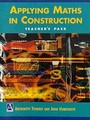
Antoinette V. Tourret | John Humphries
Applying Maths in Construction: Teacher's Pack
Book
05/1997
Butterworth-Heinemann
€282.70
Article exhausted; check different version
Content
Intoduction * Measurement 1 - Measuring lengths * Measurement 2 - Calculating lengths, + and -, whole numbers * Pythagoras 1 * Using your calculator * Orthographic projection * Trigonometry 1 * Measurement 3 - Calculating lengths, + and -, decimal numbers * Bearings and position * Calculating simple volumes * Percentages * Converting units of measurement * Calculating costs using multiplication * Calculating costs using division * Approximating * Calculating rectangular areas * Areas of rectangles and parallelograms * More about areas * Working with circles * Ratios and proportion * Calculating and using averages * Interpreting and constructing statistical diagrams * Working with fractions * Calculating complex perimeters * Isometric and oblique drawing * Reading scales * Scales and scale drawing * Using formulas * Complex volumes * Constructing regular polygons * Calculating areas of irregular shapes * Using arcs and curves * Triangles and angles * Index