


What Is Democracy?
1st Edition
Published on 3. April 1997
Book
Hardback
240 pages
978-0-8133-2706-8 (ISBN)
Description
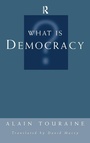
In this sequel to A Critique of Modernity, Alain Touraine questions the social and cultural content of democracy today. At a time when state power is being increasingly eroded by the economic might of transnational capital, what possible value can we ascribe to a democratic idea that is defined merely as a set of guarantees against the totalitarian state?If democracy is to survive in the postcommunist world, Touraine argues, it must accomplish two urgent goals: It must somehow protect the power of the nation-state at the same time as it limits that power (for only the state has sufficient means to counterbalance the global corporate wielders of money and information); and it must reconcile social diversity with social unity and individual liberty with integration.This is not merely a philosophical problem but a dilemma whose resolution will dramatically affect the immediate future of people everywhere. If we want a resolution in democracys favor, then it is time, in Touraines view, for us to redefine democracy in terms of active intervention rather than mere passive institution.
To preserve the power and effectiveness of our states and societies, we must make visible stridesand soonaway from a politics of particularity and toward the integration and balancing of women and minorities, of immigrants, of rich and poor. If our states become too weakened, too debased by the politics of competing identities and interest groups, we will one day find ourselves without the means to protect the very values we believe we are fighting to uphold. }In this sequel to A Critique of Modernity, Alain Touraine questions the social and cultural content of democracy today. At a time when state power is being increasingly eroded by the economic might of transnational capital, what possible value can we asc ribe to a democratic idea that is defined merely as a set of guarantees against the totalitarian state?If democracy is to survive in the postcommunist world, Touraine argues, it must accomplish two urgent goals: It must somehow protect the power of the nation-state at the same time as it limits that power (for only the state has sufficient means to counterbalance the global corporate wielders of money and information); and it must reconcile social diversity with social unity and individual liberty with integration.
This is not merely a philosophical problem but a dilemma whose resolution will dramatically affect the immediate future of people everywhere. If we want a resolution in democracys favor, then it is time, in Touraines view, for us to redefine democracy in terms of active intervention rather than mere passive institution. To preserve the power and effectiveness of our states and societies, we must make visible stridesand soonaway from a politics of particularity and toward the integration and balancing of women and minorities, of immigrants, of rich and poor. If our states become too weakened, too debased by the politics of competing identities and interest groups, we will one day find ourselves without the means to protect the very values we believe we are fighting to uphold. }
To preserve the power and effectiveness of our states and societies, we must make visible stridesand soonaway from a politics of particularity and toward the integration and balancing of women and minorities, of immigrants, of rich and poor. If our states become too weakened, too debased by the politics of competing identities and interest groups, we will one day find ourselves without the means to protect the very values we believe we are fighting to uphold. }In this sequel to A Critique of Modernity, Alain Touraine questions the social and cultural content of democracy today. At a time when state power is being increasingly eroded by the economic might of transnational capital, what possible value can we asc ribe to a democratic idea that is defined merely as a set of guarantees against the totalitarian state?If democracy is to survive in the postcommunist world, Touraine argues, it must accomplish two urgent goals: It must somehow protect the power of the nation-state at the same time as it limits that power (for only the state has sufficient means to counterbalance the global corporate wielders of money and information); and it must reconcile social diversity with social unity and individual liberty with integration.
This is not merely a philosophical problem but a dilemma whose resolution will dramatically affect the immediate future of people everywhere. If we want a resolution in democracys favor, then it is time, in Touraines view, for us to redefine democracy in terms of active intervention rather than mere passive institution. To preserve the power and effectiveness of our states and societies, we must make visible stridesand soonaway from a politics of particularity and toward the integration and balancing of women and minorities, of immigrants, of rich and poor. If our states become too weakened, too debased by the politics of competing identities and interest groups, we will one day find ourselves without the means to protect the very values we believe we are fighting to uphold. }
More details
Language
English
Place of publication
United States
Publishing group
Taylor & Francis Inc
Target group
College/higher education
Professional and scholarly
Dimensions
Height: 229 mm
Width: 152 mm
ISBN-13
978-0-8133-2706-8 (9780813327068)
Copyright in bibliographic data is held by Nielsen Book Services Limited or its licensors: all rights reserved.
Schweitzer Classification
Other editions
Additional editions
Alain Touraine | David Macey
What Is Democracy?
Book
04/1997
1st Edition
Westview Press Inc
€78.40
Shipment within 10-20 days
Content
Introduction; The Three Dimensions Of Democracy; A New Idea; Human Rights, Representation, and Citizenship; Limitations on Power; Representative Political Actors; Citizenship; A History Of The Modern Democratic Spirit; Republicans and Liberals; Opening Up a Public Space; Democratic Culture; The Politics of the Subject; Recomposing the World; Democracy And Development; Modernization or Development?; Transforming Old into New; Democratization in the East and the South?; Conclusion