

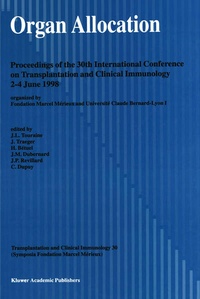
Organ Allocation
Proceedings of the 30th Conference on Transplantation and Clinical Immunology, 2-4 June, 1998
Published on 9. November 2012
Book
Paperback/Softback
XI, 311 pages
978-94-010-6091-2 (ISBN)
Description
Over the last few years, transplantation knowledge and techniques, as well as insights into pharmacology, have improved, thus enabling greater access to transplantation for patients.
The pool of organs for transplantation is stable, and therefore insufficient to cope with the growing demand. To adjust demand and resources in the most equitable way, organ procurement and allocation have been organized nationally and often across borders. The national and international organ exchange programs were studied and discussed during the Congress on Organ Allocation, from which this book is derived.
This book describes the state of the art in the management of waiting lists and the allocation of organs in transplantation. It includes chapters on the possibilities of expanding the pool of available cadaver organs. It also analyzes the results of transplantation of cadaver organs from older donors and marginal, non-heart beating donors.
Transplantation policies based on the offering of organs by living donors are also described, as is the impact of delayed graft function on organ allocation.
The pool of organs for transplantation is stable, and therefore insufficient to cope with the growing demand. To adjust demand and resources in the most equitable way, organ procurement and allocation have been organized nationally and often across borders. The national and international organ exchange programs were studied and discussed during the Congress on Organ Allocation, from which this book is derived.
This book describes the state of the art in the management of waiting lists and the allocation of organs in transplantation. It includes chapters on the possibilities of expanding the pool of available cadaver organs. It also analyzes the results of transplantation of cadaver organs from older donors and marginal, non-heart beating donors.
Transplantation policies based on the offering of organs by living donors are also described, as is the impact of delayed graft function on organ allocation.
More details
Series
Edition
Softcover reprint of the original 1st ed. 1998
Language
English
Place of publication
Dordrecht
Netherlands
Target group
Professional and scholarly
Research
Illustrations
XI, 311 p.
Dimensions
Height: 240 mm
Width: 160 mm
Thickness: 18 mm
Weight
526 gr
ISBN-13
978-94-010-6091-2 (9789401060912)
DOI
10.1007/978-94-011-4984-6
Schweitzer Classification
Other editions
Additional editions
J.-L. Touraine | J. Traeger | H. Bétuel
Organ Allocation
Proceedings of the 30th Conference on Transplantation and Clinical Immunology, 2-4 June, 1998
E-Book
12/2012
Springer
€53.49
Available for download
J.-L. Touraine | J. Traeger | H. Bétuel
Organ Allocation
Proceedings of the 30th Conference on Transplantation and Clinical Immunology, 2-4 June, 1998
Book
05/1998
1st Edition
Kluwer Academic Publishers
€96.00
Article exhausted; check different version
Content
1: Overview of organ allocation policies and strategies in different countries.- 1. Principles for allocation of cadaver organs to transplant recipients and coordinating procedures in Spain.- 2. Principles and practice of cadaver organ allocation in France.- 3. Principles for allocation of cadaver organs to transplant recipients in Italy.- 4. Allocation of cadaver organs to transplant recipients in Scandiatransplant.- 5. Principles for allocation of cadaver organs to transplant recipients in the USA (UNOS).- 6. Allocation of kidneys in the UK.- 2: Principles underlying current policies in organ allocation.- 7. What to expect from a good kidney allocation system.- 8. Allocation of cadaver organs to transplant recipients in Eurotransplant: principles and policies, Anno 1998.- 9. Increasing kidney supply as the best solution to the allocation problem.- 10. Strategies in organ donation.- 11. World Health Organization guidelines on transplantation and the WHO Task Force.- 3: Waiting list.- The French liver transplant waiting list: 5-year analysis (1992-1996).- 13. Predictors of multiple listing for cadaver kidney transplantation and the effects of a ban on multiple listing in the United States - a summary.- 14. Allocation of kidneys to patients on the transplant waiting list: a simulation-based policy model.- 15. Factors influencing early placement on the kidney transplant waiting list in the United States.- 16. The organ transplant waiting list in France.- 4: At-risk donors.- 17. Expanded donor pool.- 18. Non heart-beating donors.- 19. How to reconcile viral safety and efficacy in organ procurement.- 20. The problem of infectious transmission from donors in organ transplantation.- 21. Further readings on allocation of organs from at-risk donors.- 5: Ischemia reperfusionand organ allocation.- 22. The inflammatory cascade of liver ischemia and reperfusion: from the donor to the recipient.- 23. The role of T-cell costimulatory pathways in ischemia-reperfusion injury.- 24. Interest in an anti-LFA-1 monoclonal antibody in the prevention of reperfusion injury in kidney transplantation.- 25. Preservation solution in heart transplantation.- 26. The impact of ischemia-reperfusion injury on specific and non-specific, early and late chronic events after organ transplantation.- 27. Pharmacological intervention to decrease ischemia-reperfusion injury.- 6: Living donors and organ allocation.- 28. Organ transplantation in Islam.- 29. Liver donor transplantation in Sweden and other Nordic countries with emphasis on the benefits of the procedure.- 30. Kidney exchange programs: an expanded view of the ethical issues.- 31. Unconventional living kidney donors.- Index of names.