

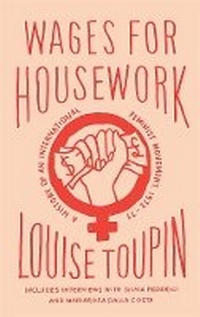
Wages for Housework
A History of an International Feminist Movement, 1972-77
Published on 15. September 2018
Book
Hardback
324 pages
978-0-7748-3763-7 (ISBN)
Description
In this first-ever international history of the influential feminist movement Wages for Housework, Louise Toupin draws on extensive archival research and interviews with the movement's founders and activists from Italy, England, Germany, Switzerland, the United States, and Canada. Featuring previously unpublished conversations with Silvia Federici and Mariarosa Dalla Costa, the book highlights the power and originality of the movement, detailing its theoretical and organizational innovations around the unrecognized labour performed by women.
Challenging both classic Marxist theory and the mainstream women's movement, Wages for Housework organized in the 1970s around the idea that domestic or "reproductive" labour is as crucial for the survival of the capitalist system as more typically male "productive" labour. Its activists demanded the wage as a way of ensuring that housework's value be recognized, an idea still hotly debated today.
Wages for Housework is a major contribution to the history of feminist and anti-capitalist movements and a provocative intervention into contemporary conversations about the changing nature of work and the gendered labour market.
Challenging both classic Marxist theory and the mainstream women's movement, Wages for Housework organized in the 1970s around the idea that domestic or "reproductive" labour is as crucial for the survival of the capitalist system as more typically male "productive" labour. Its activists demanded the wage as a way of ensuring that housework's value be recognized, an idea still hotly debated today.
Wages for Housework is a major contribution to the history of feminist and anti-capitalist movements and a provocative intervention into contemporary conversations about the changing nature of work and the gendered labour market.
Reviews / Votes
Drawing on feminism, Marxism, and capitalism, Wages for Housework is rooted in academia, but Toupin's crisp and confident writing make the book accessible to all readers with an interest in gender studies and labour history in Canada and beyond. A huge undertaking and achievement, Wages for Housework is much-needed documentation of a movement that is largely unknown. - Jessica Rose (Rabble.ca)More details
Language
English
Place of publication
Vancouver
Canada
Target group
Professional and scholarly
Product notice
sewn/stitched
Illustrations
87 b&w illustrations
Dimensions
Height: 230 mm
Width: 150 mm
Weight
600 gr
ISBN-13
978-0-7748-3763-7 (9780774837637)
Copyright in bibliographic data and cover images is held by Nielsen Book Services Limited or by the publishers or by their respective licensors: all rights reserved.
Schweitzer Classification
Persons
Louise Toupin has authored and co-authored numerous books on feminist thought and social movements and she taught political science at the Universite du Quebec a Montreal prior to her retirement.
Content
Introduction: A Political and Personal History
Part 1: The International Feminist Collective - Historical Overview and Political Perspective
1 1972: Wages for Housework in the Universe of Feminism
2 A Wage as a Lever of Power: The Political Perspective
3 The International Feminist Collective, 1972-77
Part 2: Mobilizations around Women's Invisible Work
Overview
4 Mobilizations around Women's Invisible Work in the Home
5 Mobilizations around Women's Invisible Work outside the Home
6 Mobilizations by Groups on the Periphery of the Network
Conclusion
Afterword - From Yesterday to Today: The Intellectual Journeys of Mariarosa Dalla Costa and Silvia Federici, from 1977 to 2013
Notes
Selected Bibliography
Index
Part 1: The International Feminist Collective - Historical Overview and Political Perspective
1 1972: Wages for Housework in the Universe of Feminism
2 A Wage as a Lever of Power: The Political Perspective
3 The International Feminist Collective, 1972-77
Part 2: Mobilizations around Women's Invisible Work
Overview
4 Mobilizations around Women's Invisible Work in the Home
5 Mobilizations around Women's Invisible Work outside the Home
6 Mobilizations by Groups on the Periphery of the Network
Conclusion
Afterword - From Yesterday to Today: The Intellectual Journeys of Mariarosa Dalla Costa and Silvia Federici, from 1977 to 2013
Notes
Selected Bibliography
Index