

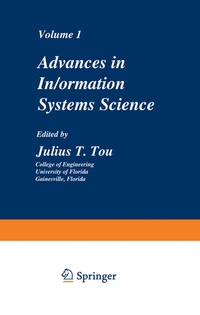
Advances in Information Systems Science
Volume 1
Published on 27. February 2013
Book
Paperback/Softback
XV, 303 pages
978-1-4615-9052-1 (ISBN)
Description
Engineering has long been thought of by the public as a profession tra ditionally categorized into such branches as electrical, mechanical, chemical, industrial, civil, etc. This classification has served its purpose for the past half century; but the last decade has witnessed a tremendous change. A continuous transition from the practical to the theoretical has made technology overlap with science, and the enlargement of scope and broad ened diversification have smeared the boundaries between traditional engi neering and scientific fields. Engineering is rapidly becoming a diversified, multidisciplinary field of scientific endeavor. This has prompted us to regard modern engineering as a science, which has as its ingredients materials, energy, and information. In our complex and technologically-oriented society organizations are flooded with an enormous amount of management information. We are now faced with problems concerning the efficient use of communicated knowledge. The steady growth in the magnitude and complexity of informa tion systems necessitates the development of new theories and techniques for solving these information problems. We demand instant access to pre viously recorded information for decision making, and we require new meth ods for analysis, recognition, processing, and display. As a consequence, information science has evolved out of necessity. Concerned with the theoretical basis of the organization, control, stor age, retrieval, processing, and communication of information both by natural and artificial systems, information science is multidisciplinary in character. It covers a vast area of subject matter in the physical and biological sciences.
More details
Edition
Softcover reprint of the original 1st ed. 1969
Language
English
Place of publication
New York
United States
Target group
College/higher education
Professional and scholarly
Research
Product notice
Paperback (trade)
Unsewn / adhesive bound
Illustrations
3 s/w Abbildungen
XV, 303 p. 3 illus.
Dimensions
Height: 229 mm
Width: 152 mm
Thickness: 18 mm
Weight
466 gr
ISBN-13
978-1-4615-9052-1 (9781461590521)
DOI
10.1007/978-1-4615-9050-7
Schweitzer Classification
Other editions
Additional editions
E-Book
12/2012
Springer
€53.49
Available for download

Julius T. Tou
Advances in Information Systems Science: Volume 1
Book
01/1969
Kluwer Academic/Plenum Publishers
€109.13
Article exhausted; check different version
Content
1 Theory of Algorithms and Discrete Processors.- 1. Introduction.- 2. Discrete Processors.- 3. Examples of Discrete Processors.- 4. Computers and Discrete Processors.- 5. Systems of Algorithmic Algebras.- 6. Application of Algorithmic Algebras to Transformations of Microprograms.- 7. Equivalence of Discrete Processors.- 8. Equivalence of Automata with Terminal States Relative to an Automaton without Cycles.- 9. Specific Cases of Solutions to the Equivalence Problem.- 10. Conclusions.- References.- 2 Programming Languages.- 1. Introduction.- 2. The Basic Linguistic Nature of Programming Languages.- 3. Programming Languages and Semiotics.- 4. The Formal Definition of Programming Lan guages.- 5. The Definition of Programmable Automata and their Languages.- 6. Parallel Concurrent Processes.- 7. Machine Languages.- 8. Special and General-Purpose Algorithmic Languages.- 9. Special Problem-Oriented Languages.- 10. Simulation Languages.- 11. Conversational Languages.- 12. Conclusion.- References.- 3 Formula Manipulation-The User's Point of View.- 1. Introduction.- 2. Different Types of Formula Manipulation Systems.- 3. Toward a Mathematical Utility.- 4. The Formula Manipulation Language Symbal.- 5. The Syntax of Symbal.- 6. The Basic Symbols and Syntactic Entities.- 7. Expressions.- 8. The Remaining Parts of the Language.- 9. Standard Variables.- 10. Techniques and Applications.- 11. Summary.- References.- 4 Engineering Principles of Pattern Recognition.- 1. Introduction.- 2. Basic Problems in Pattern Recognition.- 3. Feature Selection and Preprocessing.- 4. Pattern Classification by Distance Functions.- 5. Pattern Classification by Potential Functions...- 6. Pattern Classification by Likelihood Functions.- 7. Pattern Classification by Entropy Functions...- 8. Conclusions.-References.- 5 Learning Control Systems.- 1. Introduction.- 2. Trainable Controllers.- 3. Reinforcement Learning Control Systems.- 4. Bayesian Learning in Control Systems.- 5. Learning Control Systems Using Stochastic Approximation.- 6. The Method of Potential Functions and its Application to Learning Control.- 7. Stochastic Automata as Models of Learning Controllers.- 8. Conclusions.- Appendix. Stochastic Approximation-A Brief Survey.- References.- Author Index.