

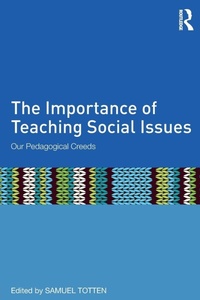
The Importance of Teaching Social Issues
Our Pedagogical Creeds
1st Edition
Published on 7. August 2014
Book
Paperback/Softback
274 pages
978-1-138-78853-4 (ISBN)
Description
John Dewey's My Pedagogical Creed outlined his beliefs in regard to teaching and learning. In this volume, prominent contemporary teacher educators such as Diana Hess, Geneva Gay and O.L. Davis follow in Dewey's footsteps, articulating their own pedagogical creeds as they relate to educating about social issues. Through personal stories, each contributor reveals the major concerns, tenets, and interests behind their own teaching and research, including the experiences underlying their motivation to explore social issues via the school curriculum. Rich with biographical detail, The Importance of Teaching Social Issues combines diverse voices from curriculum theory, social studies education, science education, and critical theory, providing a unique volume relevant for today's teachers and education scholars.
Reviews / Votes
"Samuel Totten has assembled a who's who of educators in this compelling volume that will serve as a much-needed refresher on the core values and beliefs that examine the place of social issues in the extant curriculum. Readers will be affirmed, challenged and inspired by the pointed biographies and rhapsodic beliefs that eloquently echo John Dewey's famous refrain of 1897, 'I believe...". And in the true spirit of education worthy of its name, readers will be called to act, to teach by light of this elegant volume. This work is a great tribute to Dewey's deep legacy by his contemporary students."- William Gaudelli, Teachers College, Columbia University
"We owe Samuel Totten and the contributors to The Importance of Teaching Social Issues a debt of gratitude. They bear witness and give voice to the need to understand children and pedagogy within a historical context of humane concerns and commitments. In an era of "big data," hot money, and "creative destruction," they challenge us to remember that data are not wisdom, profit is not success, and that real lives are being destroyed by our retreat from the ideal of a common good."
- Alex Molnar, Research Professor, University of Colorado-Boulder
More details
Language
English
Place of publication
London
United Kingdom
Publishing group
Taylor & Francis Ltd
Target group
College/higher education
Product notice
Paperback (trade)
Unsewn / adhesive bound
Dimensions
Height: 231 mm
Width: 152 mm
Thickness: 15 mm
Weight
386 gr
ISBN-13
978-1-138-78853-4 (9781138788534)
Copyright in bibliographic data and cover images is held by Nielsen Book Services Limited or by the publishers or by their respective licensors: all rights reserved.
Schweitzer Classification
Other editions
Additional editions
E-Book
08/2014
Routledge
€69.99
Available for download
E-Book
08/2014
Routledge
€69.99
Available for download
Book
08/2014
1st Edition
Routledge
€231.90
Shipment within 10-20 days
Person
Samuel Totten is Professor Emeritus of Curriculum and Instruction at the University of Arkansas.
Content
Preface: Education in a Time of Crisis-H. Svi Shapiro. Introduction-Samuel Totten. PART ONE: THE IMPERATIVE. 1. The Imperative to Incorporate a Study of Social Issues into the School Curriculum-Samuel Totten. 2. The Social Issues Education Imperative-William G. Wraga. 3. Authentic Teaching is Venturing into Uncertainty-Geneva Gay. 4. Roots, Branches, and Shoots-Margaret Smith Crocco. 5. A Creed for the Non-Religious: Intellectual Freedom-Jack Nelson. 6. Opening Up to Inquiry-Jack Zevin. 7. Teaching About Social Issues and Concerns Need Not Be an "All or None" Circumstance-O.L. Davis. PART TWO: UNDERPINNING DEMOCRATIC SOCIETY. 8. The Challenge of Teaching About and For Democracy when Democracy is so Troubled-Diana E. Hess. 9. Imagining and Constructing Social Democracy: An Educator's Creed-William R. Fernekes. 10. Preparing Effective Citizens via an Issues Centered Approach-Mark A. Previte. 11. From Controversy to Decisionmaking: The Heart of Social Issues Instruction-William B. Russell III. PART THREE: CRITICAL STUDIES. 12. "Prepare to Be on Center Stage": A Critical, Issues-Centered Approach to Teaching for Social Understanding-Ronald W. Evans. 13. Teaching to Change the World?-Carlos Alberto Torres. 14. Teaching for Change: Social Education and Critical Knowledge of Everyday Life-E. Wayne Ross. 15. Knowledge, Education and Power: A Social Justice Pedagogical Creed-Charlene Johnson-Carter. 16. From Voicing to Naming to Re-humanization-Miguel Zavala. 17. Positionality, Recognition, and Dialogue in Democratic Education-Steven P. Camicia. PART FOUR: MOVING FROM THE CLASSROOM INTO THE WORLD. 18. Searching for Understanding, Finding the Peacemakers-Elizabeth Yeager Washington. 19. Delving into the World within and Beyond the Classroom Door: Lessons About Inequality and Opportunity-Chara Haeussler Bohan. 20. Questioning and Blurring Boundaries in a Context of Change: Science, Technology, Engineering, and Mathematics (STEM) Education-Barbara Solomon Spector. 21. Developing Global Consciousness-Merry M. Merryfield. 22. Big History as Core Curriculum-Cynthia Brown. 23. The Centrality of Students and Their Appreciation and Understanding of Social Issues-Robert E. Yager. Appendix: "My Pedagogic Creed"-John Dewey.