

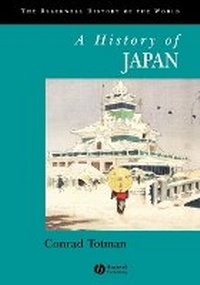
A History of Japan
1st Edition
Published on 24. April 2000
Book
Paperback/Softback
660 pages
978-0-631-21447-2 (ISBN)
Description
This authoritative and accessible book charts the history of Japan from c.8000 bc to the 1990s.
Reviews / Votes
"A History of Japan is a highly recommended, informative, scholarly, comprehensive, and 'reader friendly' introduction and historical survey that will be much appreciated by students of Japanese history and culture, and has a wealth of material for the non-specialist general reader seeking to understand the Japan of antiquity as well as a contemporary and influential society." The Midwest Book Review"Not until Conrad Totman's A History of Japan has there been such a sophisticated and detailed record of Japan's past, one that combines and critiques the standard perspectives while adding a new vision all its own. In a word, this is the best single-volume examination of Japan's history available .. A History of Japan is a masterpiece." Monumenta Nipponica
"A clear and concise overview of the whole of Japanese history." History
"Students and the ... general reader ... will profit from engagement with this book." English Historical Review
"A History of Japan is one of the most perceptive and illuminating studies of Japan's history to have appeared in English in recent decades, and is likely to be widely used by teachers, students and researchers." Times Higher Education Supplement
"Totman's work reflects its author's erudition, expansive vision, and humanism. It will suit the needs of instructors and many general readers perfectly." David Howell, Princeton University, for the Journal of Japanese Studies
More details
Series
Language
English
Place of publication
Hoboken
United Kingdom
Publishing group
John Wiley and Sons Ltd
Target group
College/higher education
Professional and scholarly
Dimensions
Height: 246 mm
Width: 175 mm
Thickness: 36 mm
Weight
1106 gr
ISBN-13
978-0-631-21447-2 (9780631214472)
Copyright in bibliographic data and cover images is held by Nielsen Book Services Limited or by the publishers or by their respective licensors: all rights reserved.
Schweitzer Classification
Other editions
New editions
Person
Conrad Totman is Professor Emeritus at Yale University. He has also taught Japanese history at the University of California, Santa Barbara and at Northwestern University. He is the author of ten previous books, including Japan before Perry: A Short History (1981), Early Modern Japan (1993), and Pre-industrial Korea and Japan in Environmental Perspective (2004).
Content
List of Illustrations. Conventions Used.
Acknowledgements.
Preface.
Maps.
Introduction.
Part I: Beginnings:.
1. Geology, Climate, and Biota.
2. From Origins to Agriculture.
Part II: The Age of Dispersed Agriculturalists (400 BCE - 1250 CE):.
3. Political Consolidation to 671 CE.
4. Establishing the Ritsuryo Order (672-750).
5. Ritsuryo Adaptation and Decay (750-1250).
6. Classical Higher Culture (750-1250).
Part III: The Age of Intensive Agriculture (1250-1890):.
7. The Centuries of Disorder (1250-1890).
8. Medieval Higher Culture (1250-1550).
9. Establishing the Bakuhan Order (1550-1700).
10. The Age of Growth (1590-1700).
11. Stasis and Decay (1700-1850).
12. Crisis and Redirection (1800-1890).
Part IV: The Age of Industrialism: Early Decades (1890-Present):.
13. Early Imperial Triumph (1890-1914).
14. Early Imperial Society and Culture.
15. Later Imperial Politics and Economy (1914-1945).
16. Later Imperial Society and Culture (1914-1945).
17. Drift to Disaster (1914-1945).
18. Entrepreneurial Japan: Politics and Economy (1945-1990).
19. Society and Environment (1945-1990).
20. The Culture of Entrepreneurial Japan (1945-1990).
Epilogue: Japan Today and Tomorrow.
Endnotes.
Appendices.
A. Tables I-X.
B. Chinese Words: Wade-Giles & Pinyin Orthographies.
C. Glossary of Japanese Terms.
D. Supplemental.
Readings.
Index.
Acknowledgements.
Preface.
Maps.
Introduction.
Part I: Beginnings:.
1. Geology, Climate, and Biota.
2. From Origins to Agriculture.
Part II: The Age of Dispersed Agriculturalists (400 BCE - 1250 CE):.
3. Political Consolidation to 671 CE.
4. Establishing the Ritsuryo Order (672-750).
5. Ritsuryo Adaptation and Decay (750-1250).
6. Classical Higher Culture (750-1250).
Part III: The Age of Intensive Agriculture (1250-1890):.
7. The Centuries of Disorder (1250-1890).
8. Medieval Higher Culture (1250-1550).
9. Establishing the Bakuhan Order (1550-1700).
10. The Age of Growth (1590-1700).
11. Stasis and Decay (1700-1850).
12. Crisis and Redirection (1800-1890).
Part IV: The Age of Industrialism: Early Decades (1890-Present):.
13. Early Imperial Triumph (1890-1914).
14. Early Imperial Society and Culture.
15. Later Imperial Politics and Economy (1914-1945).
16. Later Imperial Society and Culture (1914-1945).
17. Drift to Disaster (1914-1945).
18. Entrepreneurial Japan: Politics and Economy (1945-1990).
19. Society and Environment (1945-1990).
20. The Culture of Entrepreneurial Japan (1945-1990).
Epilogue: Japan Today and Tomorrow.
Endnotes.
Appendices.
A. Tables I-X.
B. Chinese Words: Wade-Giles & Pinyin Orthographies.
C. Glossary of Japanese Terms.
D. Supplemental.
Readings.
Index.