

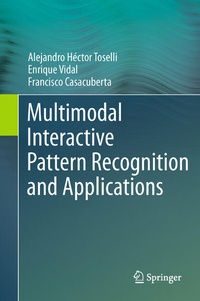
Multimodal Interactive Pattern Recognition and Applications
1st Edition
Published on 28. May 2011
Book
Hardback
XVI, 274 pages
978-0-85729-478-4 (ISBN)
Description
This book presents a different approach to pattern recognition (PR) systems, in which users of a system are involved during the recognition process. This can help to avoid later errors and reduce the costs associated with post-processing. The book also examines a range of advanced multimodal interactions between the machine and the users, including handwriting, speech and gestures. Features: presents an introduction to the fundamental concepts and general PR approaches for multimodal interaction modeling and search (or inference); provides numerous examples and a helpful Glossary; discusses approaches for computer-assisted transcription of handwritten and spoken documents; examines systems for computer-assisted language translation, interactive text generation and parsing, relevance-based image retrieval, and interactive document layout analysis; reviews several full working prototypes of multimodal interactive PR applications, including live demonstrations that can be publicly accessed on the Internet.
More details
Other editions
Additional editions
Alejandro Héctor Toselli | Enrique Vidal | Francisco Casacuberta
Multimodal Interactive Pattern Recognition and Applications
Book
08/2014
Springer
€106.99
Shipment within 15-20 days
Alejandro Héctor Toselli | Enrique Vidal | Francisco Casacuberta
Multimodal Interactive Pattern Recognition and Applications
E-Book
05/2011
1st Edition
Springer
€96.29
Available for download
Persons
Alejandro Héctor Toselli, is currently working as a PostDoc (María Zambrano grant) at the Universitat Politècnica de València. He obtained an Electrical Engineer degree from the University Nacional de Tucumán (Argentina, 1997) and a Phd in Computer Science from the Universitat Politècnica de València (UPV) (Spain, 2004). His research expertise focuses primarily on Document Analysis and Recognition, in which he has more than 20 years of experience, publishing on these topics and working on related projects funded by European and US institutions. He held a Post-Doctoral Fellow at Northeastern University (Boston, USA) in the the multi-institutional Open Islamicate Texts Initiative (OpenITI) and at the "Institut de Recherche en Informatique et Systèmes Aléatoires" (IRISA, Rennes France).
Joan Puigcerver received his MSc and PhD in Computer Science from the Universitat Politècnica de València, in 2014 and 2018, respectively, focusing on probabilistic indexing and handwritten text recognition. In 2018, he joined Google Research as a software engineer. His research focuses on deep learning architectures, transfer learning, and computer vision. Joan is a member of the Spanish Society for Pattern Recognition and Image Analysis (AERFAI), an affiliate organization of the International Association for Pattern Recognition (IAPR).
Enrique Vidal is an emeritus professor of the Universitat Politècnica de València (Spain) and former co-leader of the PRHLT research center there. He is co-author of hundreds of research papers in the fields of Pattern Recognition, Multimodal Interaction and applications to Language, Speech and Image Processing and has led many important projects in these fields. Enrique is a fellow of the International Association for Pattern Recognition (IAPR).
Content
General Framework.- Computer Assisted Transcription: General Framework.- Computer Assisted Transcription of Text Images.- Computer Assisted Transcription of Speech Signals.- Active Learning and Interactive Handwritten Transcription.- Interactive Machine Translation.- Multi-modality for Interactive Machine Translation.- Incremental and Adaptive Learning for Interactive Machine Translation.- Interactive Parsing.- Interactive Text Generation.- Interactive Image Retrieval.- Prototypes and Demonstrators.