

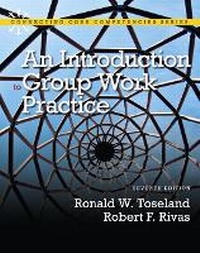
An Introduction to Group Work Practice
7th Edition
Published on 22. February 2011
Book
Hardback
528 pages
978-0-205-82004-7 (ISBN)
Description
This comprehenisve group practice text prepares students to work with either treatment or task oriented groups, this comprehensive revised edition offers the most up-to-date research available and continues to stress the importance of developing skills in group-work.
Students receive a thorough grounding in areas that vary from treatment to organizational and community settings. Numerous case studies, practice examples, and guiding principles add to the ease and readability of this popular text. Content is tied to CSWE's core competencies and practice behaviors that are necessary for generalist and specialized social work practice with groups.
Students receive a thorough grounding in areas that vary from treatment to organizational and community settings. Numerous case studies, practice examples, and guiding principles add to the ease and readability of this popular text. Content is tied to CSWE's core competencies and practice behaviors that are necessary for generalist and specialized social work practice with groups.
More details
Edition
7th edition
Language
English
Place of publication
United States
Publishing group
Pearson Education (US)
Target group
College/higher education
Dimensions
Height: 254 mm
Width: 203 mm
Weight
820 gr
ISBN-13
978-0-205-82004-7 (9780205820047)
Copyright in bibliographic data and cover images is held by Nielsen Book Services Limited or by the publishers or by their respective licensors: all rights reserved.
Schweitzer Classification
Other editions
New editions
Ronald Toseland | Robert Rivas
Introduction to Group Work Practice, An
Book
03/2016
8th Edition
Pearson
€222.50
Article exhausted; check different version
Previous edition
Book
04/2008
6th Edition
Pearson
€113.79
Article exhausted; check for reprint
Persons
Ronald W. Toseland, University at Albany, State University of New York Dr. Ronald W. Toseland is Director and Professor, Institute of Gerontology, School of Social Welfare, University at Albany, State University of New York. He holds an MSW from Fordham University and a Ph.D. from the University of Wisconsin at Madison. He has published 6 books and over 110 articles and book chapters, many of which have focused on clinical practice with the frail and chronically ill older adults and their family caregivers. An edited book (with David Haigler and Deborah Monahan) Education and Support Group Programs for Family Caregivers: Implications for Practice, Research and Policy is in press (N.Y.:Springer). Dr. Toseland is internationally recognized for his research on social work practice with groups and effective interventions for problems faced by aging individuals. His research findings have been featured in Congress and internationally. Dr. Toseland has received more than $10 million in grants for research. He was awarded the Association for Gerontology Education in Social Work Career Achievement Award in 2007 for outstanding lifelong contributions' the Society for Social Work and Research Distinguished Achievement Award in 2008 and was inducted as a Fellow of the American Academy of Social Work and Social Welfare in 2010.
Robert F. Rivas, SienaCollege Robert F. Rivas is Professor of Social Work at Siena College in Albany NY. He has published 2 books, several articles, book chapters and conference papers. He holds a BA Degree from New Mexico Highlands University and an MSW degree from Arizona State University. His practice has focused on individual and group work with children and families as well as work with Native Americans. Professor Rivas has served on both the Commission on Accreditation and he Board of Directors for the Council on Social Work Education (CSWE). He has also been honored by the Association of Baccalaureate Program Directors in Social Work (BPD) and was awarded the BPD Presidential Medal of Honor in 2008 for his service to this organization. Professor Rivas has consulted extensively with social work education programs across the country, specializing in curriculum development and accreditation services.
Robert F. Rivas, SienaCollege Robert F. Rivas is Professor of Social Work at Siena College in Albany NY. He has published 2 books, several articles, book chapters and conference papers. He holds a BA Degree from New Mexico Highlands University and an MSW degree from Arizona State University. His practice has focused on individual and group work with children and families as well as work with Native Americans. Professor Rivas has served on both the Commission on Accreditation and he Board of Directors for the Council on Social Work Education (CSWE). He has also been honored by the Association of Baccalaureate Program Directors in Social Work (BPD) and was awarded the BPD Presidential Medal of Honor in 2008 for his service to this organization. Professor Rivas has consulted extensively with social work education programs across the country, specializing in curriculum development and accreditation services.
Content
PART I: THE KNOWLEDGE BASE OF GROUP WORK PRACTICE
Chapter 1: Introduction
Chapter 2: Historical Developments
Chapter 3: Understanding Group Dynamics
Chapter 4: Leadership
Chapter 5: Leadership and Diversity
PART II: THE PLANNING STAGE
Chapter 6: Planning the Group
PART III: THE BEGINNING STAGE
Chapter 7: The Group Begins
Chapter 8: Assessment
PART IV: THE MIDDLE STAGE
Chapter 9: Treatment Groups: Foundation Methods
Chapter 10: Treatment Groups: Specialized Methods
Chapter 11: Task Groups: Foundation Methods
Chapter 12: Task Groups: Specialized Methods
PART V: THE ENDING STAGE
Chapter 13: Ending the Group's Work
Chapter 14: Evaluation
Chapter 1: Introduction
Chapter 2: Historical Developments
Chapter 3: Understanding Group Dynamics
Chapter 4: Leadership
Chapter 5: Leadership and Diversity
PART II: THE PLANNING STAGE
Chapter 6: Planning the Group
PART III: THE BEGINNING STAGE
Chapter 7: The Group Begins
Chapter 8: Assessment
PART IV: THE MIDDLE STAGE
Chapter 9: Treatment Groups: Foundation Methods
Chapter 10: Treatment Groups: Specialized Methods
Chapter 11: Task Groups: Foundation Methods
Chapter 12: Task Groups: Specialized Methods
PART V: THE ENDING STAGE
Chapter 13: Ending the Group's Work
Chapter 14: Evaluation