

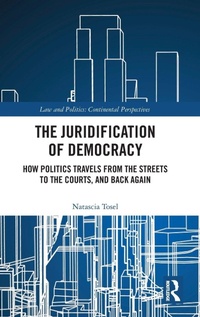
The Juridification of Democracy
How Politics Travels from the Streets to the Courts, and Back Again
1st Edition
Will be published approx. on 28. January 2026
Book
Hardback
206 pages
978-1-032-93272-9 (ISBN)
Description
This book examines what it identifies as an increasing juridification of politics. This term refers to the use of law by both state and non-state social actors to advance their political demands and strategies.
Juridification is often portrayed as a depoliticising, even democratising, process; it is frequently attributed to the logics of neoliberal governance. In this view, a small number of litigants appealing to a few unelected judges for political change seems to bypass representative institutions and, with them, the democratic will. This book challenges that narrative. By tracing the genealogy of juridification and examining its performative role in present-day democratic practices, it offers a more nuanced understanding of the relationship between juridification and democracy. Combining theoretical inquiry with case studies of human rights adjudication, it reveals how courts have become arenas of political struggle where the supralegal values of democracy are named, claimed, and contested, and how this process reverberates far beyond the courtroom, supplementing rather than supplanting democratic decision-making.
The Juridification of Democracy will appeal to scholars and post-graduate students in the fields of political theory, law, critical theory, continental philosophy, socio-legal studies, and social and juridical anthropology.
Juridification is often portrayed as a depoliticising, even democratising, process; it is frequently attributed to the logics of neoliberal governance. In this view, a small number of litigants appealing to a few unelected judges for political change seems to bypass representative institutions and, with them, the democratic will. This book challenges that narrative. By tracing the genealogy of juridification and examining its performative role in present-day democratic practices, it offers a more nuanced understanding of the relationship between juridification and democracy. Combining theoretical inquiry with case studies of human rights adjudication, it reveals how courts have become arenas of political struggle where the supralegal values of democracy are named, claimed, and contested, and how this process reverberates far beyond the courtroom, supplementing rather than supplanting democratic decision-making.
The Juridification of Democracy will appeal to scholars and post-graduate students in the fields of political theory, law, critical theory, continental philosophy, socio-legal studies, and social and juridical anthropology.
More details
Series
Language
English
Place of publication
London
United Kingdom
Publishing group
Taylor & Francis Ltd
Target group
College/higher education
Postgraduate
Dimensions
Height: 240 mm
Width: 161 mm
Thickness: 15 mm
Weight
464 gr
ISBN-13
978-1-032-93272-9 (9781032932729)
Copyright in bibliographic data and cover images is held by Nielsen Book Services Limited or by the publishers or by their respective licensors: all rights reserved.
Schweitzer Classification
Other editions
Additional editions
Natascia Tosel
The Juridification of Democracy
How Politics Travels from the Streets to the Courts, and Back Again
E-Book
01/2026
1st Edition
Routledge
€60.49
Available for download
Natascia Tosel
The Juridification of Democracy
How Politics Travels from the Streets to the Courts, and Back Again
E-Book
01/2026
1st Edition
Routledge
€60.49
Available for download
Person
Natascia Tosel is a Marie Sklodowska-Curie Postdoctoral Fellow at the Hannah Arendt Center for Political Studies, University of Verona, and an Assistant Researcher at the Interdisciplinary Centre for Gender Studies (CIEG), University of Lisbon. She holds a PhD in Philosophy from a joint doctoral program between the University of Padua and Universite Paris 8 Vincennes-Saint-Denis. She has been a research fellow at the Institute for Cultural Inquiry in Berlin. Her research lies at the intersection of political and legal philosophy and feminist theory.
Content
Introduction
Chapter 1: Juridification as Neoliberal Depoliticisation: A Genealogy
Chapter 2: Breaking the Model: Otto Kirchheimer on the Juridification(s) of Liberal Democracy
Chapter 3: Is the Judiciary the New Sovereign Power? Juridification vs. Juristocracy
Chapter 4: How Are the Values of Democracy Defined? The Case of Vulnerability in the ECtHR Jurisprudence
Chapter 5: Juridification 'from Below'. How Citizens Make Politics with Rights
Chapter 6: The Performativity of Juridification. Minoritarian, Anti-Majoritarian, or Democratic Politics?
Conclusion. Juridification and Democracy in Dark Times
Chapter 1: Juridification as Neoliberal Depoliticisation: A Genealogy
Chapter 2: Breaking the Model: Otto Kirchheimer on the Juridification(s) of Liberal Democracy
Chapter 3: Is the Judiciary the New Sovereign Power? Juridification vs. Juristocracy
Chapter 4: How Are the Values of Democracy Defined? The Case of Vulnerability in the ECtHR Jurisprudence
Chapter 5: Juridification 'from Below'. How Citizens Make Politics with Rights
Chapter 6: The Performativity of Juridification. Minoritarian, Anti-Majoritarian, or Democratic Politics?
Conclusion. Juridification and Democracy in Dark Times