

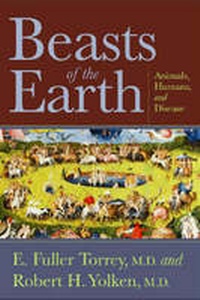
Beasts of the Earth
Animals, Humans, and Disease
Published on 3. February 2005
Book
Hardback
208 pages
978-0-8135-3571-5 (ISBN)
Description
Humans have lived in close proximity to other animals for thousands of years. Recent scientific studies have even shown that the presence of animals has a positive effect on our physical and mental health. People with pets typically have lower levels of cholesterol and lower blood pressure, show fewer symptoms of depression, and tend to get more exercise. But there is a darker side to the relationship between animals and humans. Animals are carriers of harmful infectious agents and the source of a myriad of human diseases. In recent years, the emergence of high-profile illnesses such as AIDS, SARS, West Nile virus, and Lyme disease has drawn much public attention, but as E. Fuller Torrey and Robert H. Yolken reveal, the transfer of deadly microbes from animals to humans is neither a new nor an easily avoided problem. Beginning with the domestication of farm animals nearly 10,000 years ago, Beasts of the Earth traces the ways that human-animal contact has evolved over time. Today, shared living quarters, overlapping ecosystems, and experimental surgical practices such as those that transplant organs or tissues from nonhumans into humans, continue to open new avenues for the transmission of infectious agents. Other changes in human behavior, such as increased air travel, automated food processing, and threats of bioterrorism are increasing the contagion factor, by transporting microbes further distances and to larger populations in virtually no time at all. While the authors urge that a better understanding of past diseases may help us lessen the severity of some illnesses, they also warn that given our increasingly crowded planet, it is not a question of if, but when and how often animal-transmitted diseases will pose serious challenges to human health in the future.
More details
Language
English
Place of publication
New Brunswick, NJ
United States
Target group
College/higher education
Professional and scholarly
Dimensions
Height: 229 mm
Width: 152 mm
Weight
500 gr
ISBN-13
978-0-8135-3571-5 (9780813535715)
Copyright in bibliographic data and cover images is held by Nielsen Book Services Limited or by the publishers or by their respective licensors: all rights reserved.
Schweitzer Classification
Other editions
Additional editions
E-Book
02/2005
1st Edition
Rutgers University Press
€99.99
Available for download
Persons
E. FULLER TORREY, M.D. is associate director for research at the Stanley Medical Research Institute in Bethesda, Maryland and a professor of psychiatry at the Uniformed Services University of the Health Sciences. He has authored or coauthored eighteen books, including The Invisible Plague: The Rise of Mental Illness from 1750 to the Present. ROBERT H. YOLKEN, M.D. is the director of the Stanley Laboratory of Developmental Neurovirology and a professor of pediatrics at Johns Hopkins University Medical Center. A specialist in infectious diseases, he is the coeditor of the standard textbook, Manual of Clinical Microbiology.