

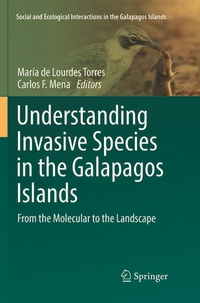
Understanding Invasive Species in the Galapagos Islands
From the Molecular to the Landscape
Published on 4. June 2019
Book
Paperback/Softback
XXVII, 237 pages
978-3-319-88391-5 (ISBN)
Description
This book investigates the introduction of invasive species and their behavior in oceanic islands. How can we define invasive species? What is their history? How did they come to dominate and transform ecosystems? These are relevant questions when trying to understand the behavior of invasive species-primarily in fragile ecosystems such as islands-and to understand the biological, ecological, social and economic impacts of invasions.
We chose the Galapagos Islands, a place well-known to be unique in the study of evolution, as a laboratory to analyze the interactions between invasive and endemic species, to understand the makeup of the ecosystems emerging after invasions have occurred, to describe the relationships of invasives with the people that live in these islands, and to try to develop comprehensive analyses on this topic from multi-scalar and multi-disciplinary points of view. For a long time, the discussion has been about how proper management of the speciescould achieve two main goals: the eradication of the species to recover affected ecosystems and the conservation of endemic species. The discussion has taken on other nuances, including the suggestion that an invasive species, when it is already adapted to an ecosystem, forms an integral part of it, and thus eradication would in itself go against conservation. On the other hand, some invasive species are not only part of the biological compound of the island ecosystems, but they also form part of the social and cultural history of the inhabited islands. Some of these identified by the local inhabitants are species of real or potential economic value.
We chose the Galapagos Islands, a place well-known to be unique in the study of evolution, as a laboratory to analyze the interactions between invasive and endemic species, to understand the makeup of the ecosystems emerging after invasions have occurred, to describe the relationships of invasives with the people that live in these islands, and to try to develop comprehensive analyses on this topic from multi-scalar and multi-disciplinary points of view. For a long time, the discussion has been about how proper management of the speciescould achieve two main goals: the eradication of the species to recover affected ecosystems and the conservation of endemic species. The discussion has taken on other nuances, including the suggestion that an invasive species, when it is already adapted to an ecosystem, forms an integral part of it, and thus eradication would in itself go against conservation. On the other hand, some invasive species are not only part of the biological compound of the island ecosystems, but they also form part of the social and cultural history of the inhabited islands. Some of these identified by the local inhabitants are species of real or potential economic value.
More details
Series
Edition
Softcover Reprint of the Original 1st 2018 ed.
Language
English
Place of publication
Cham
Switzerland
Publishing group
Springer International Publishing
Target group
Professional and scholarly
Illustrations
6 s/w Abbildungen, 37 farbige Abbildungen
XXVII, 237 p. 43 illus., 37 illus. in color.
Dimensions
Height: 235 mm
Width: 155 mm
Thickness: 15 mm
Weight
411 gr
ISBN-13
978-3-319-88391-5 (9783319883915)
DOI
10.1007/978-3-319-67177-2
Schweitzer Classification
Other editions
Additional editions
María de Lourdes Torres | Carlos F. Mena
Understanding Invasive Species in the Galapagos Islands
From the Molecular to the Landscape
Book
02/2018
Springer
€106.99
Shipment within 10-15 days
Persons
María de Lourdes Torres, Ph.D.Vicedecana, Coordinadora BiotecnologíaColegio de Ciencias Biológicas y Ambientales, COCIBAUniversidad San Francisco de QuitoT: (+593) 2 297-1700 ext. 1746E-mail: ltorres@usfq.edu.ecDiego de Robles y Vía Interoceánica, Quito, Ecuador
Carlos F. MenaColegio de Ciencias Biológicas y Ambientales, COCIBAUniversidad San Francisco de QuitoT: (+593 2) 297-1700, ext. 1866E-mail: cmena@usfq.edu.ec
Carlos F. MenaColegio de Ciencias Biológicas y Ambientales, COCIBAUniversidad San Francisco de QuitoT: (+593 2) 297-1700, ext. 1866E-mail: cmena@usfq.edu.ec
Content
Preface.- Introduction: Introduced Species and the Threats to the Galapagos.- Chapter 1. A Preliminary Assessment of the Genetic Diversity and Population Structure of Guava, Psidium Guajava, In San Cristobal.- Chapter 2. Genetic consequences of invasive species in the Galapagos Islands.- Chapter 3. Interactions Among Exotics: Guava and its Associated Fauna in the Highlands of San Cristobal.- Chapter 4. A Study Contrasting Two Congener Plant Species: Psidium guajava (introduced guava) and P. galapageium (Galapagos guava) in the Galapagos Islands.- Chapter 5. Quinine tree invasion and control in Galapagos: a case study.- Chapter 6. Allelopathic Impacts of the Invasive Tree Cedrela odorata L. (Meliaceae, Sapindales=Magnoliidae) in the Galapagos Flora.- Chapter 7. The Hitchhiker Wave: Non-native small terrestrial vertebrates in the Galápagos.- Chapter 8. Multi-Scale Remote Sensing of Introduced and Invasive Species: An Overview of Approaches and Perspectives.- Chapter 9. Remote Sensing of Invasive Species in the Galapagos Islands: Comparison of Pixel-Based, Principal Components and Object-Oriented Image Classification Approaches.- Chapter 10. Stakeholder Perceptions of Invasive Species and Participatory Remote Sensing in the Galapagos Islands.- Chapter 11: A Conceptual Framework for the Management of a Highly Valued Invasive Tree in the Galapagos Islands.- Conclusion: Conclusion and Management Implications.