

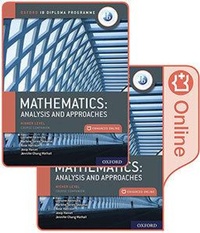
Oxford IB Diploma Programme: IB Mathematics: analysis and approaches, Higher Level, Print and Enhanced Online Course Book Pack
Published on 21. March 2019
Book
Paperback/Softback
832 pages
978-0-19-842716-2 (ISBN)
Description
Featuring a wealth of digital content, this concept-based Print and Enhanced Online Course Book Pack has been developed in cooperation with the IB to provide the most comprehensive support for the new DP Mathematics: analysis and approaches HL syllabus, for first teaching in September 2019. Each Enhanced Online Course Book Pack is made up of one full-colour, print textbook and one online textbook - packed full of investigations, exercises, worksheets, worked solutions and answers, plus assessment preparation support.
More details
Series
Language
English
Place of publication
Oxford
United Kingdom
Target group
Adult education
Illustrations
Colour
Dimensions
Height: 200 mm
Width: 257 mm
Thickness: 36 mm
Weight
1760 gr
ISBN-13
978-0-19-842716-2 (9780198427162)
Copyright in bibliographic data and cover images is held by Nielsen Book Services Limited or by the publishers or by their respective licensors: all rights reserved.
Schweitzer Classification
Persons
Marlene Torres Skoumal, Rose Harrison, Josip Harcet, Jennifer Wathall, Lorraine Heinrichs
Content
From patterns to generalizations: sequences and series 1.1: Sequences, series and sigma notation 1.2: Arithmetic and geometric sequences and series 1.3: Proof 1.4: Counting principles and the binomial theorem Representing relationships: introducing functions 2.1: Functional relationships 2.2: Special functions and their graphs 2.3: Classification of functions 2.4: Operations with functions 2.5: Function transformations Expanding the number system: complex numbers 3.1: Quadratic equations and inequalities 3.2: Complex numbers 3.3: Polynomial equations and inequalities 3.4: The fundamental theorem of algebra 3.5: Solving equations and inequalities 3.6: Solving systems of linear equations Measuring change: differentiation 4.1: Limits, continuity and convergence 4.2: The derivative of a function 4.3: Differentiation rules 4.4: Graphical interpretation of the derivatives 4.5: Applications of differential calculus 4.6: Implicit differentiation and related rates Analysing data and quantifying randomness: statistics and probability 5.1: Sampling 5.2: Descriptive statistics 5.3: The justification of statistical techniques 5.4: Correlation, causation and linear regression Relationships in space: geometry and trigonometry 6.1: The properties of 3D space 6.2: Angles of measure 6.3: Ratios and identities 6.4: Trigonometric functions 6.5: Trigonometric equations Generalizing relationships: exponents, logarithms and integration 7.1: Integration as antidifferentiation and definite integrals 7.2: Exponents and logarithms 7.3: Derivatives of exponential and logarithmic functions; tangents and normals 7.4: Integration techniques Modelling changes: more calculus 8.1: Areas and volumes 8.2: Kinematics 8.3: Ordinary differential equations (ODEs) 8.4: Limits revisited Modelling 3D space: vectors 9.1: Geometrical representation of vectors 9.2: Introduction to vector algebra 9.3: Scalar product and its properties 9.4: Vector equations of a line 9.5: Vector product and properties 9.6: Vector equation of a plane 9.7: Lines, planes and angles 9.8: Application of vectors Equivalent systems of representation: more complex numbers 10.1: Forms of a complex number 10.2: Operations with complex numbers in polar form 10.3: Powers and roots of complex numbers in polar form Valid comparisons and informed decisions: probability distributions 11.1: Axiomatic probability systems 11.2: Probability distributions 11.3: Continuous random variables 11.4: Binomial distribution 11.5: The normal distribution Exploration