

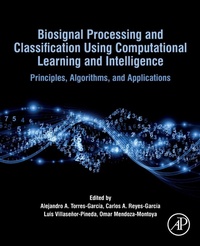
Biosignal Processing and Classification Using Computational Learning and Intelligence
Principles, Algorithms, and Applications
Published on 22. September 2021
Book
Paperback/Softback
536 pages
978-0-12-820125-1 (ISBN)
Description
Biosignal Processing and Classification Using Computational Learning and Intelligence: Principles, Algorithms and Applications posits an approach for biosignal processing and classification using computational learning and intelligence, highlighting that the term biosignal refers to all kinds of signals that can be continuously measured and monitored in living beings. The book is composed of five relevant parts. Part One is an introduction to biosignals and Part Two describes the relevant techniques for biosignal processing, feature extraction and feature selection/dimensionality reduction. Part Three presents the fundamentals of computational learning (machine learning). Then, the main techniques of computational intelligence are described in Part Four. The authors focus primarily on the explanation of the most used methods in the last part of this book, which is the most extensive portion of the book. This part consists of a recapitulation of the newest applications and reviews in which these techniques have been successfully applied to the biosignals' domain, including EEG-based Brain-Computer Interfaces (BCI) focused on P300 and Imagined Speech, emotion recognition from voice and video, leukemia recognition, infant cry recognition, EEGbased ADHD identification among others.
More details
Language
English
Place of publication
San Diego
United States
Publishing group
Elsevier Science Publishing Co Inc
Target group
Professional and scholarly
Product notice
Paperback (trade)
Dimensions
Height: 235 mm
Width: 191 mm
Thickness: 27 mm
Weight
912 gr
ISBN-13
978-0-12-820125-1 (9780128201251)
Copyright in bibliographic data and cover images is held by Nielsen Book Services Limited or by the publishers or by their respective licensors: all rights reserved.
Schweitzer Classification
Other editions
Additional editions
Alejandro A. Torres-García | Carlos Alberto Reyes Garcia | Luis Villasenor-Pineda
Biosignal Processing and Classification Using Computational Learning and Intelligence
Principles, Algorithms, and Applications
E-Book
09/2021
Academic Press
€148.00
Available for download
Persons
Dr. Alejandro A. Torres-Garcia is a researcher and a member of the Mexican National System of Researchers Level-1 (2021-2023). His research interests are; biosignals processing and analysis, brain-computer interfaces, silent speech interfaces, machine learning, computational intelligence, and computational thinking. He holds a Ph. D degree in Computer Sciences from the Instituto Nacional de Astrofisica Optica y Electronica in Puebla, Mexico. Also, he was an ERCIM postdoctoral researcher at the Norwegian University of Science and Technology in Trondheim, Norway (2019-2020). He has published one book, two book chapters, and about 30 articles in scientific journals and proceedings of national and international conferences. Furthermore, he has done shorts stays as visiting researcher at Freie Universitaet Berlin (Germany in 2014 and 2015), Universita Degli Studi di Firenze (Italy in 2016), Universidad de Jaen (Spain in 2017 and 2018), and Institut National de Recherche en Informatique et en Automatique (INRIA, FRANCE in 2019). He is also a member of the CONACYT thematic networks on Applied Computational Intelligence, and Language Technologies. Carlos Alberto Reyes Garcia Garcia is a full-time researcher in the Department of Computer Science, the head of the Bio signal Processing and Medical Computing laboratory, and is the founding Coordinator of the Graduate Program in Biomedical Sciences and Technologies as of August of 2017. at the Instituto Nacional de Astrofisica Optica y Electronica in Puebla, Mexico since January 2001. He holds a PhD degree in computer science with a specialty in artificial intelligence from Florida State University in Tallahassee, Florida. He is a Level II National Researcher of the National System of Researchers (SNI). He is the national president of the Thematic Network on Applied Computational Intelligence from 2016 to date, IEEE Senior Member and AMEXCOMP invited member He was President of the board of directors of the Mexican Society of Artificial Intelligence (SMIA) and now is an Emeritus Member. His areas of particular research interest are; Computational Intelligence, Bio signal Processing and Classification, Processing, Analysis and Classification of Speech, Analysis and Recognition of Baby's Cry, and Classification of Patterns in General. Dr. Luis Villasenor-Pineda is a full-time researcher in the Department of Computer Science at the Instituto Nacional de Astrofisica Optica y Electronica in Puebla, Mexico. He obtained his Ph.D. degree in Computer Science from the Universite Joseph Fourier (now Universite Grenoble Alpes), France. His research interests focus on finding solutions to provide the computer with capabilities to process human language, including written language, spoken language and new forms of interaction, such as brain-computer interfaces based on imagined speech. He is the author of more than 150 refereed articles on these topics. In addition, he is a member of the National System of Researchers (Level II), the Mexican Academy of Sciences (AMC), the Artificial Intelligence Society (SMIA), the Mexican Academy of Computational Sciences (AMEXCOMP) and the Mexican Association for Natural Language Processing (AMPLN), of which he was president from 2018-2020. Dr. Omar Mendoza Montoya, is a professor and researcher in the Department of Computer Science at Tecnologico de Monterrey campus Guadalajara, Mexico. He holds a Ph.D. in Computer Science from the Freie Universitaet Berlin. He was a member of the BrainModes Research Group at the Charite-Medical University of Berlin. His research activities involve the development of brain-computer interfaces for assistive technology, neurorehabilitation, and therapy. At the moment, he leads multiple projects focusing on robotic applications controlled by biosignals for people with mobility limitations and neurological conditions, such as amyotrophic lateral sclerosis (ALS). Other of his interests are signal processing, numerical analysis, optimization, statistical learning, mathematical modeling, and neuroimaging.
Editor
Research Project Collaborator, Instituto Nacional de Astrofisica Optica y Electronica, Puebla, Mexico
Full-Time Researcher, Department of Computer Science, Instituto Nacional de Astrofisica Optica y Electronica, Puebla, Mexico
Lead Researcher, Department of Computer Science, Instituto Nacional de Astrofisica Optica y Electronica in Puebla, Mexico
Researcher/Professor, School of Engineering and Science, Tecnologico de Monterrey, Monterrey, N.L., Mexico
Content
PART 1 INTRODUCTION
1. Introduction to this book
2. Biosignals analysis (heart, phonatory system, and muscles)
3. Neuroimaging techniques
PART 2 BIOSIGNAL PROCESSING: FROM BIOSIGNALS TO FEATURES' DATASETS
4. Pre-processing and feature extraction
5. Dimensionality reduction
PART 3 COMPUTATIONAL LEARNING (MACHINE LEARNING)
6. A brief introduction to supervised, unsupervised, and reinforcement learning
7. Assessing classifier's performance
PART 4 COMPUTATIONAL INTELLIGENCE
8. Fuzzy logic and fuzzy systems
9. Neural networks and deep learning
10. Spiking neural networks and dendrite morphological neural networks: an introduction
11. Bio-inspired algorithms
PART 5 APPLICATIONS AND REVIEWS
12. A survey on EEG-based imagined speech classification
13. P300-based brain-computer interface for communication and control
14. EEG-based subject identification with multi-class classification
15. Emotion recognition: from speech and facial expressions
16. Trends and applications of ECG analysis and classification
17. Analysis and processing of infant cry for diagnosis purposes
18. Physics augmented classification of fNIRS signals
19. Evaluation of mechanical variables by registration and analysis of electromyographic activity
20. A review on machine learning techniques for acute leukemia classification
21. Attention deficit and hyperactivity disorder classification with EEG and machine learning
22. Representation for event-related fMRI
1. Introduction to this book
2. Biosignals analysis (heart, phonatory system, and muscles)
3. Neuroimaging techniques
PART 2 BIOSIGNAL PROCESSING: FROM BIOSIGNALS TO FEATURES' DATASETS
4. Pre-processing and feature extraction
5. Dimensionality reduction
PART 3 COMPUTATIONAL LEARNING (MACHINE LEARNING)
6. A brief introduction to supervised, unsupervised, and reinforcement learning
7. Assessing classifier's performance
PART 4 COMPUTATIONAL INTELLIGENCE
8. Fuzzy logic and fuzzy systems
9. Neural networks and deep learning
10. Spiking neural networks and dendrite morphological neural networks: an introduction
11. Bio-inspired algorithms
PART 5 APPLICATIONS AND REVIEWS
12. A survey on EEG-based imagined speech classification
13. P300-based brain-computer interface for communication and control
14. EEG-based subject identification with multi-class classification
15. Emotion recognition: from speech and facial expressions
16. Trends and applications of ECG analysis and classification
17. Analysis and processing of infant cry for diagnosis purposes
18. Physics augmented classification of fNIRS signals
19. Evaluation of mechanical variables by registration and analysis of electromyographic activity
20. A review on machine learning techniques for acute leukemia classification
21. Attention deficit and hyperactivity disorder classification with EEG and machine learning
22. Representation for event-related fMRI